


Areas We Cover
Categories

HANFU REVIVAL: THE RETURN OF TRADITIONAL CHINESE DRESS
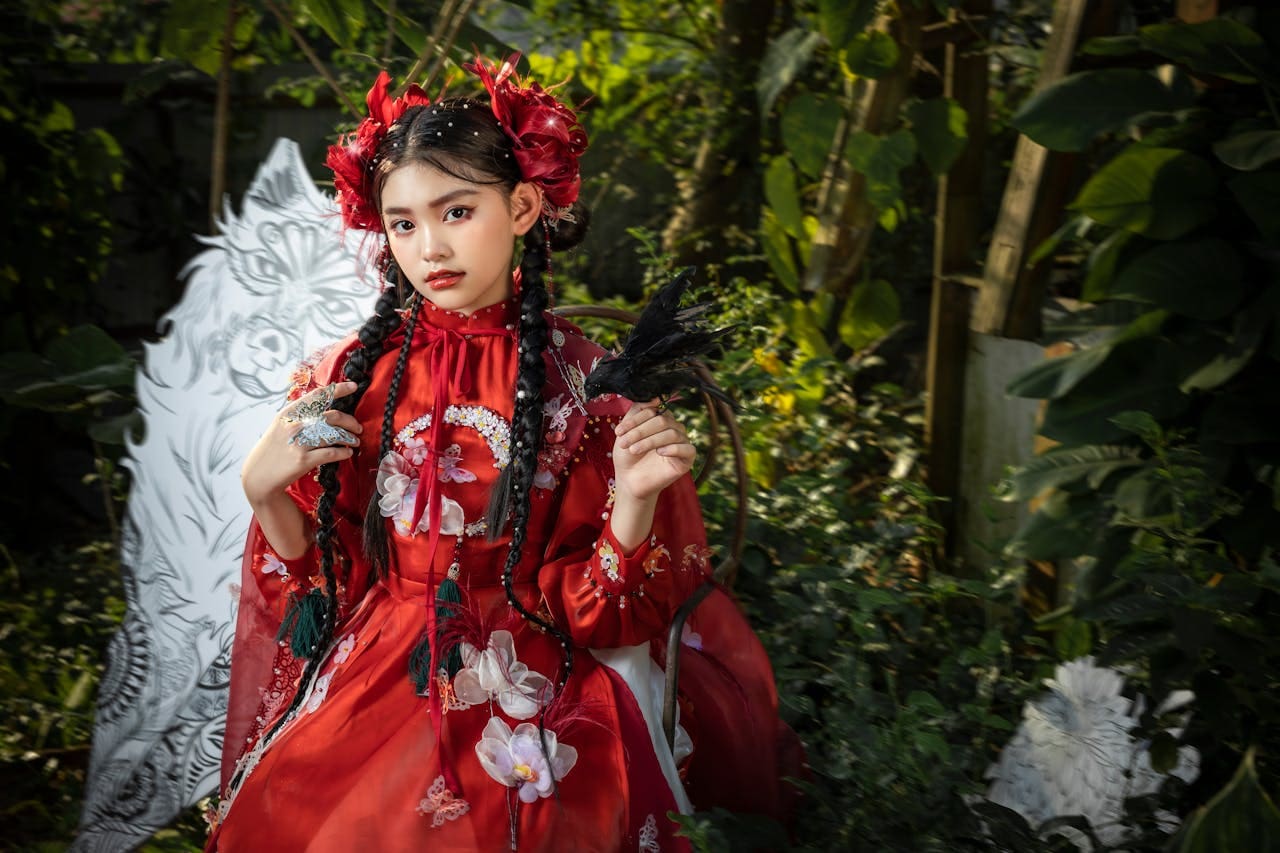
In the historic districts of Xi’an, Chengdu, and Luoyang, it has become increasingly common to encounter young people dressed in layered robes and hair ornaments. This may be considered a form of hanfu movement — a cultural trend that has grown from a small online community in the early 2000s into a mainstream consumer market estimated to be worth tens of billions of yuan annually! If you happen to learn Chinese online, this may be something you have come across before.
What Hanfu Is and Where It Comes From
Hanfu refers to the traditional dress of the Han Chinese people prior to the Qing dynasty, which came to power in 1644. One of the early acts of Qing rule was to mandate that Han subjects adopt Manchu dress as a symbol of political submission. Han clothing conventions, which had developed continuously across more than two thousand years of Chinese history, were effectively suppressed within a generation. The term hanfu covers a wide range of garments across multiple dynasties. Tang dynasty court robes, with their wide sleeves and symmetrical layering, are visually distinct from the wrapped, narrow-cut garments of the Han period, which in turn differ from the pleated skirts and crossed collars of Song dynasty dress. What unites them structurally are crossed or overlap collars, wrap-around fastenings secured with ties, and draped rather than fitted silhouettes.
The Movement
The contemporary hanfu movement is generally traced to 2003, when a man named Wang Letian walked through the streets of Zhengzhou dressed in reconstructed Han dynasty clothing and had photographs taken that circulated online. The images attracted attention within early Chinese internet communities and prompted the formation of dedicated forums where enthusiasts began researching historical garments, sharing construction methods, and debating standards of historical accuracy. For its first decade, the movement remained relatively marginal. Wearing hanfu in public attracted curiosity and occasional ridicule, and the community was largely self-teaching, working from archaeological records, classical paintings, and surviving museum artifacts to reconstruct garment forms for which no living tradition of production existed.
The transition toward mainstream acceptance was gradual and driven by several overlapping factors. The rapid expansion of Chinese historical drama productions on streaming platforms brought elaborately costumed period content to audiences numbering in the hundreds of millions, normalizing the aesthetic of historical Chinese dress. The development of Xiaohongshu as a lifestyle content platform gave hanfu enthusiasts an effective distribution channel for visual content. And a sustained policy environment emphasizing the value of traditional Chinese culture provided institutional legitimacy to activities framed as cultural heritage engagement. By 2020, hanfu had become a recognized retail category with a developed supply chain, dedicated designers, and products at every price point. Industry estimates placed the number of hanfu consumers in China at over one hundred million by the mid-2020s, though definitions of what counts as hanfu participation vary considerably.
The hanfu community is not internally uniform and has sustained ongoing debates about several substantive questions. The most persistent concerns historical accuracy: there is significant disagreement about what level of historical fidelity is required for a garment to qualify as genuine hanfu, and about whether commercially produced, simplified versions that adopt the general aesthetic without adhering to period construction methods should be considered part of the tradition or a dilution of it. A second set of debates concerns ethnic and national identity. Hanfu is explicitly defined as Han Chinese dress, which raises questions about its relationship to China’s 55 recognized ethnic minorities, whose own clothing traditions are distinct and in some cases equally suppressed historically. Critics have argued that the movement’s framing can tend toward Han ethnic chauvinism, while proponents contend that the revival of any suppressed cultural tradition is a legitimate act of heritage recovery regardless of ethnicity.
Teaching institutions like GoEast Mandarin in Shanghai offer language programs that develop reading and listening comprehension alongside spoken fluency, providing students with the tools to engage directly with Chinese cultural discourse in its primary forms. For researchers, journalists, or culturally curious learners with a specific interest in contemporary Chinese society, this level of access — the ability to read a Xiaohongshu thread, follow a Weibo debate, or understand a documentary in Mandarin — represents a qualitatively different relationship with Chinese culture than is available through translation alone.
