


Areas We Cover
Categories

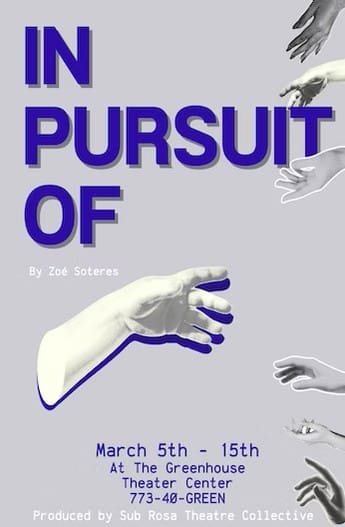
Theater Review: IN PURSUIT OF (Sub Rosa Theatre Collective at Greenhouse Theatre Center)
by C.J. Fernandes | March 11, 2026
in Chicago, Theater
CRIME, PUNISHMENT,
AND TOO MANY SET CHANGES
A sharp modern riff on Dostoevsky boasts strong
performances and ideas, but it’s a production
that won’t stop getting in its own way
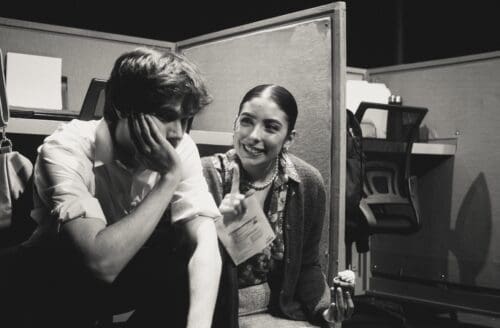
The opening scene of Zoé Soteres’s In Pursuit Of is a case study in narrative efficiency. A young man steps into a disheveled room with a toothbrush in his mouth. He sniffs his laundry to determine whether it’s fit for public wear, dresses in a collared white shirt and formal black trousers, chokes down some stale bread for breakfast, grabs a bookbag incongruous with his outfit, and leaves. In just a few minutes we know that Theo is a student, impoverished, living alone, and working at some low-level office position (data entry, as it turns out)—all without a single word spoken.
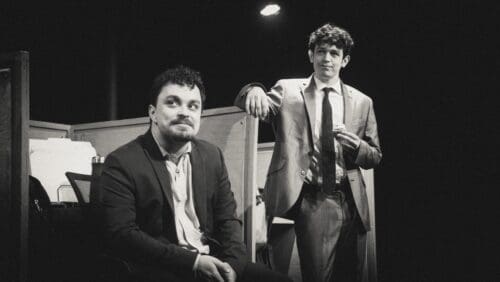
Widely considered one of the greatest novels ever written, Fyodor Dostoevsky’s Crime and Punishment provides the source material for the Sub Rosa Collective’s production of In Pursuit Of, now on stage at the Greenhouse in Lincoln Park. Cleverly updating the plot, Soteres builds the story around Theo, an undergraduate at the University of Chicago with a full-time job and ambitions to enter a master’s program at Wharton. The play unfolds across three primary locations: Theo’s spartan apartment, where he interacts with no one and ignores phone calls from his mother and sister; his office, where he endures the indignity of working under two toxic bosses; and a university office where, along with a fellow student, Shannon, he is mentored by the head of the Philosophy department, Tim—a smooth-talking, unctuous figure played with evident relish by Dan Walsh.
Directed by Nole Beran, In Pursuit Of follows the basic plot of Crime and Punishment. Theo—who has written a controversial paper titled The Extraordinary Man, arguing that truly brilliant individuals stand above morality and should not be bound by ordinary laws—grows tired of being bossed around by mediocrities and begins sabotaging his immediate supervisor. Starting with minor pranks, he soon escalates his behavior, descending into outright sociopathy in his determination to claim the position he believes he deserves.
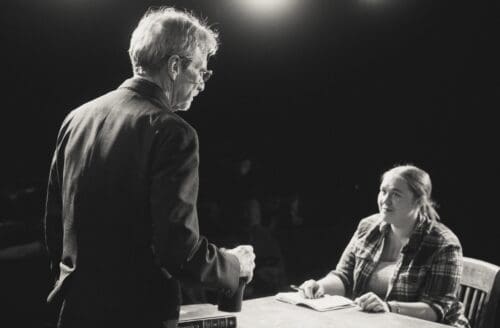
While the workplace is where much of the plot unfolds, the most compelling scenes occur in the professor’s office, where Soteres reframes the novel through the lens of contemporary generational tension. There Shannon—Theo’s classmate and eventually his only friend—openly challenges her Boomer mentor over questions of morality and empathy (“Call me Tim,” he says, with faux affability, even as he grows increasingly dismissive and insulting toward her objections. Tempers flare until he launches into a blistering monologue of intellectual dishonesty and malice delivered in perfectly modulated academic tones. It is the strongest piece of writing in the play, and Walsh performs it with such controlled venom that when a stunned Shannon responds with, “You’re an asshole, Tim”, muffled cheers rippled through the audience.
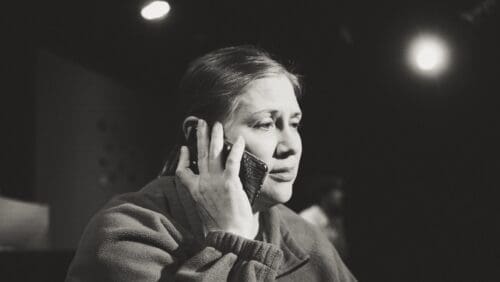
Theo’s pranks have their intended effect and he replaces his immediate boss; soon his guilt kicks in, manifesting both psychologically and physiologically, until he starts to question his entire ethos and the value of his life.
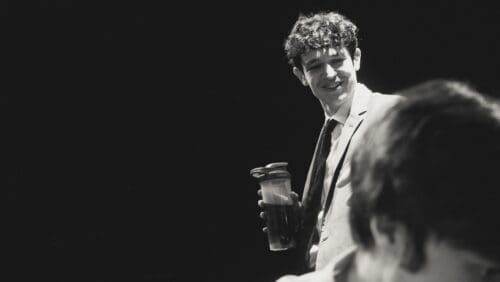
Kieran Rowe, a young actor with considerable stage presence, makes an excellent Theo—particularly in the first act, when the character’s sociopathy is on the rise and his speech remains carefully controlled and evasive. Rowe is adept at concealing Theo’s motives; we sense he is plotting something, though its exact nature remains unclear until midway through the play. In the second act, as Theo unravels, Rowe is somewhat less effective. His climactic confessional monologue feels rushed and frantic rather than deeply distraught. Still, it remains a strong performance overall—one that could benefit from a bit of fine-tuning.
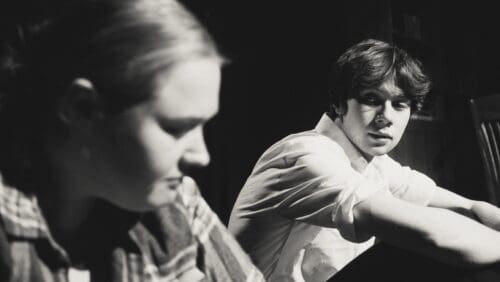
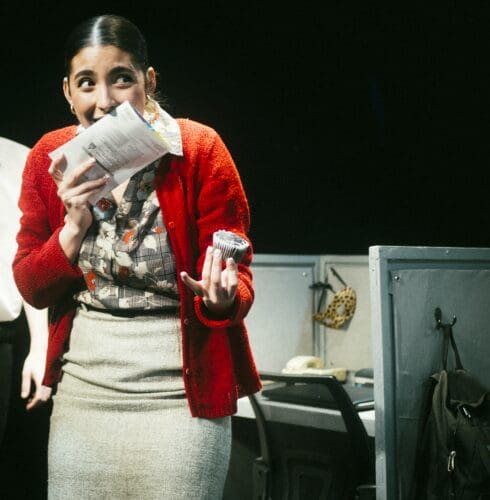
The best performance in the play comes from Madeline Meyer as Shannon. Loosely drawn from the novel’s Sonya—the names have the same meaning: “wise/possessor of wisdom” which is another nice touch—Shannon is the character with the strongest moral compass and Meyer gives a beautifully rounded and precise performance that nails every beat and contradiction. She is simply wonderful and I hope to see her more often on stage in the future.
As impressive as Soteres’ script and the cast’s performances are, both are severely undermined by the production design—specifically the set.
It is a strange coincidence that In Pursuit Of is the second play in a row I’ve reviewed in which interminable set changes generate long stretches of dead air while furniture is shuffled on and off stage (the other being Oscar Wao at the Goodman). Here the problem becomes particularly damaging in the second act, where the transitions are often longer than the scenes themselves. Many scenes last only a few minutes, and watching actors begin moving furniture before the moment has fully landed grows irritating very quickly—which makes me appreciate the quality of the performances even more.
The script structure is better suited to film with its ability to use quick cuts than it is to the stage; for this to work on stage it needs a far more imaginative and far less literal set; one that does not deploy dozens of interruptions to the flow of incident.
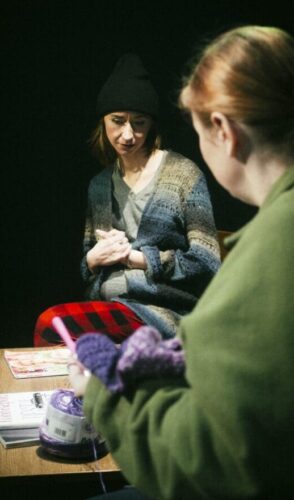
The script’s structure—rapid shifts between locations—would likely work better on film, where quick cuts are possible. Onstage it requires a far more imaginative and less literal approach to design, one that avoids the dozens of interruptions that currently disrupt the flow of the drama.
In Pursuit Of is the work of a playwright with formidable intelligence and perspicacity, performed by a talented and committed cast. It is unfortunate, then, that the production’s staging repeatedly sabotages those strengths. I still enjoyed the evening because of its merits, but as I stepped out onto a foggy Lincoln Avenue afterward, I couldn’t help thinking about what might have been.
✦ ✦ ✦ ✦ ✦ ✦ ✦ ✦ ✦ ✦
photos courtesy of Sub Rosa Collective
In Pursuit Of
Sub Rosa Theatre Collective
Up Studio at the Greenhouse Theater Center, 2257 N Lincoln Ave.
ends on March 15, 2026
for tickets, visit Greenhouse Theater Center
✦ ✦ ✦ ✦ ✦ ✦ ✦ ✦ ✦ ✦
