


Areas We Cover
Categories

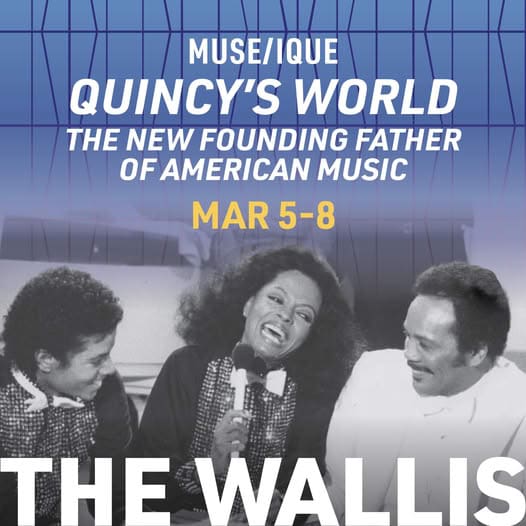
QUINCY’S WORLD: THE NEW FOUNDING FATHER OF AMERICAN MUSIC (MUSE/IQUE at The Wallis)
by Shari Barrett | March 13, 2026
in Concerts / Events, Los Angeles, Music
A THRILLER OF A CONCERT
MUSE/IQUE’s vibrant tribute traces the
extraordinary career of one of
America’s greatest musical innovators
Quincy Jones changed the face of music as a bold, brave, multi-hyphenate music mogul whose storied legacy is unlike anyone else’s—as a record producer, multi-instrumentalist, songwriter, composer, arranger, and cultural force. Over a career spanning more than seventy years in the entertainment industry, he was nominated for 80 GRAMMY Awards and won 28, including the GRAMMY Legend Award in 1991. In 2008 he received the NEA Jazz Masters Award.
He was also one of only a handful of EGOT (Emmy, Grammy, Oscar, Tony) winners in history. His accolades included seven Academy Award nominations and the Academy of Motion Picture Arts and Sciences’ Jean Hersholt Humanitarian Award. Among many international honors, he received France’s Commandeur de la Légion d’Honneur and the National Medal of Arts—the highest award given to artists and arts patrons by the United States government—from President Barack Obama in 2011.
Jones produced the best-selling album of all time, Michael Jackson’s Thriller, which sold more than 110 million copies worldwide and spawned six Top Ten singles. He also produced and conducted the best-selling single of all time, “We Are the World,” which sold more than 20 million copies and raised tens of millions for victims of Ethiopia’s famine in 1985.
Rachael Worby conducts the MUSE/IQUE orchestra
Quincy Jones left us in November 2024, but his contributions to music will live on for generations. Music Director Rachael Worby and MUSE/IQUE honored that legacy with Quincy’s World: The New Founding Father of American Music, performed March 5–8, 2026 at The Wallis in Beverly Hills. Guest vocalists Vanessa Bryan and Tony and GRAMMY Award winner Brandon Victor Dixon joined the orchestra in performances that repeatedly jolted the Bram Goldsmith Theatre with lightning.
The program traced Jones’ remarkable journey—from playing trumpet alongside jazz icon Dizzy Gillespie, to becoming a groundbreaking film composer, to his legendary collaborations with Frank Sinatra, Michael Jackson, and many others. Narrating the evening, Worby shared historical insights “to celebrate Quincy’s power as a social activist and changemaker, influencing some of the biggest names in music and opening the door for future generations.”
Guest singer Vanessa Bryan
Projections from Jones’ seven-decade career filled the stage, including studio photographs with some of the greatest singers of the twentieth century. Worby’s commentary offered context for the evening’s musical selections, which illustrated the astonishing range of Jones’ accomplishments.
Highlights included “Soul Bossa Nova,” immortalized in the Austin Powers films; he composed it in twenty minutes at age twenty-two while touring with Dizzy Gillespie, who, until his death in 1993, remained great friends with Jones.
The program also explored Jones’s time at Mercury Records, where label head Irving Green helped guide the young arranger’s career. There Jones conducted Dinah Washington’s hit “Mad About the Boy.” Later, after listening to demo tapes, he discovered Lesley Gore and arranged and conducted her breakout hit “It’s My Party,” which was sung by Vanessa Bryan with great reverence for the true heartbreak written in the lyrics.
Known throughout the industry simply as “Q,” Jones also worked closely with Count Basie, conducting “I Can’t Stop Loving You,” which became his first GRAMMY-winning record. MUSE/IQUE’s orchestra captured the sweeping big-band sound, highlighted by the ensemble’s trumpet and trombone players.
First violinist Alyssa Park (center in dark blue gown) plays the
rare Milstein Stradivarius violin during The Color Purple score.
While at Mercury, Jones arranged and conducted ten songs for Frank Sinatra, including “Fly Me to the Moon,” famously played during the Apollo astronauts’ journey to the Moon. Brandon Victor Dixon brought the vocal swagger and spirit of Ol’ Blue Eyes vividly into the theater.
The orchestra also performed the title theme from Jones’ score for Sidney Lumet’s film The Pawnbroker, which Lumet called “the real classical music of the twentieth century.” Ms. Bryan, accompanied by MUSE/IQUE’s lush string section, delivered a soulful rendition of “You Put a Move on My Heart” from the album Q’s Jook Joint.
Selections from Jones’s film and television scores followed, including “In the Heat of the Night,” with lyrics by Alan and Marilyn Bergman, and music from the 1983 film The Color Purple, for which Jones composed the score and served as producer. First violinist Alyssa Park performed the haunting theme on a magnificent 1716 Milstein Stradivarius.
Jones also convinced Steven Spielberg to direct the film adaptation of The Color Purple while Spielberg was finishing work on E.T. in the adjacent studio. After hearing the completed score, author Alice Walker told Jones that he had “stretched yourself to embrace us all,” noting his desire to honor all humanity with his music.
Guest singer Brandon Victor Dixon conducted by Rachael Worby
The evening continued with Rodgers and Hart’s “Bewitched, Bothered and Bewildered,” arranged by Jones for Lena Horne’s Broadway show The Lady and Her Music, whose cast album he produced.
Demonstrating his limitless musical curiosity, Jones’ collaboration with Michael Jackson transformed the music industry. One highlight of the program was “Human Nature,” written by M.J. Dixon from the group Toto, arranged by Jones, and recorded by Jackson for the landmark album Thriller.
The concert concluded with “Let the Good Times Roll,” associated with Ray Charles, whom Jones first met in Seattle when Jones was fourteen and Charles seventeen. Jones arranged the song for the 1959 album The Genius of Ray Charles, demonstrating his talent as a young arranger already shaping American music. The song was produced by Jerry Wexler ad Nesuhi Ertegun for the 1959 album The Genius of Ray Charles, arranged by Quincy at the age of 26.
There is little doubt that Quincy Jones stands among the greatest innovators in American music, sharing songs which will live around the globe for as long as people listen to music. And that is the greatest honor of all, to be remembered for your artistic contribution and overwhelming artistry, honoring the humanity in all of us.
Brandon Victor Dixon and Vanessa Bryan
✦ ✦ ✦ ✦ ✦ ✦ ✦ ✦ ✦ ✦
photos by Haoyuan Ren
Quincy’s World: The New Founding Father of American Music
The Wallis Annenberg Center for the Performing Arts
9390 N. Santa Monica Blvd. in Beverly Hills
performed March 5–8, 2026
for future concerts, call 626.539.7085 or visit MUSE/IQUE
Back to Oz at the Mark Taper Forum April 18-16;
The Sun Rises in Harlem at The Huntington June 2-3; Skirball Center June 7;
Defiantly Joni at the Mark Taper Forum July 11-19
✦ ✦ ✦ ✦ ✦ ✦ ✦ ✦ ✦ ✦
