


Areas We Cover
Categories

Theater Review: FAIRVIEW (Rogue Machine Theatre)
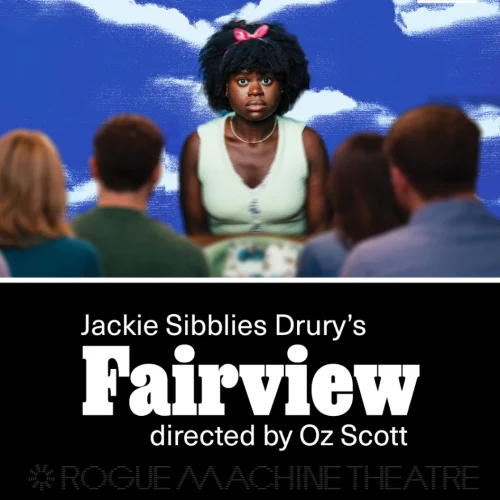
by Michael M. Landman-Karny | March 16, 2026
in Los Angeles, Theater
WHEN COMFORT TURNS
INTO A TRAP
Jackie Sibblies Drury’s Pulitzer-winning play
dismantles what we think we’re watching
Marie-Françoise Theodore, iesha m. daniels
Writing honestly about Fairview without ruining it is close to a contradiction in terms. The play runs on surprise, on jolts timed so precisely that a critic who telegraphs them is doing active harm. Skip the other reviews. Most of them spoil it, and this play earns its ambush. What I can do is say what kind of thing it is and what it does to a room, and leave the machinery for you to encounter on your own. It won the 2019 Pulitzer Prize for Drama. The committee knew exactly what it was honoring: the highest prize in American playwriting going to a work that holds the American theatergoer up to the light.
The Rogue Machine production is directed by Oz Scott, and no director working today carries more relevant history into this play. Scott made his name with the original Off-Broadway and Broadway productions of Ntozake Shange’s for colored girls who have considered suicide / when the rainbow is enuf, winning the Drama Desk Award in 1977 and directing the television adaptation five years later. Then came four decades of series television: The Cosby Show, Hill Street Blues, L.A. Law, CSI, Black Lightning. Scott has spent his career inside the very apparatus Drury is writing about—the one that frames Black life for a watching public—and he brings to this production a knowledge of its mechanics that you cannot fake.
Marie-Francoise Theodore, Marco Martinez, iesha m. daniels, Jasmine Ashanti
The opening is a decoy, though you won’t know that yet. Beverly and her husband Dayton, her sister Jasmine, and her teenage daughter Keisha are preparing for Grandma’s birthday dinner in a living room that practically exhales upper-middle-class ease. Mark Mendelson’s set works its own persuasion: tasteful, warm, every surface in its right place. You have seen this room before—on television, many times.
Beverly grates carrots. Dayton creeps up behind her and she scolds him for watching instead of saying hello. A throwaway line. It will not stay one.
Marco Martinez, Marie-Francoise Theodore, Jasmine Ashanti, iesha m. daniel
For roughly forty minutes Drury writes a slick, tartly observed family comedy. Jasmine swans in overdressed and snarky, loudly skeptical of the Brie. Dayton—played by Marco Martinez with the loose confidence of a man who considers himself the funniest person in any room—goofs off like a sitcom dad auditioning to play himself. Keisha, a magnetic iesha m. daniels, nurses something unspoken and adolescent just below the surface. Jasmine Ashanti is superb as Jasmine, all loose-limbed comic timing and withering asides, every laugh landing with the ease of someone who has been doing this since before she could drive. Marie-Françoise Theodore, as Beverly, moves between genuine warmth and low-grade sitcom panic in a way that keeps you slightly off-balance, never quite certain which register you’re in.
There are glitches: a power surge, a hiccup in the sound design. You barely notice. We know this kind of show. We have been trained to watch Black families on stage and screen since The Jeffersons and Good Times, since Lorraine Hansberry, and I include myself in that “we.” We settle. We are comfortable. We are certain we know what we are watching.
That comfort is the trap.
Marie-Francoise Theodore, Tyler Gaylord , Michael Guarasci (below),
iesha m. daniels, Daisy Tichenor, Gala Nikolic, Jasmine Ashanti
Here I have to go vague on you. What Jackie Sibblies Drury does next—and then what she does after that—is the boldest thing I have seen a playwright do in years. The play runs three acts. Each one strips another layer off the night, and what is underneath is never what you were expecting. And what is underneath that is something else again, harder to name.
The third act broke something in the room the night I attended. People around me were shifting. I could feel the audience become aware of itself as a collective body—a group of people with a shared set of assumptions it had not, until that particular moment, been asked to confront.
I am not going to tell you what happens.
Jasmine Ashanti, Tyler Gaylord
The distance between what you believed this play was at minute five and what you understand it to be at minute ninety is the largest gap I have experienced sitting in a theater.
The title keeps folding back on itself. A fair view of whom? For whom? Constructed by whom?
Drury offers no resolution. She rearranges the room and leaves you sitting in it, and you step outside into the night watching the people around you a little differently—unsure how long it will last, aware she made no promises either way.
What you do with what you notice is entirely your own problem.
She’s already done her part.
iesha m. daniels, Daisy Tichenor
✦ ✦ ✦ ✦ ✦ ✦ ✦ ✦ ✦ ✦
photo by Jeff Lorch
Fairview
Rogue Machine
Matrix Theatre, 7657 Melrose Ave.
Fri, Sat & Mon at 8; Sun at 2 (dark Apr 13)
ends on April 19, 2026
for tickets ($25-$45), call 855.585.5185 or visit Rogue Machine
for more shows, visit Theatre in LA
✦ ✦ ✦ ✦ ✦ ✦ ✦ ✦ ✦ ✦

I always enter a theatre with great trepidation when the “P” word is involved … that being Pulitzer. It’s been my experience that the Pulitzer committee must generally experience productions with their heads firmly up their butts … and I usually do not care for that particular view.
Not that everyone isn’t trying their very best and working very hard but what results from their efforts is a big – Huh?!?!?! What?!?!?! Oy!
To paraphrase Anita in West Side Story … Forget that play and find another!
Couldn’t agree more. There are very very few exceptions in Pulitzer land. Or most awards orgs too for that matter.