


Areas We Cover
Categories

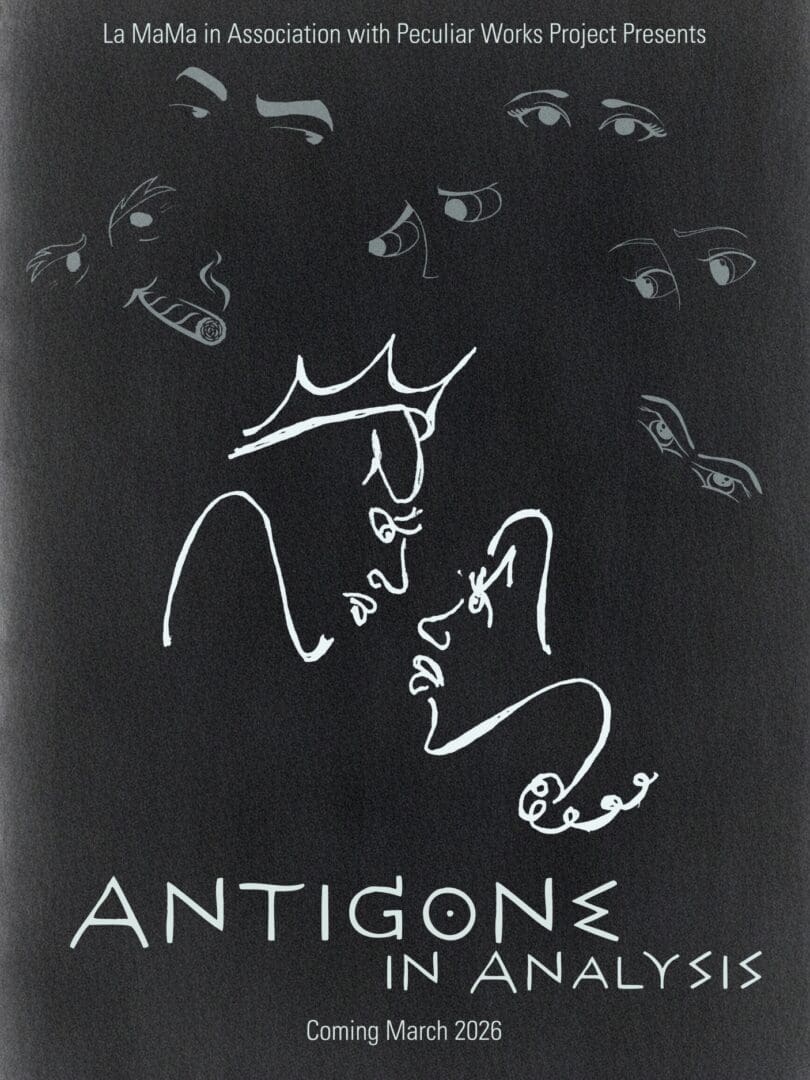
Off-Broadway Review: ANTIGONE IN ANALYSIS (Peculiar Works Project at La MaMa)
by Alex Simmons | March 24, 2026
in New York, Theater
A FEMINIST REFRAME
Peculiar Works Project’s ambitious reimagining offers striking
ideas but struggles to make its case with uneven execution
Alessandra Lopez
There’s an ancient folktale of a hero who arranges a proper burial for a corpse, whose spirit—the “grateful dead”—would later come to the hero’s aid. A common story passed around to emphasize the importance of death rites, and also the genesis of the name Jerry Garcia and co. would pick for their legendary jam band, the Grateful Dead.
Indeed, death rites are some of the most sacred and severe rites across all cultures. Different though they be, reverence and respect for the dead are powerful convictions, some say more powerful than laws made by any man.
Bianca Leigh
To ponder these convictions, OBIE and NYIT-winning company Peculiar Works Project returns to La MaMa ETC’s Downstairs Theatre to commemorate Women’s History Month with a radical and bold feminist reimagining of the Sophocles classic tragedy Antigone.
Alessandra Lopez
Antigone, the second-oldest surviving play by the ancient Greek playwright, is one of the only female-led plays of the era that come to mind (check out Lysistrata if you want some Aristophanic shenanigans). Being a story of a woman fighting an authoritarian, it’s apropos for the times, no doubt.
Freja Højland Høj
Writer Barbara Barclay takes a radical departure from the play it bears the name of to create Antigone in Analysis. “In Analysis” is not metaphorical here, as our Greek chorus is cast as historical and modern philosophers from Lacan to Butler. But that’s not even the biggest change here.
The most drastic departure is the casting of Jocasta instead of King Creon (Oedipus’s brother-in-law). This version of the matriarch from Oedipus didn’t kill herself when she found out she’d had two sons with her own son, surviving to take power after the civil war between Eteocles and Polynices—a war started in the power vacuum left after their father, Oedipus, makes way for his blind exile.
Bianca Leigh
The conflict between Antigone (Alessandra Lopez) and Jocasta (Bianca Leigh) is now a showdown between Antigone—sister to two warring brothers and daughter to an authoritarian queen—and Jocasta, for a feminist examination of this ancient drama. These two actresses do what they can with the adapted Sophocles text, providing some of the strongest moments of the production.
Nomi Tichman
Our chorus of Sammy Rivas, Simon Henriques, Nomi Tichman, Mick Hilgers, and Linna Scott are a lively bunch as they argue for and against Antigone. Sadly, only a philosophy student or enthusiast might find joy in this reimagined chorus, as their arguments are circular, the dead air between lines weighty, and a lack of compelling drama apparent.
Thankfully, Antigone in Analysis clocks in at a merciful 75 minutes.
Nomi Tichman, Bianca Leigh and Linnea Scott
Director Ralph Lewis keeps things moving throughout the deconstruction, along with choreographer Rachel Cohen; philosophers encircle and argue, birds sing, and other spectacles enter and exit to hold attention.
Set and projections by Evan Frank, along with lighting from David Castaneda, dazzle the eye when nonstop talking can’t engage the ear.
Costume design from Grace Martin defines the look of our philosophers, using waistcoats to nylon windbreakers and everything in between.
The production is at its strongest when showing the conflict between Antigone and this production’s fan-fiction version of Jocasta, and other scenes from the classic text, though long stretches of philosophers talking about Antigone’s situation fail to make the case for Antigone in Analysis. Be on the lookout for better thought-out adaptations of the earliest theatrical dramas.
✦ ✦ ✦ ✦ ✦ ✦ ✦ ✦ ✦ ✦
photos by Marina Levitskaya
Antigone in Analysis
Peculiar Works Project
La MaMa ETC, Downstairs Theatre, 66 E 4th St, New York, NY
75 minutes, no intermission
Thurs–Sat at 8; Sun at 4
ends on April 4, 2026
for tickets, visit La MaMa
✦ ✦ ✦ ✦ ✦ ✦ ✦ ✦ ✦ ✦

I haven’t seen the play, but calling the reinterpreted character merely a fan fiction version of Jocasta is an oversimplification. Sophocles didn’t invent the myth of Oedipus – it existed in oral history and was referenced in Odyssey hundreds of years before Sophocles’ version was first presented. In other iterations of the tale, Jocasta did not commit suicide. Euripides was a contemporary of Sophocles and wrote / presented a version of Oedipus in which Jocasta lives. However, the full text of his play has been lost to history and only survived as a reference point in much later texts. For this reason, the Sophoclean version remains the predominant interpretation performed today.