


Areas We Cover
Categories

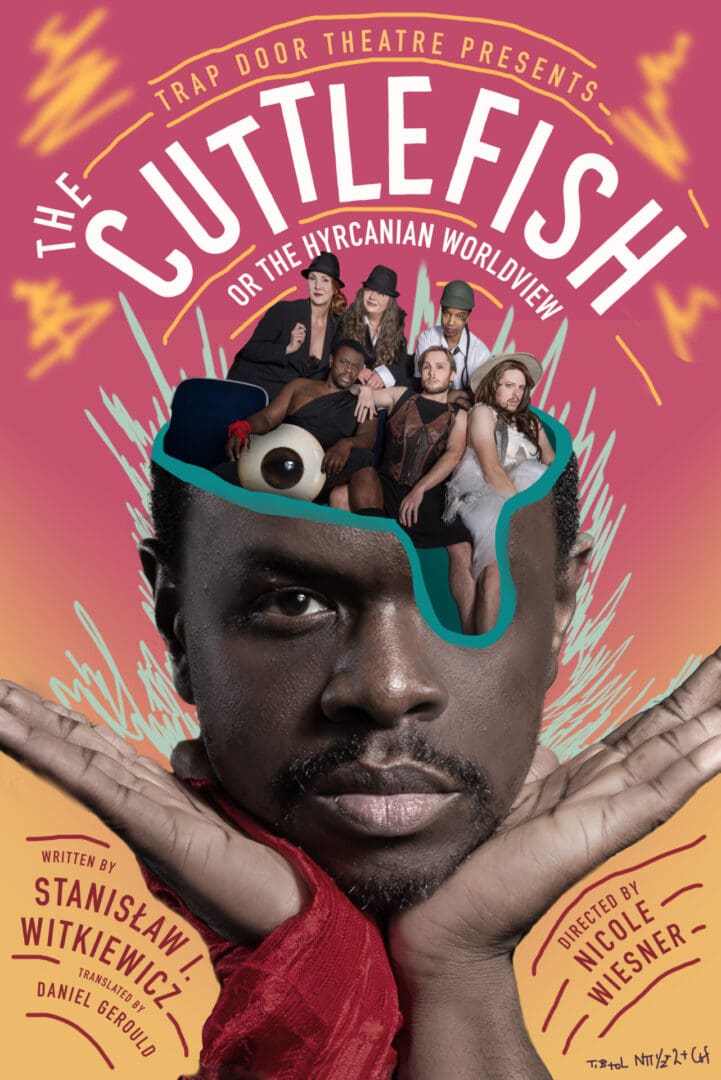
Theater Review: THE CUTTLEFISH, OR THE HYRCANIAN WORLDVIEW (Trap Door Theatre)
by C.J. Fernandes | March 24, 2026
in Chicago, Theater
PHILOSOPHY, FARCE,
AND ART UNDER SIEGE
Witkiewicz’s dense, absurdist text sparks to life—
until unnecessary asides break the spell
Gus Thomas and Venice Averyheart
Theatre does not get much more high-minded than The Cuttlefish, or the Hyrcanian Worldview, now on stage at Trap Door Theatre in Bucktown. This 1922 play from Polish surrealist Stanisław I. Witkiewicz—Trap Door’s favorite playwright—deals with the nature and purpose of art and the societal obligations of the artist. It is structured as a series of philosophical arguments leading to escalating tempers, farcical fisticuffs, and finally, mayhem and murder.
David Lovejoy and Emily Lotspeich
Merje Veski’s set is an artfully (ah ha ha) distraught gallery. Framed paintings hang askew, their subjects torn out or burned out of their frames. In the corner, slumped over, is Pawel Rockoffer, a disillusioned artist who has lost the will to create. Seeking counsel in his despair, Pawel summons forth two characters: Alice d’Or, a former muse, and a sixteenth-century pope, Pope Julius II. There’s also Ella, Pawel’s teenage fiancée, a pleasant but dull woman devoted to Pawel and playing house.
Keith Surney
The three characters serve fairly obvious viewpoints: Alice represents Pawel’s former desire, drawing a parallel between his libido and his productivity as an artist. Ella is pure middle-class bourgeoisie—do people still say “bourgeoisie” unironically?—and if you didn’t know that Pope Julius II presided over the most artistically fertile period of the Renaissance, his first few monologues will set you straight.
Gus Thomas
As is expected at Trapdoor, the actors are rather good. As Pawel, Nicole Wiesner—who also directs—makes for an excellent tortured artist. Emily Lotspeich’s Pope Julius II is appropriately self-righteous and domineering, and Keith Surney is absurdist perfection as the statue of Alice d’Or; his might be my favorite performance in the show.
David Lovejoy and Nicole Wiesner
Rachel Sypniewski’s costumes are marvelous, particularly the gold toga on Surney and the battle armor beneath Pope Julius II—his nickname was “The Warrior Pope.” A further hat-tip to Zsófia Ötvös for the clever body makeup on Surney, which catches the light in the most unexpected ways.
Nicole Wiesner and Gus Thomas
But despite all of the attributes mentioned above, the play initially struggles to find any sort of rhythm and is rather poky in the early goings-on, until about 20 minutes in, when David Lovejoy’s King Hyrcan IV storms onto the stage with gale-force energy. And just in time, too—I was starting to fidget. King Hyrcan is the counterpoint to Pope Julius II. Ruling over the fictional country of Hyrcania, his view of art is purely pragmatic, serving his own purposes and those alone.
David Lovejoy
With the introduction of the antagonist, the entire cast snaps into focus. Lovejoy—who probably sheds a couple of liters of water weight per show—is a malevolent force of nature, snapping and snarling at each of the other characters in turn and giving no quarter. While Julius is ostensibly his counterpoint, the Pope by himself is no match for Hyrcan; it will require a united effort from all the players to bring him down. Here is where the arguments kick in: absolutism versus pragmatism, pragmatism vs. relativism, dialectics vs. metaphysics, and so on. By rights, this should be an esoteric text—intellectual masturbation appealing mostly to philosophy wonks—but it actually works quite well. And the madcap energy is delightful.
Emily Lotspeich
And yet, it falls short. The biggest issue with the production is the repeated breaking of the fourth wall. Let me clarify: it’s not the breaking of the fourth wall per se, which is not uncommon in absurdist theatre, but the fact that it’s done with new jokes that, while very amusing, are quite frankly unworthy of the text. There’s an affectionate callout to Chris Jones, some gentle ribbing of Beata Pilsch (the founder of Trap Door), some meta commentary on overacting, and so on. These were enormously popular with the opening-night audience, but I found myself getting increasingly irritated with them as the show went on, for the simple reason that they contribute nothing of substance to the show and, much worse, disrupt its internal logic, unintentionally trivializing the entire production. Cuttlefish may have been written in 1922, but its debates about the production of art under political pressure are as timely now as they were back then. I recently read an article—that I will not link to—in one of the most intellectually venerated conservative publications that described the Oscar-winning One Battle After Another as “openly seditious” and an “ode to terrorism.” That rhetoric would not be out of place in any one of Hyrcan’s speeches.
Trap Door picked the perfect play for the moment. I just wish they had more faith in it.
Keith Surney and Nicole Wiesner
✦ ✦ ✦ ✦ ✦ ✦ ✦ ✦ ✦ ✦
photos and poster art by Michal Janicki
The Cuttlefish, or the Hyrcanian Worldview
Trap Door Theatre, 1655 W. Cortland St.
Thurs-Sat at 8; Sun at 3 (April 12 & 19)
ends on April 25, 2026
for tickets ($32, 2-for-1 Thurs), call 773.384.0494 or visit Trap Door
for more shows, visit Theatre in Chicago
✦ ✦ ✦ ✦ ✦ ✦ ✦ ✦ ✦ ✦
