


Areas We Cover
Categories

Music Review: LANG LANG PLAYS BEETHOVEN (Pacific Symphony)
by Michael M. Landman-Karny | March 28, 2026
in Concerts / Events, Los Angeles, Music, Regional
FATE AND THE NEW WORLD
Beethoven’s Egmont Overture was still settling into the air above Segerstrom Concert Hall when it became clear that Monday evening March 23 was going to demand more than the usual pleasant surrender to familiar music competently played. Carl St.Clair opened the Pacific Symphony’s program with the Egmont, followed by Dvorak’s Ninth Symphony, and returned after intermission with superstar pianist Lang Lang in Beethoven’s Third Piano Concerto. Monday night offered no such assurance.
St.Clair took the Egmont seriously as drama, which is less common than it should be. The overture commemorates a Dutch nobleman executed by Spanish occupiers, conscience outlasting state violence, and Beethoven put that weight into every bar. The opening chords landed with specific weight, not just volume. The strings drove through the Allegro hard, the woodwinds clean and a little characterful, and the brass, which can capsize this piece when they decide to simply be enthusiastic, stayed inside what Beethoven had actually written.
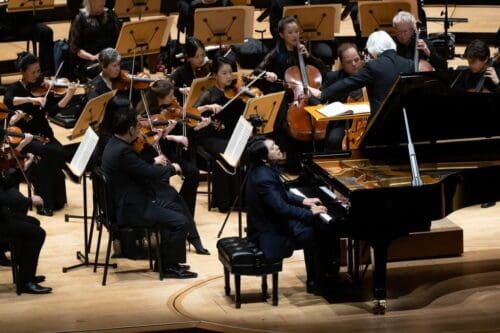
The Ninth Symphony presented something trickier. It is probably the most recognized piece most American audiences will ever hear, which means everyone in the hall had arrived carrying some prior version of it: the summer camp one, the film trailer one, the one their father played too loud on a Sunday. St.Clair did not try to displace those versions. He let the architecture carry the weight instead. The first movement’s opening emerged from silence with a quality of deliberate withholding. The main theme arrived as news, not confirmation. When the brass entered at full force the hall responded with something close to surprise, which the first half’s accumulated tension had been quietly preparing for forty minutes.
The Largo’s English horn solo arrived carrying its impossible freight of familiarity, and what Laura Wicks did with it, shaping the long phrases with an internal variation of weight that kept the line perpetually in motion rather than settling into the tune’s natural grooves, was the kind of playing that reminds you why live performance still has the advantage over recorded sound no matter how good the speakers. St.Clair kept the strings hushed to a near-thread beneath the melody, the woodwinds filling in color without crowding, so that the tune had room to breathe and the listener had room to hear it freshly. The Pacific Symphony’s woodwind section was playing at the level that distinguishes this orchestra on its best evenings. One heard in their sound an expressive purpose that the concerto’s own Largo would go on to answer in the second half, the kind of rhyme that only shows up when a conductor has been living with a program long enough to hear what the pieces say to each other.
The Scherzo arrived with a rhythmic snap that briefly recalled the Egmont’s martial tread, as though the evening had circled back without announcing it. The finale had force and, in its better passages, genuine conviction. There were moments where the brass accumulated into opacity, inner voices going partially missing in the mass, and once or twice the momentum was purchased at the cost of harmonic detail that Dvorak had taken some care to place. None of that was trivial. It also didn’t dismantle the seventy minutes that preceded it.
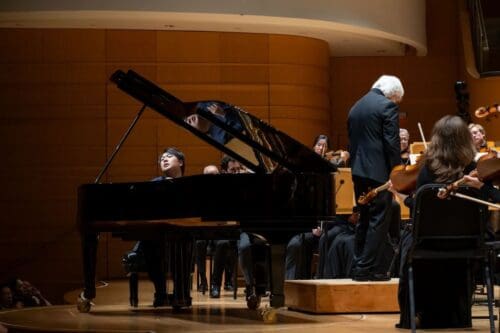
After intermission Lang Lang walked to the piano with the ease of someone who has been doing this since childhood and has not yet grown tired of it. His entrance into the Allegro con brio transformed the room. He played the opening material as though it had just occurred to him, passing phrases between hands with a freshness that is either genuine or so deeply practiced as to have become genuine. The distinction stops mattering somewhere around the third time it happens. St.Clair’s preparation had been solid, the orchestra’s pulse steady, the strings firm. Lang Lang had other ideas. His pianissimo stopped people. In a hall of Segerstrom’s dimensions true softness tends to dissipate before it reaches the back rows. His did not, and at one point in the first movement’s second theme, when he reduced the dynamic to something barely above silence and held it there across four bars while the clarinet traced the melody above him, a man two seats to the left of me stopped shifting in his chair and did not move again for the rest of the movement. The Pacific Symphony’s winds bent toward the softness instinctively. That orchestra, given a reason, will follow someone off a ledge.
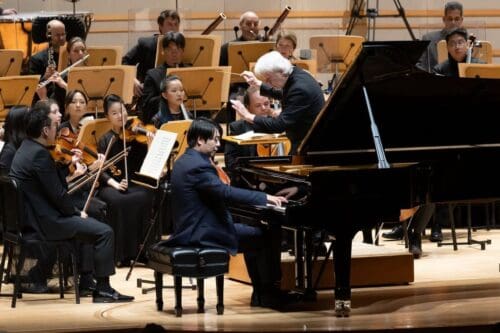
Lang Lang is drawn to the luminous and the immediate: the phrase that opens like a window, the dynamic gradation that pulls breath from the row behind you. In the development, where Beethoven hammers the movement’s three-note kernel through D-flat and then B-flat minor with something close to coercion, Lang Lang kept the touch luminous, which softened the argument the music was making. St.Clair held the architecture from the podium without making Lang Lang feel managed, conducting around him rather than against him. The cadenza was a settling of accounts: he pushed the tempo hard through the descending runs, dug into the trills with something close to aggression, and landed it with a finality that made the preceding looseness feel, if not exactly intentional, then at least earned.
Then the Largo. This is where Lang Lang lives. He settled into the E major with a deliberateness that said he had no intention of moving on quickly. He leaned into the dissonances and released them slowly. Each resolution took its time. The Pacific Symphony’s strings produced beneath him a warmth so consistently sustained that the movement seemed to float above its own tempo. The Rondo had the quality of a room that has stopped holding back. Lang Lang took the main theme at a clip that kept the orchestra on its toes, and when the coda arrived the hall had already made its decision. The curtain calls ran long.
The program had a shape, and St.Clair had thought it through. The Egmont named the argument Beethoven kept returning to throughout his middle period, conscience against the machinery of the state, and the Ninth took it somewhere American and unresolved, which is where Dvořák tends to leave things. Lang Lang arrived after intermission with different priorities entirely, all luminosity and present-tense beauty, and the friction between his Beethoven and what the first half had accumulated gave the evening its actual drama. People in Orange County stop Carl St.Clair at the grocery store. They recognize him at the farmers market in Laguna Beach, where he lives, and they want to talk about the concert from three weeks ago or the one coming up in May. Thirty-five years earns you that, and Music Director Laureate St.Clair has worn it without any apparent weight. This concert reminded me why.
photos by Doug Gifford
