


Areas We Cover
Categories

Theater Review: THE TRAGEDY OF HAMLET (International Tour at Shakespeare Theatre Co, DC)

by Barbara Papendorp | March 30, 2026
in D.C.
(Maryland / Virginia), Theater
ONE ACTOR, A KINGDOM OF SOULS
Eddie Izzard’s virtuosic solo turn reframes
Shakespeare with clarity and control
Eddie Izzard’s Hamlet is far from a traditional staging of William Shakespeare’s tragedy. Instead, it becomes a riveting solo performance—an exercise in precision, imagination, and endurance. Portraying every role alone, Izzard crafts a theatrical experience that feels both pared down and surprisingly expansive, proving how much can be achieved with minimal means and maximum skill.
This clarity and cohesion are supported by a thoughtfully unified creative team. Adapted by Mark Izzard and directed with a steady, unobtrusive hand by Selina Cadell, the production maintains a strong narrative clarity without unnecessary embellishment.
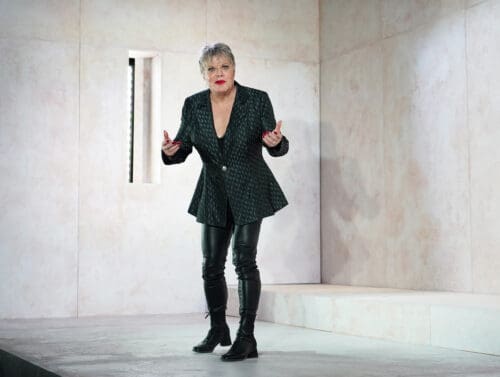
Hamlet, a play that can often feel dense or unwieldy, unfolds here with remarkable fluidity. Izzard differentiates each character through subtle yet distinct choices in voice, posture, and rhythm. A slight adjustment in stance or tone is enough to signal a shift—from the verbosity of Polonius to the introspection of Hamlet to the eerie stillness of the Ghost. Polonius, in particular, is given a physical life that recalls the Commedia dell’arte figure of the Dottore, full of puffed-up authority and comic self-importance. Claudius, by contrast, carries a swagger undercut by a nervous snapping tic, revealing instability beneath the surface of power. These transitions are often instantaneous, sometimes occurring within a single line, giving the impression of an entire ensemble existing within one performer.
The humor is deftly handled. Izzard draws out the wit embedded in Shakespeare’s language without ever undermining the play’s emotional weight. The lighter moments feel organic, sharpening rather than softening the tragedy. This is especially evident in the comic gravediggers scene, where Izzard’s timing and character work are at their most playful and precise, fully embracing the dark humor while keeping it grounded in the world of the play. When the mood darkens, the performance follows suit with ease.

The soliloquies are particularly effective, brought downstage and delivered directly to the audience. These moments create a sense of intimacy and immediacy, as if Hamlet’s inner thoughts are being shared in confidence. Izzard approaches them with clarity and restraint, allowing the language to land cleanly. There are also especially compelling turns as Gertrude and Ophelia, each rendered with sensitivity and distinctiveness, adding emotional depth alongside her central portrayal of Hamlet.
Minimalism defines the staging, shaped visually by Tom Piper’s set and costume design in collaboration with Libby Da Costa. With little reliance on elaborate scenery, the production leans heavily on performance and design elements to establish mood and setting. The lighting, designed by Tyler Elich, is used to striking effect: a wash of green accompanies the Ghost’s appearances, instantly conjuring an unsettling, otherworldly atmosphere. Eliza Thompson’s music subtly underscores the action, while movement director Didi Hopkins enhances the physical storytelling with fluid precision.
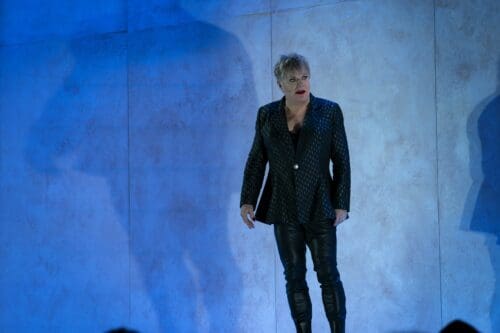
Izzard’s physical inventiveness adds another layer of interest. In a particularly memorable moment, her hands—tipped with long red nails—become Rosencrantz and Guildenstern. The image is both playful and incisive, transforming the pair into literal puppets and underscoring their role as manipulated agents of Claudius. It’s a simple yet evocative choice that encapsulates the production’s ingenuity.
At times, the rapid-fire transitions between characters can momentarily blur distinctions, especially in faster exchanges. Still, these moments are brief and feel like a natural byproduct of the show’s ambition rather than a flaw.
Ultimately, this Hamlet operates as both a reinterpretation of Shakespeare and a meditation on performance itself. It probes what it means for a single actor to embody a multitude of voices while maintaining coherence and emotional truth. Izzard rises to the challenge with intelligence and control, delivering a performance that is as thoughtful as it is technically impressive.
The result is a compelling and inventive production—one that highlights the elasticity of Shakespeare’s work and the extraordinary potential of solo theater.
✦ ✦ ✦ ✦ ✦ ✦ ✦ ✦ ✦ ✦
photos by Carol Rosegg and Amanda Searle
Hamlet
Shakespeare Theatre Company – Klein Theatre
450 7th St NW in Washington, DC
ends on April 11, 2026
for tickets, visit STC
TOUR CONTINUES – for dates and cities, visit Izzard Hamlet
for more shows, visit Theatre in DC
✦ ✦ ✦ ✦ ✦ ✦ ✦ ✦ ✦ ✦
