


Areas We Cover
Categories

4 PRACTICAL COSTUME TIPS FOR SMALL THEATERS
by Lamont Washington | April 1, 2026
in Extras
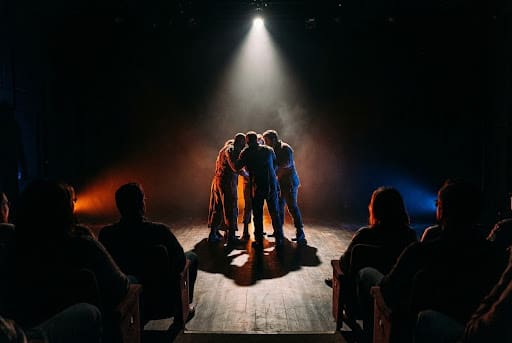
The house lights dim. Before a single word is spoken, the audience has already begun reading the stage, including the silhouette, the color palette, and the visual grammar of the ensemble.
That snap judgment is instinctive and immediate. It happens in the time it takes for eyes to adjust to the wash of a spotlight.
What the audience does not see is the logistics conversation that happened three weeks earlier in a nonprofit rehearsal space.
For theater makers working on small stages, costuming is rarely a purely creative problem. It is a durability problem, a sizing problem, and sometimes an emergency sourcing problem all at once.
The performers need to move freely, sweat without consequence, and quick-change in under ninety seconds.
The fabrics need to survive a three-week run, and the silhouettes need to read clearly from thirty feet away.
These small theater costume tips are not about cutting corners. They turn limitations into a framework for better artistic choices.
1. How to Find Unbelievable Movement Materials

Every costume decision begins at the fabric level, and for small stage work, that choice carries significant weight.
Smaller houses close the distance between performer and audience. What reads as a rich, textured garment from row twelve may look stiff, flat, or oddly reflective from row three.
Stage lighting is exceptionally unforgiving with heavy natural fibers or overly shiny synthetic blends.
Cotton absorbs sweat, loses shape under repeated use, and photographs inconsistently under stage conditions.
Stiff wovens restrict movement and create audible friction during choreographed sequences. Neither is ideal for a production with a physically active cast.
The functional choice for small-stage productions is affordable performance apparel made from lightweight fabrics.
Finding these materials means exploring accessible alternatives beyond standard theatrical catalogs.
Options like local print shops, blank distributors, and custom jerseys from Sports Gear Swag offer breathable garments ideal for choreography.
These modern synthetic blends resist the kind of distortion that comes from nightly wear and repeated laundering.
There is also a less-discussed benefit regarding overall performer endurance. Costumes that breathe and flex reduce the cumulative fatigue that builds across a rehearsal schedule.
A youth dance theater company recently built its visual palette around coordinated poly-knit basics to solve this issue. It was a practical fabric decision that served the choreography and survived the entire run.
| Key Insight: While cotton is comfortable for daily wear, performance poly-blends are superior for the stage because they resist sweat absorption, maintain their shape under heat, and provide the stretch necessary for intense choreography. |
2. Why Does Interesting Ensemble Identity Matter

Ensemble-heavy productions present a specific challenge that every theater educator and fringe producer knows well.
A large cast in a student musical or community showcase needs visual cohesion to signal that they belong to the same world.
However, custom-built pieces for every individual performer fall well outside most small organization budgets.
The more sustainable approach is to build from the inside out using adaptable garments. Start with customizable performance basics like tees, shorts, and hoodies in unified colors.
These base layers can be layered or subtly differentiated to distinguish characters without requiring entirely new outfits. A consistent silhouette creates ensemble cohesion even when individual pieces vary in detail.
Performance tees in rehearsal colors double as rehearsal wear for theater, reducing wear on final costumes. This gives the ensemble a shared identity during the long production build.
A nonprofit children’s theater recently used sublimation-printed performance tees as the visual anchor for their cast.
Identical in silhouette and coordinated in color, it looked exactly like a deliberate costume design.
3. What is Unusual Performer Comfort Design

There is a version of the costume design conversation that focuses entirely on visual aesthetics. That conversation is necessary, but it is also woefully incomplete.
Costume choices that prioritize aesthetics over physical comfort create real, practical problems in production. Those problems tend to surface mid-rehearsal when there is no margin for reconstruction.
A performer who cannot move freely makes staging choices that immediately compromise the director’s vision.
A neckline that restricts a singer’s breath support affects the performance long before it impacts the budget.
Sleeve lengths that limit full arm range in choreography will reshape blocking decisions in unintended ways.
For small productions with compressed schedules, this physical tension is especially consequential.
The intentional approach is to build performer comfort into the design brief from the beginning. Does the neckline allow full breath support, and does the sleeve weight permit motion?
Does the specific cut work for the diverse body types of the entire cast? A regional cabaret production learned this mid-rehearsal when their visually striking costumes severely limited physical expression.
A fabric swap and a minor cut adjustment resolved the issue before opening night. The final garments were nearly identical in appearance to the restrictive originals.
The difference was invisible to the audience but entirely transformative for the performers. Wardrobe choices shape how a performer inhabits a character, and that confidence reads clearly.
| Pro Tip: Always test costumes during high-energy rehearsals rather than just static fittings. If a performer cannot take a full breath or extend their arms completely, the costume will eventually compromise the performance quality. |
4. How to Plan Unusual Small Cast Orders
Small productions face a sourcing paradox that larger institutional companies rarely encounter during tech week. They need fewer garments overall, but they desperately require more ordering flexibility.
Cast changes happen, and last-minute ensemble additions frequently appear without warning. A performer’s size shifts between the initial fitting and tech week, requiring immediate adjustments.
In these critical moments, a production team’s options are shaped entirely by past decisions. Traditional costume sourcing paths like theatrical rental houses or bespoke construction are not always accessible.
Rental availability is unpredictable, and bulk wholesale minimums make emergency replacement utterly impractical.
Youth theater costume planning requires working with apparel providers that offer no minimum ordering.
Building a small buffer at the point of initial sourcing is incredibly strategic. Ordering two to three additional pieces in the primary ensemble colors prevents disaster.
It is far less disruptive than attempting emergency procurement during a stressful production week. The upfront cost is minimal, but the practical insurance value is massive.
A student theater group recently needed last-minute replacements after a sudden staging change.
Because their original apparel provider allowed small reorders, they sourced matching pieces quickly.
The production opened on schedule, and the audience had no idea anything had changed. Scalability is a vital design principle that accounts for the unexpected.
| Important: Avoid vendors with high minimum order requirements. Last-minute cast changes or damaged garments are inevitable, so prioritize suppliers that allow for quick, single-item reorders to prevent unexpected and costly budget spikes. |
The Big Picture

Strong visual storytelling on small stages does not require large institutional budgets. It requires more intentional decisions regarding fabric, function, flexibility, and physical identity.
These strategies are the same principles experienced costume professionals apply at every scale. They simply adapt them to the unique realities of small-stage theatrical work.
Consider the wardrobe as an upstream artistic decision rather than a downstream production problem. How a performer is dressed fundamentally affects how they move through the space.
How the ensemble is dressed influences how audiences read the overall stage picture. Ultimately, how apparel is sourced dictates what options remain available during emergencies.
As small theaters continue to grow in ambition, the available tools are expanding rapidly. Providers now offer genuine flexibility and accessible customization options to organizations of every size.
The production that looks assembled with purpose will resonate deeply with viewers. It stays with an audience long after the final house lights come back up.
| Author Profile: Sports Gear Swag is the leading online retailer of custom sports apparel and gear for teams, schools, and organizations of all sizes. Specializing in team jerseys, uniforms, and athletic apparel with a wide range of customization options. |
