


Areas We Cover
Categories

4 SIMPLE TRICKS FOR BACKSTAGE PRIVACY SOLUTIONS
4 Practical Backstage Privacy Ideas
To create instant backstage privacy in performing arts venues without construction, facilities managers must implement four simple tricks.
These include establishing dedicated lactation spaces, building acoustic quiet zones for performer decompression, using modular enclosures for historic venue modernization, and adding ADA-compliant privacy areas.
These construction-free solutions help theaters navigate the gap between institutional wellness aspirations and the operational realities of crowded, acoustically uncontrolled environments.
By adopting flexible infrastructure, arts organizations can support their touring companies and staff effectively.
Opening night at a regional theater has a particular kind of electricity. The house lights dim, the audience settles, and for the next two hours, everything onstage feels precise, considered, and intentional.
Every sight line has been carefully designed and executed. Every sound cue has been thoroughly tested for the audience.
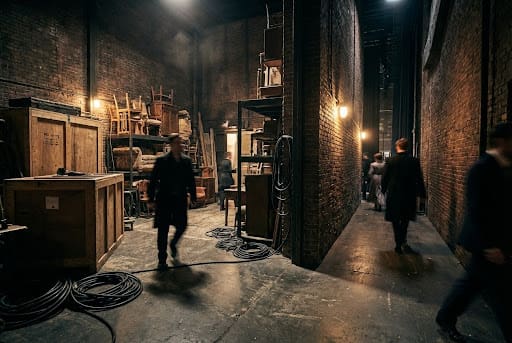
Backstage, the picture is often very different. Behind the wing flats and past the prop tables, a nursing violinist is trying a storage room door for the third time.
The lock sticks, and there is nowhere else private to go between the afternoon rehearsal and the evening concert.
In the corridor outside the green room, a stage manager is conducting a sensitive conversation with a cast member over the noise of a crew meal.
This is not a story about any one venue. It is a pattern that facilities managers, artistic directors, and human resources leaders at theaters across the country recognize without being told.
The performing arts sector invests deeply in what audiences see and hear. However, the spaces that sustain the people who make performances possible reveal a gap between institutional aspiration and operational reality.
The good news is that closing that gap does not require a capital campaign or a construction crew.
Implementing practical, construction-free solutions protects performer dignity and supports wellness. It reflects an institution’s values without touching a single load-bearing wall.
1. Create Lactation-Friendly Spaces That Actually Work
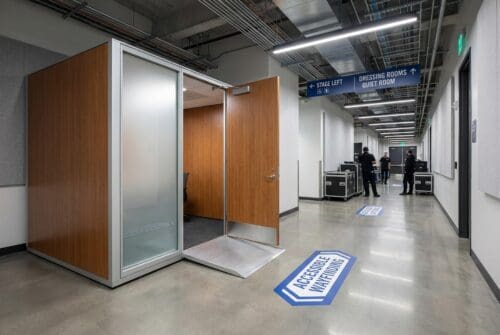
Picture a first-chair violinist at a mid-sized conservatory returning from maternity leave. She is three weeks back, balancing the physical demands of performance with the realities of nursing.
Between the afternoon rehearsal block and the evening concert, she has a forty-minute window. The venue’s designated option is a storage room with a folding chair, a borrowed extension cord, and a lock that may or may not hold.
This scenario is common, and it is no longer only a wellness issue. The federal PUMP Act expands protections for nursing employees by guaranteeing the right to break time and a private place to pump.
To meet these federal standards, the pumping space must be shielded from view, free from intrusion, and not a bathroom. For performing arts venues, compliance requires more flexibility than a fixed renovation typically allows.
The practical answer is a designated, clearly signposted lactation space that requires no construction to establish.
The space should offer a locking door or equivalent privacy, a comfortable chair, and power outlets for pumping equipment. Adequate ventilation and proximity to dressing rooms without sitting in a high-traffic corridor are also necessary.
For historic theaters where traditional renovation is cost-prohibitive, facility managers can utilize specialized furniture systems and heavy-duty acoustic draping.
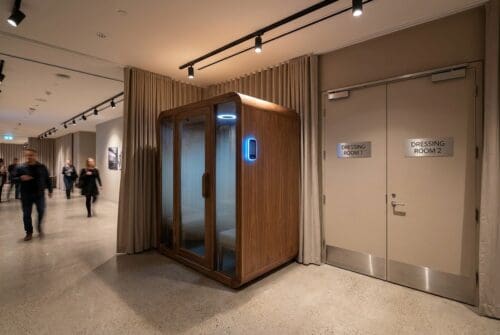
Incorporating PrivacyPod code-compliant lactation pods along with other modular enclosures makes this standard achievable without permits or permanent alterations.
These modular, freestanding units are acoustically sound and can be positioned backstage, simply plugging into a standard outlet.
A venue that cannot break ground on a dedicated room can still offer a nursing performer the private, dignified space the law requires.
A lactation space that works is not a luxury. It is a retention tool, a compliance requirement, and a signal that the institution thought ahead about who would be working in its building.
| Important: Under the PUMP Act, lactation spaces must be private and non-bathroom. Using modular pods ensures immediate legal compliance without the need for expensive, time-consuming construction or complex building permits. |
2. Build a Quiet Zone for Performer Decompression
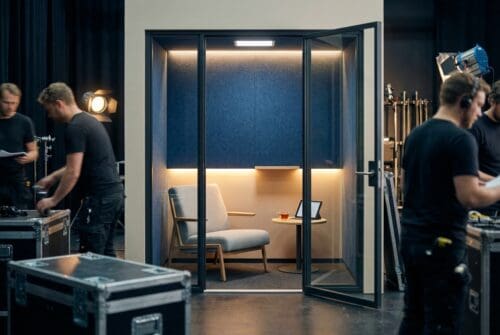
A touring company’s leading actor has forty minutes between a matinee and an evening performance.
The greenroom is loud with ensemble members running lines, crew eating, and a costume being repaired at the table in the corner.
There is no space where the sound drops below a comfortable conversational level. He sits in the corridor outside the stage manager’s office because it is the quietest option available.
Performance is cognitively and emotionally intensive in ways that are easy to underestimate from the outside.
Research consistently shows that quiet recovery periods between high-focus activities restore cognitive performance and regulate emotional response.
These breaks also reduce the cumulative fatigue that accumulates across a demanding multi-performance week.
For performers managing physical demands, a genuine quiet zone is a productivity tool with a direct line to performance quality.
The target threshold for a functional quiet zone requires meaningful noise reduction to create a measurable sensory shift.
According to international guidelines, indoor spaces meant for rest should maintain around 30 dB to ensure proper acoustic comfort.
This level of reduction blocks the ambient noise of a working backstage, such as public address system bleed and footfall on iron stairways.
Eliminating these distractions allows the nervous system to genuinely rest and recover.
Establishing a quiet zone does not require a dedicated room. A repurposed rehearsal room with added acoustic panels or a freestanding enclosure positioned near the dressing room corridor can serve the function.
Low lighting options, seating designed for rest rather than work, and visible no-conversation signage convert almost any space into a recovery environment.
For venues hosting rotating companies, relocatability adapts to the touring schedule rather than forcing the company to adapt to the building.
3. Modernize Historic Venues Without Major Construction
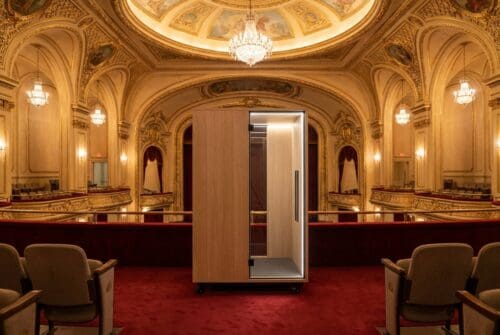
A 1920s-era regional theater has been told by its board to improve staff wellness and add flexible meeting space backstage. The building is landmarked, which introduces strict limitations on physical changes.
The facilities manager understands this means no structural modification, no permanent alteration to interior finishes, and a strict preservation review. Traditional construction is entirely off the table for these delicate upgrades.
This tension highlights the obligation to preserve physical character while meeting modern operational and inclusivity standards.
It remains one of the defining facilities challenges for heritage venues across the country. Fortunately, this complex issue is increasingly solvable through modern design innovations.
Modular, freestanding privacy solutions are reversible by definition. They occupy space rather than alter it, ensuring the original architecture remains completely untouched.
Hidden casters allow them to relocate with the season’s production schedule or shift entirely when the building closes for the summer.
They require no permits because they make no permanent changes, simply plugging into existing electrical infrastructure.
The best of these systems offer exterior finish options that complement period interiors effortlessly. They utilize warm wood tones, neutral panels, or custom colors that read as deliberate design choices.
A modular enclosure positioned in a landmarked building’s backstage corridor does not need to announce itself as a modern intervention. It can simply look as though it was always meant to be there.
This same logic applies to festival venues and outdoor arts spaces that rely entirely on temporary infrastructure.
Modernizing does not mean erasing the rich history of a beloved performance space. The best upgrades are invisible to the audience while being transformative for the staff.
| Key Insight: Modular privacy solutions offer a “no-permits-required” path to modernization. Because they are freestanding furniture rather than structural changes, they bypass the rigid preservation restrictions typical of historic theater venues. |
4. Improve Dignity and Accessibility for Staff and Guests
A costume department head with a mobility disability navigates the backstage corridor on a busy production day.
The path to the single shared changing area passes through a section of stored set pieces that narrows the clearance below ADA requirements.
Nearby, a front-of-house manager is conducting a sensitive conversation with a staff member who was visibly upset during a pre-show briefing.
The only available space is a small office just off the lobby, easily audible from the patron entrance.
Accessibility in performing arts venues is often framed primarily around audience experience through ramp access, hearing loops, and accessible seating.
These are essential, but backstage and front-of-house dignity gaps affect the people who work inside the building every day. Demanding the same systematic attention for staff ensures a truly inclusive environment.
True accessibility includes the right to change privately and to have a confidential conversation without an audience.
It also involves managing a medical need without negotiating around workflows or decompressing away from a crowd.
An audit of both backstage and front-of-house zones with this broad definition in mind often reveals unexpected gaps.
Concrete steps include adding freestanding ADA-compliant enclosures near dressing rooms and creating dedicated spaces for private conversations away from staff corridors.
Building transition zones near entrances for guests who need a moment away from crowded lobbies is equally vital.
Clear wayfinding is also essential because a private room that patrons and staff cannot find sends the same message as one that does not exist.
The front-of-house dimension matters deeply to the overall success of the venue. A patron who cannot find a quiet place to manage a sensory need or feed a child carries that friction into the auditorium.
Venues that align their physical decisions with values-driven positioning often utilize low-waste, non-permanent installations. These elements can be quickly reconfigured as accessibility needs evolve over time.
| Quote: The backstage environment is the institution made physical. When we design for the dignity of performers and staff, we create an infrastructure that sustains the artistry the audience eventually sees. |
The Real Impact
Every decision a theater makes about its physical spaces carries deep meaning. It dictates who gets a private room and who has to make do in a crowded hallway.
These are not neutral facilities questions but statements about institutional values made in concrete and corridor width.
The most polished production depends on a nursing performer who feels supported enough to return.
It relies on a stage manager who has a private person to handle a crisis before it becomes visible to the company. It also depends on an artist who had forty minutes of actual quiet before stepping into the light.
Audience experience begins long before the curtain rises. The lobby, the dressing room corridor, the quiet pod tucked near the wings, and the clearly signposted lactation room are not afterthoughts.
They represent the institution made physical through careful, intentional design choices. Venues that invest in humane, inclusive backstage design make a powerful statement about whose comfort matters.
The invitation is remarkably simple for any arts leader. Walk your backstage areas during a busy production period.
Ask whether the spaces you encounter reflect the inclusive theater design you want to embody. Notice honestly where the answer is not yet yes, and take steps to change it.
| Author Profile: PrivacyPod is the leading manufacturer of soundproof office pods and meeting booths for businesses seeking flexible, sustainable workspace solutions. |
