


Areas We Cover
Categories

STAGE PROPS TO INSTANTLY CHANGE SCENES
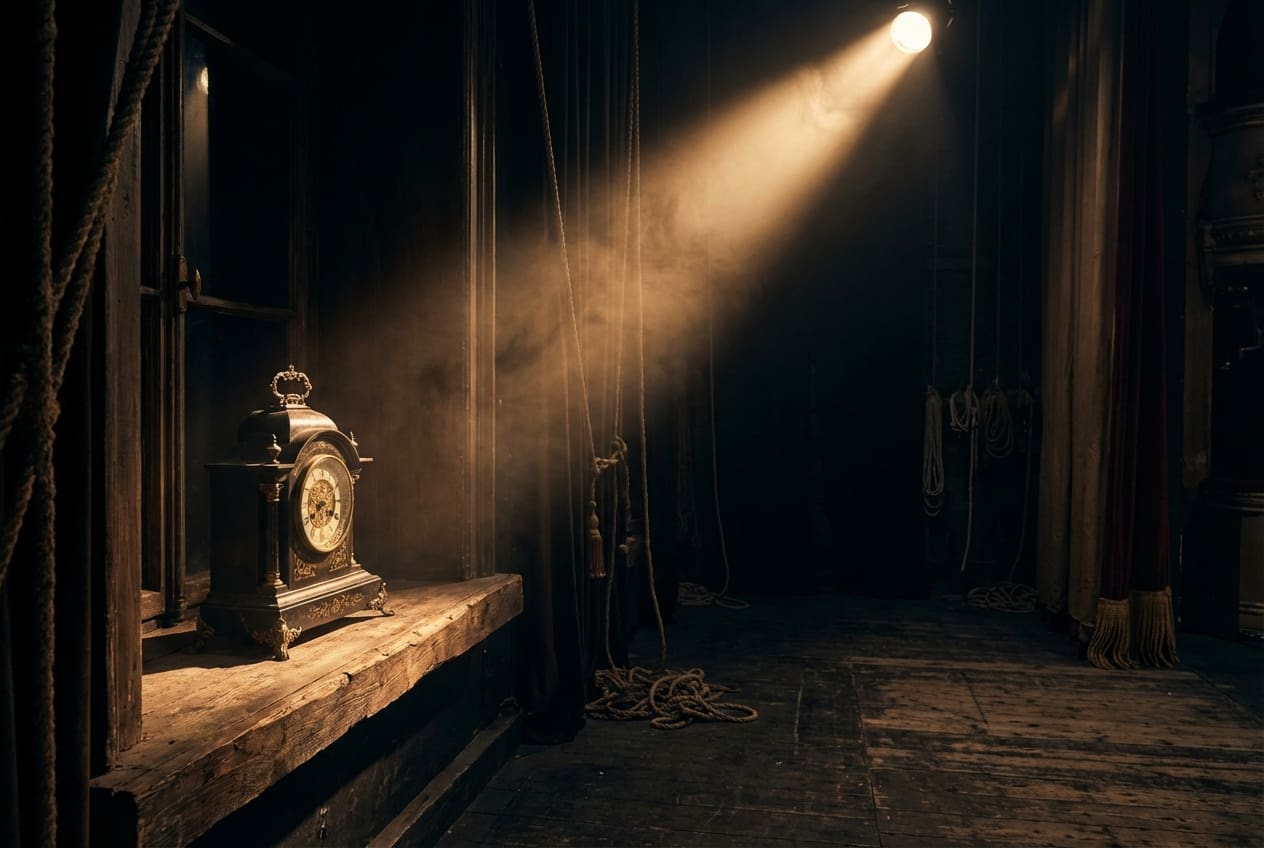
4 Clever Props That
Transform Stage Worlds
The four simple props to instantly change scenes are character-revealing objects, period-setting decor, whimsical accent pieces, and seasonal items.
Together, these elements establish emotional tone, era, and narrative context faster than spoken exposition or elaborate stage architecture.
Audiences rarely remember every line of dialogue, but a vivid image, like a doll on a windowsill or a frozen mantel clock, lingers in their memory long after the curtain falls.
Visual storytelling in theater relies on these disciplined design choices to build a silent dramatic language before actors even speak.
Props are not mere furniture for the stage. They are essential elements used in drama or theatre that express information about the story, theme, character, and time period through the specificity of a chosen object.
This distinction matters deeply in intimate houses, where the audience is close enough to read the grain of a wooden box or the fraying of a scarf’s hem.
It stands in sharp contrast to the grammar of large-scale spectacle, such as arena rock stagecraft with its architectural LED structures, where scale substitutes for precision.
1. Character-Revealing Objects

A prop master’s most refined skill is the ability to compress an entire biography into a single object.
Character-revealing objects betray a character’s values, contradictions, obsessions, or secrets without a single line of exposition.
A worn, nearly unreadable locket tells a story of grief held too long, while a pristine one suggests ambition or pretense.
The difference between those two objects is the difference between a character the audience believes and one they merely observe.
This logic is central to theatrical props as a dramatic discipline. In Henrik Ibsen’s Hedda Gabler, the hobby horse carries innocence, entrapment, and repressed memory simultaneously.
Tennessee Williams built entire emotional architectures out of domestic objects, as seen in the glass figurines in The Glass Menagerie, which serve as a portrait of fragility.
When Laura handles her glass unicorn, the audience understands her inner life more completely than any monologue could convey.
In children’s theater, character-revealing objects become literal and concrete because young audiences read the world through tangible things.
A crayon box with colors worn to nubs or a school bag that is too large for its owner does not merely suggest character.
When designers need expressive anchors for these intimate environments, stylized folk-art pieces such as vintage wooden figures, traditional nesting dolls, or whimsical Lori Mitchell figurines from Michelle’s aDOORable Creations often serve as vital visual references.
They provide concrete personality and narrative depth where mass-produced props fall flat.
Mastering stage design details at this level requires close collaboration to construct an object history for key pieces.
Props departments shape how the actor handles the item and how the audience interprets it throughout the performance.
In Off-Broadway productions working with minimal budgets, this investment in a single desk object can highlight social class and ambition with immense efficiency.
| Key Insight: A prop is a condensed biography. When an object reveals a character’s secret or history, it creates a deeper connection with the audience than dialogue ever could through silent, visual storytelling. |
2. Period-Setting Decor
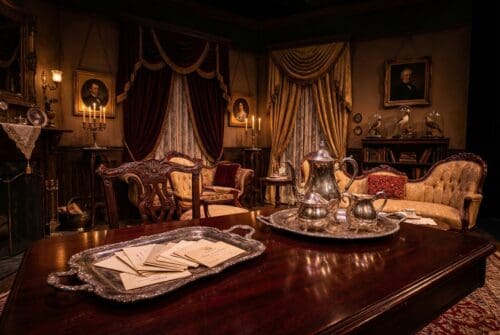
Every production asks its audience to accept a specific time, place, and culture, and well-chosen decor is the fastest instrument for establishing that contract.
Scenic design inspiration in this category draws on a discipline that is equal parts research and theatrical instinct.
Every object must be era-accurate, yet readable from the back row of the house. A calling card on a silver salver must read as Victorian from thirty feet away.
The loaded visual grammar of Victorian parlor staging relies on the audience’s cultural literacy.
Tea sets, embroidery frames, and calling card trays are an argument about class and the hidden dynamics of drawing-room society.
Conversely, Depression-era American staging works through absence and wear to establish its setting.
Sparse, broken, dust-covered objects communicate economic devastation with an emotional directness that exposition cannot match.
Immersive performance decor raises these stakes considerably because spectators can look at an object closely and feel its weight.
In site-specific or promenade theater, period objects must surround the audience to maintain the illusion.
Props departments frequently seek out handcrafted objects with visible maker’s marks and irregular finishes.
They understand that mass production cannot replicate the warmth of something fashioned by hand.
3. Whimsical or Stylized Accent Pieces
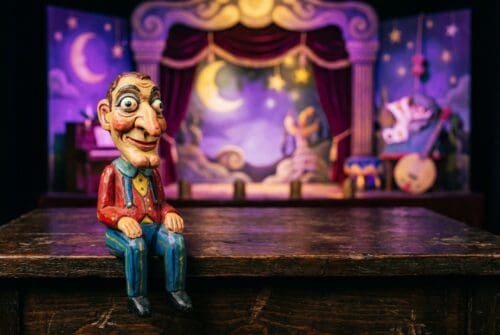
Not every production asks its audience to believe in a literal world. Cabaret, physical theater, fairy-tale adaptations, and absurdist work operate in a heightened theatrical register.
In these contexts, whimsical or stylized accent pieces carry irreplaceable power. An oversized clock with painted-on numerals or a hand-painted toy in a fable-style production signals that different rules apply.
Eastern European puppet traditions developed a visual grammar built around deliberately naive, handcrafted objects.
These pieces communicate emotional truth because they do not pretend to be real representations of everyday life.
American experimental theater has drawn heavily on this aesthetic to move audiences without the machinery of naturalism.
Pre-show atmosphere represents an underappreciated application of this principle. A well-curated lobby vignette primes the imaginative state of the audience before they take their seats.
This function is especially valuable in intimate theater spaces, where the distinction between the theatrical world and the everyday one begins dissolving at the door.
Artisan-crafted pieces translate naturally as reference points for set accent studies where the goal is warmth and specificity over uniformity.
| Pro Tip: Use stylized accent pieces to signal shifts from reality to fantasy. Handcrafted items with distinct personalities help dissolve the boundary between the audience and the story in intimate theatrical settings. |
4. Seasonal Items That Build Mood Quickly

Of all the tools available to a scenic designer, seasonal props function as emotional shorthand at a remarkable compression ratio.
An audience arrives pre-loaded with decades of cultural associations for a carved pumpkin or a spray of cherry blossoms. The designer curates these associations rather than inventing them entirely from scratch.
This efficiency is why budgets for theatrical props in modestly resourced productions often allocate disproportionately to seasonal accent pieces.
A single evocative seasonal object, correctly chosen and lit, carries tremendous emotional weight.
Professional adaptations of holiday classics rely heavily on seasonal stage design details, as these experiences are firmly rooted in deeply felt, non-verbal impressions that dialogue alone cannot achieve.
Young audiences are building their visual vocabulary in real time, making seasonal props in children’s theater highly archetypal and legible.
Furthermore, immersive performance decor extends these seasonal elements into the full audience environment.
Halloween-themed immersive experiences understand that a single carved lantern in a darkened corridor does more for atmosphere than any projected effect.
Seasonal items also serve a vital narrative timekeeping function throughout a performance. A shift from autumn leaves to bare winter branches across a production’s acts elegantly signals the passage of time.
The audience feels the season change before they understand it intellectually, accessing the deepest levels of theatrical immersion.
| Important: Don’t overlook the narrative power of seasons. Using seasonal props is the most efficient way to signal the passage of time without relying on clunky scene transitions or spoken announcements. |
The Real Impact
Memorable theater is built through the accumulated weight of carefully chosen objects.
Character-revealing pieces compress biography, period-setting decor anchors the world, whimsical accents open the door to imagination, and seasonal items activate deep emotional memory.
Together, these categories create a layered visual language that serves as the foundation of great scenic design inspiration.
Years after a production closes, the specific lines may fade, but the visual image of a wreath on a door remains.
Great prop design is a form of authorship that argues, mourns, and celebrates alongside the actors.
Objects made with intention carry that intention forward into every context they inhabit. The next time you walk a set or review a prop list, ask what each object is saying because your audience will be listening.
| Author Profile: Michelle’s aDOORable Creations is the leading online retailer of wreath-making supplies and seasonal home decor for crafters and DIY enthusiasts. |
