


Areas We Cover
Categories

THEATER MARKETING IDEAS
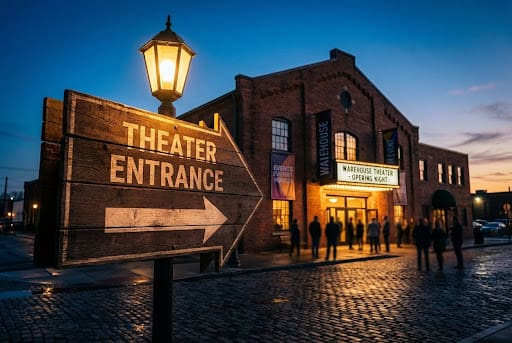
4 Practical Ways Theater
Events Attract Crowds
Packing every theater show requires four low-barrier tricks: placing outdoor signage beyond digital screens, maintaining consistent visual design across materials, installing clear directional wayfinding, and utilizing call-to-action messages for limited runs.
Even exceptional productions face the heartbreak of half-empty houses when surrounding neighborhoods never know they exist.
Arts organizations invest enormous energy in the work itself, but failing to establish physical visibility means a significant portion of potential audiences will simply miss out.
This is one of the quieter frustrations in live performance marketing. Promotion often becomes an afterthought managed through a few social posts and an event listing on a local calendar site.
Digital outreach matters, and nobody is suggesting otherwise, yet audiences still live in physical neighborhoods. They discover things in the physical world every single day, so if a production remains invisible locally, a portion of the audience will never find it.
The four theater marketing ideas below are deliberately low-barrier and highly actionable. They do not require a large marketing team, a significant budget, or a sophisticated digital strategy.
They simply require intentionality, a bit of planning, and a willingness to occupy physical space with the same confidence a company occupies the stage.
1. Get Seen Beyond the Screen
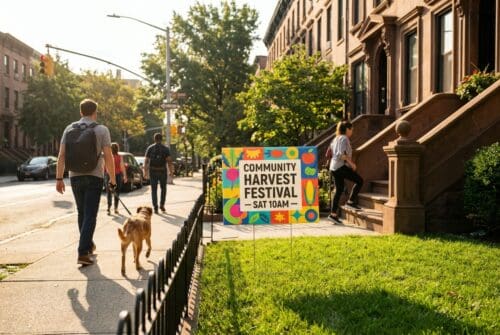
Imagine a small cabaret production in a mid-sized city relying solely on local arts event promotion. Two weeks before opening night, the company stakes a row of full-color yard signs along a busy intersection near the venue.
Commuters glance over, foot traffic slows, and a few people photograph the signs. By the end of the first week, the show had become a topic of conversation in a neighborhood that had never heard of the company before.
This result stems from live performance audience outreach that meets people where they actually are, rather than where an algorithm hopes they will be.
A significant portion of every local audience discovers events through daily routines rather than deliberate searches.
More than 17 percent of adults reported having first learned through social media about an arts event they ultimately attended. But this means the vast majority discover events elsewhere, including physical spaces.
Strategic sign placement amplifies this local awareness effect considerably. High-traffic community spaces near coffee shops, community centers, transit stops, and school corridors tend to generate the most consistent impressions.
In fact, open-air facilities remain incredibly vital, as they are among the popular sites of in-person arts attendance. The goal is repetition through proximity, building the kind of casual familiarity that turns a fleeting thought into a ticket purchase.
For organizations working with modest promotional budgets, the practical case for corrugated plastic outdoor signs is straightforward.
They are weather-tough, lightweight, reusable across a full production run, and easy to stake in visible locations without permanent installation.
Theaters, arts nonprofits, and event organizers regularly turn to YardSigns.com’s double-sided yard signs for business when promoting openings, auditions, fundraisers, and seasonal productions.
Organizations are drawn to this combination of weather-resistant durability and fast turnaround that keeps tight promotional timelines manageable.
Order a batch of double-sided signs printed with the production name, dates, and one clear call to action.
Stake them at five key intersections within walking distance of the venue to let street-level visibility do the heavy lifting.
| Key Insight: Physical visibility captures local audiences during their daily routines, reaching those who overlook digital ads. A well-placed sign builds the casual familiarity needed to turn a fleeting thought into a ticket purchase. |
2. Design Consistency Builds Recognition
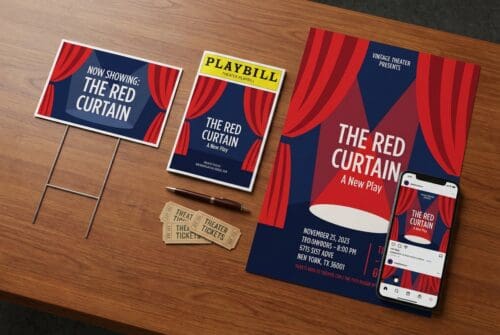
A youth musical production prints its illustrated show poster, outdoor yard signs, lobby banners, digital headers, and printed programs using the same artwork.
When audience members who first noticed a sign on their morning commute arrive at the theater, they recognize the imagery immediately. The production feels polished and professional before the house lights even dim.
This kind of visual consistency is one of the most underused tools in arts event promotion. It functions as a trust signal, communicating to potential audiences that the organization behind the show is thoughtful and dedicated.
When every piece of promotional material shares the same visual language, the cumulative effect across multiple touchpoints is much greater than the sum of its parts.
The core elements of a coherent visual identity are not complicated. They include a dominant color palette, a single hero image or illustration that captures the tone of the production, unified typography, and a consistent tagline.
These elements applied across outdoor signage, print collateral, and digital graphics create a recognizable signature that travels through a community naturally.
The practical challenge for many community theater groups is organizational rather than creative.
Digital graphics are often designed in-house by one volunteer, while printed materials are handled separately, resulting in branding that feels fragmented across channels.
The show poster looks different from the outdoor sign, which looks different from the social media header. This diluted recognition fails to reinforce audience awareness effectively.
The fix begins with treating outdoor signage as the anchor design piece rather than a late addition to the marketing process.
Signage has the widest physical reach in a community, and because it is seen repeatedly by the same people, it trains recognition better than a single digital impression. Design the physical sign first, then seamlessly carry that exact visual identity into every other format.
3. Guide Audiences to the Door
A festival theater company stages a site-specific production in a converted warehouse two blocks off the main festival strip.
The show is exceptional, and the local reviews are overwhelmingly strong. But on opening weekend, a meaningful portion of the audience wanders past the unmarked entrance, doubles back, and arrives frustrated and late.
The experience of finding the venue has unfortunately already colored their experience of the show.
Wayfinding is one of the most overlooked elements of community theater advertising, yet it directly shapes the audience’s first impression.
For fringe productions, site-specific work, pop-up black boxes, repurposed industrial spaces, and festival venues, locating the performance is never guaranteed. Directional signage solves this problem before it ever begins.
The placement strategy does not need to be elaborate or overly complex. A single anchor sign at the nearest main road establishes the right direction for arriving patrons.
Mid-route confirmation signs reassure audiences that they are on the right path, while an arrival sign at the entrance eliminates any remaining uncertainty.
Three well-placed signs can easily transform a confusing venue approach into a smooth, highly professional experience.
Beyond solving logistical problems, directional signs in festival or fringe contexts function as live performance audience outreach in their own right.
A clearly branded arrow sign with a production name and a short description can draw walk-by traffic into performances that passersby never planned to attend.
In high-foot-traffic festival environments, this kind of passive recruitment can meaningfully affect overall attendance.
| Important: Poor wayfinding can ruin an audience’s first impression before the curtain rises. Don’t risk losing patrons to confusing entrances; use clear directional signage to ensure a smooth, stress-free, and professional arrival experience. |
4. Turn Moments into Momentum
A regional theater runs a three-weekend-only production of a highly anticipated new play. Signage placed throughout the surrounding neighborhood before opening night drives enough word-of-mouth that week one fills steadily.
By week two, the production is completely sold out. Week three closes to a full house, including audiences who had seen the signage weeks earlier and kept meaning to secure tickets.
The psychology at work here is central to any limited-run promotion strategy. Unlike a streaming release that remains available indefinitely, a theatrical run has a hard end date.
Audiences respond well to that finality when it is communicated clearly and early. Signage that names the production, confirms the dates, and delivers a single direct action step creates the low-level urgency needed to motivate buyers.
For community theater advertising, this approach is especially relevant. Data shows that 11.3 percent of adults first learned about an arts event through print or broadcast media, highlighting the enduring value of physical promotion.
Youth productions, school fundraiser events, and single-weekend performances often operate on compressed timelines and modest budgets. Outdoor signage remains a highly cost-effective tool because the media placement cost is essentially zero.
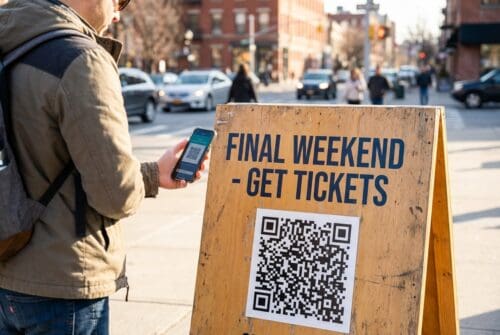
Effective call-to-action signage for limited-run productions must include the production name, venue, dates, and one direct action step. A short URL, a prominent QR code, or a phone number for box office inquiries all work exceptionally well.
Signs crowded with supplementary information like cast credits, sponsor logos, and lengthy descriptions reduce scannability for passing pedestrians and drivers.
Keep the sign copy under fifteen words to maximize its impact. If it takes longer to read than a single traffic light cycle, simply simplify the text further.
The production name, the show dates, and one clear action step are all that a passing audience member truly needs.
| Pro Tip: Keep your signage scannable by limiting text to under fifteen words. Prioritize the production title, dates, and one clear action step, like a QR code or short URL to maximize ticket conversions. |
The Big Picture
The four tactics above are practical and proven, but there is a larger argument worth making about visibility.
Signage is not merely pre-show advertising; it is the first physical touchpoint in an audience member’s journey with a production.
The moment a pedestrian notices a well-designed yard sign, they have already begun their engagement with that specific show.
They immediately begin forming impressions of the organization, the production’s tone, and whether the experience is worth their time.
Strong audience development strategies always combine digital reach with tangible physical presence.
For most performing arts organizations, outdoor signage remains one of the most underutilized tools in that valuable combination.
The barriers to using it are genuinely low, but the impact is incredibly high for community-facing organizations.
Treating neighborhood signs with the same intentionality as lighting design or costume choices ensures your next production is actually seen in the real world.
| Author Profile: YardSigns.com is the leading online retailer of custom yard signs for businesses, political campaigns, real estate professionals, and special events. |
