


Areas We Cover
Categories

Theater Review: DEATH OF A SALESMAN (A Noise Within, Pasadena)

by Michael M. Landman-Karny | April 6, 2026
in Los Angeles, Theater
THE DREAM ON CREDIT
A clear-eyed, unsentimental staging that
lets Miller’s argument land with full force
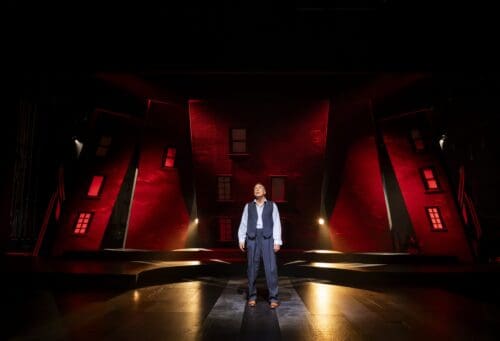
Geoff Elliott
Arthur Miller finished Act I of Death of a Salesman in a single day and the rest in six weeks, which tells you something about the pressure behind it. He had been watching his uncle Manny Newman for years, a salesman who lived on the installment plan in every sense: paying down a house he could not quite afford, financing two sons on dreams he could not quite deliver, borrowing against a future that kept receding. When Miller finally understood what he was looking at, what came out was not autobiography but argument: that a society which hands a man a dream on credit and forecloses it at sixty-three has produced the conditions for tragedy, and the man’s occupation does not change the moral calculus. American drama critic George Jean Nathan said it did. Tragedy, Nathan insisted, required stature, and a traveling salesman on commission had none. Nathan was wrong. The play ran 742 performances on Broadway, won the Pulitzer Prize for Drama, the Tony Award for Best Play, and the New York Drama Critics Circle Award in the same season, the first play to collect all three. That trifecta was the market pricing Nathan’s position correctly.

Kasey Mahaffy, Bert Emmett, Deborah Strang, David Kepner and Ian Littleworth
The play is seventy-seven years old. It still goes off. The question any production has to answer is not whether the thing works but how to get out of its way while it does, and at A Noise Within in Pasadena, where Julia Rodriguez-Elliott has staged it with a restraint that occasionally reads as severity, the answer is mostly correct. The scenic design by Frederica Nascimento places the action on a wide black stage backed by a skyline of Brooklyn tenement windows, their brick faces tilted just slightly, as though the whole built world is carrying more weight than its frame was rated for. Center stage: a wooden table, four chairs, and a Hastings refrigerator that has cost twenty-five years of mortgage payments and keeps breaking. Miller put that refrigerator in the script for a reason. It is the installment plan made visible, the thing you bought on credit that wears out before it is paid off, and Nascimento lets it sit there without comment, which is what good design does.
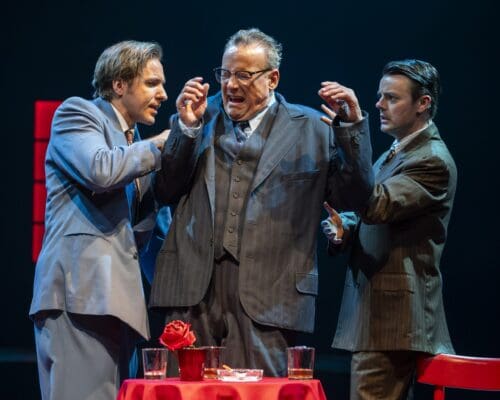
David Kepner, Geoff Elliott, Ian Littleworth
Miller wrote the past into the present tense and left the seam showing, and the staging here earns that coexistence rather than simply declaring it. The young Biff walks in because Willy needs him to. Ben materializes because Willy has a question thirty years old he still cannot phrase correctly. The woman from the Boston hotel room does not appear in the first act at all, but her absence is already bending the shape of every scene around it. Rodriguez-Elliott keeps the transitions unannounced: no blackout held a beat past its use, no musical cue that signals a memory before it lands. When this works—and it works often enough to matter—you stop tracking which decade you are in and start experiencing the play from inside Willy’s arithmetic, where the past is not then but now, running alongside the kitchen conversation at the same volume. The scenes where the staging earns this are the best the production has. There are enough of them.
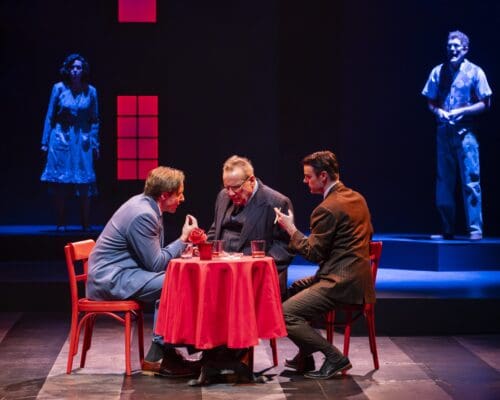
David Kepner. Geoff Elliott, Ian Littleworth, (back) Deborah Strang, Kasey Mahaffy
Geoff Elliott, who is also the company’s co-artistic director alongside Rodriguez-Elliott, plays Willy not as a small man but as a man who was once large and cannot stop acting like it. The distinction matters more than it sounds. The temptation after seventy-seven years of productions is to sentimentalize Willy into pathos and let the audience feel superior in its sympathy. Elliott refuses. His Willy still fills a room. He still has the salesman’s instinct to perform for whoever is watching, and when that instinct fires in a room where no one is buying—which is every room he enters now—the gap between the energy he generates and the response he gets becomes the play’s central wound. Watch him in the scene where he goes to Charley for money: he comes in with a joke, then another joke, adjusting, working the room out of sheer muscle memory, and what Elliott lets you see is not a man who has given up but a man whose entire professional equipment is still running full-throttle with nowhere to go. He has been paying into this identity for forty years. The company is no longer honoring the account.

Geoff Elliott and Deborah Strang
Deborah Strang’s Linda does not play long-suffering. She plays vigilant. The difference is everything. Too many productions bury Linda under her own forbearance, letting her function as the play’s emotional weather vane rather than its moral intelligence. Strang corrects this. Her “attention must be paid” speech arrives not as plea but as declaration from someone who has already paid more attention than she can afford and who is naming it now because she needs a witness. The precision in this performance is physical: the way she moves through the kitchen knowing exactly where Willy left things, the way she folds her stockings while his voice carries from the other room, the way she receives information she already has and registers it without surprise because she used up surprise years ago. What this Linda has never done is confuse seeing Willy clearly with approving of him. She sees him exactly because she loves him, and that lucidity is the performance’s quiet devastation.
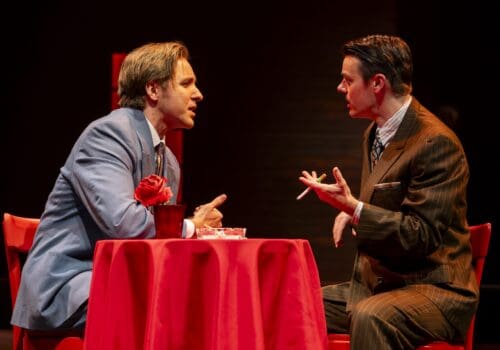
David Kepner and Ian Littleworth
Biff and Happy are where productions of this play typically go slack, reduced to one anguished son and one oblivious one. David Kepner as Biff refuses the character’s standard-issue righteousness. This is not a truth-teller standing in a family of liars. This is a man who grasped something true about himself and has been punishing everyone for it since, himself included. In the restaurant confrontation, usually staged as a showcase for Willy’s breakdown, Kepner shifts the weight: Biff is reaching for his father, actually reaching, and missing, and what reads on his face when he misses is not contempt but a grief he has no language for, because the Loman family never developed one. Willy reaches back and misses too. The gap between them is not absence of feeling but a surplus of it, too much heat and no shared vocabulary. I have seen this scene played as accusation, as collapse, as theater of guilt. Here it plays as two people genuinely trying and genuinely failing, which is the hardest version and the correct one. Ian Littleworth’s Happy is more difficult to assess. The buoyancy is right—Happy’s cheerfulness is self-preservation—but there are moments in the first act where the performance sits on the surface of that choice rather than inside it, giving us the result of Happy’s bargain without quite showing us the cost. The requiem redeems this: when he insists on carrying his father’s dream forward, the lightness cracks open into something that reads as orphan’s terror, and that is the right note to end on.

Kasey Mahaffy and Geoff Elliott
Bert Emmett’s Charley is the production’s most efficient rebuke: a man passionate about almost nothing who does very well financially, who lends Willy money every week with a steadiness that is its own indictment of what passion has cost the Lomans. Emmett drains any desire to be liked from the line readings, which is exactly right, because Charley has never confused likeability with solvency. Kasey Mahaffy’s Bernard moves cleanly from the school nerd Willy’s family mocks to the composed adult heading to argue before the Supreme Court; the arc lands because Mahaffy does not editorialize the distance between the two, just inhabits each age and lets the contrast do the work. Michael Uribes as Howard plays the firing with a flat administrative efficiency, a man not cruel enough to be a villain who fires Willy anyway, which is the worse thing. Ken Booth’s lighting marks the temporal shifts with a slightly warmer past without tipping into nostalgia. Robert Oriol’s original composition stays below the action, which keeps it honest.
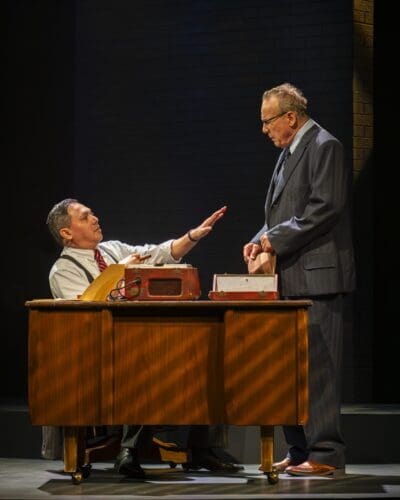
Michael Uribes and Geoff Elliott
Miller was accused of communism for writing this play. What he had actually done was more threatening than that: he described the transaction accurately. You sign on for the American dream the way you sign a mortgage, on faith, with payments due. The company takes possession of your working years and, when you are no longer useful, exercises its contractual right to foreclose. Willy named his boss’s son Howard. So what, Charley tells him; you can’t sell that. It is one of the most precise sentences in American drama, and Emmett delivers it here with the flatness of a man explaining arithmetic to someone who has been doing the math wrong for forty years. The play’s argument was never that capitalism is malicious. It is that capitalism is indifferent, and indifference at scale produces casualties who cannot identify the mechanism that caught them, which is a far more unsettling thing to sit with than villainy. Sixty-three is not old. It is simply past the point of return on investment, and in 1949 that was still a fact people found shocking. It is now policy.
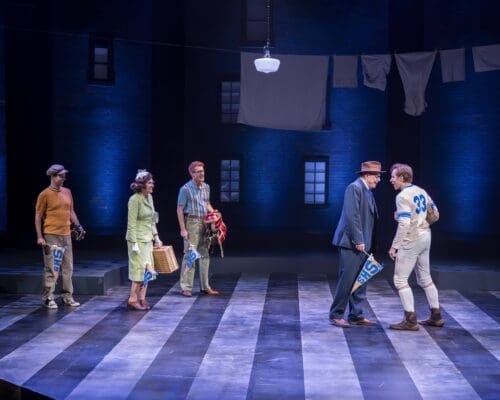
Ian Littleworth, Deborah Strang, Kasey Mahaffy, Geoff Elliott, David Kepner
The play was staged in Beijing in 1983, with Miller directing, and found its audience there immediately, attributed by the Chinese actors to the father-son material, which needed no translation. Miller had discovered something he did not expect: the dream sold on installment, the foreclosure at sixty-three, was the surface of the play, not its subject. Below it was something that belonged to any society that makes a man’s worth contingent on his output and then outlives his usefulness to it. Rodriguez-Elliott does not try to resolve that. Her staging refuses the easy release of sentiment: the requiem does not console, the funeral does not explain, and the play ends with the mortgage still on the house and Linda alone making the last payment on a debt that was never hers to carry. I left the theater with the particular discomfort of having watched something true. A Noise Within has spent years on the argument that classic texts speak to the present without being pointed at it, that Miller’s language is already doing the work if you leave it room. Death of a Salesman makes the case. The dream arrives on installment. The payments never stop. The thing you were promised is still depreciating in the driveway when they come to take the house, and there is no one to call about it, because the company does not have a complaints department. Willy Loman already knew that. We keep needing to be told.
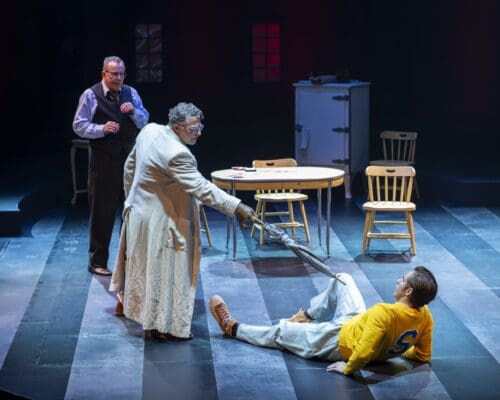
Geoff Elliott, David Nevell, David Kepner
✦ ✦ ✦ ✦ ✦ ✦ ✦ ✦ ✦ ✦
photos by Craig Schwartz
Death of a Salesman
A Noise Within
3352 E. Foothill Blvd., Pasadena
Thu & Fri at 7:30; Sat at 2 & 7:30; Sun at 2
ends on April 19, 2026
for tickets, visit A Noise Within
for more theater, visit Theatre in LA
✦ ✦ ✦ ✦ ✦ ✦ ✦ ✦ ✦ ✦
