


Areas We Cover
Categories

London Theatre Reviews: THE TEMPEST; SUMMERFOLK; LES LIAISONS DANGEREUSES (The Globe and National Theatre)
by Carol Rocamora | April 6, 2026
in International, Theater
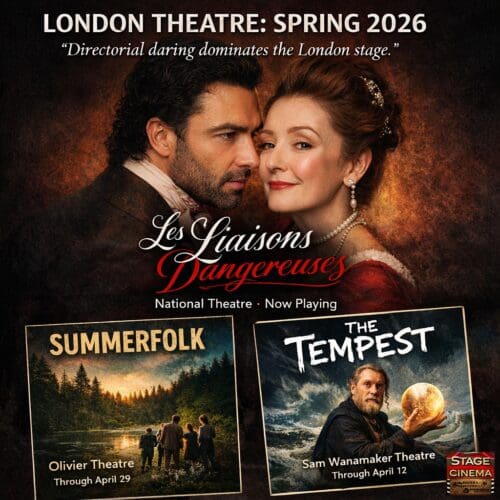
DIRECTORS TAKE CENTER STAGE
Bold vision and theatrical daring
define a revelatory London season
Directorial daring dominates the London stages this spring season, providing some of the most memorable moments in the theatre that I’ve witnessed in years.
Of the eight plays I saw in London last week, none were new. Yet, thanks to some stunning directorial vision, they are offering fresh, revelatory theatrical experiences to an eager and grateful audience.
Theatricality—sensational and mind-blowing—describes director Marianne Elliott’s lavish revival of Les Liaisons Dangereuses, Christopher Hampton’s brutal satire on the manners and morals (or lack thereof) of the French aristocracy, now playing at the National in the Lyttelton Theatre. The play, based on an infamous 1782 novel by Pierre Choderlos de Laclos, dramatizes a plot designed by two members of France’s high society in the late 18th century who use sexual intrigue and manipulation as weapons of power, revenge, and humiliation.
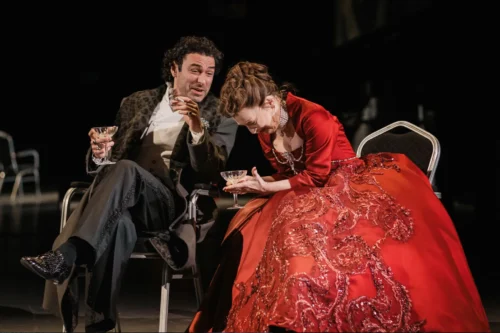
Aidan Turner and Lesley Manville in Les Liaisons Dangereuses (photo Sarah Lee)
Hampton’s long-admired adaptation has enjoyed numerous productions, awards, and revivals on both London and New York stages since it opened in 1985. (It has featured star performers over the decades like Lindsay Duncan, Alan Rickman, Glenn Close, and John Malkovich.) But now, in the hands of the masterful Elliott (of War Horse and The Curious Incident of the Dog in the Night-Time fame), it’s taken on a whole new theatrical persona. Elliott has come up with a dynamite dramatic idea—to frame the play in elaborate choreography, as if to provide the metaphor of society as a deadly dance of power and competition, with painful contemporary relevance.
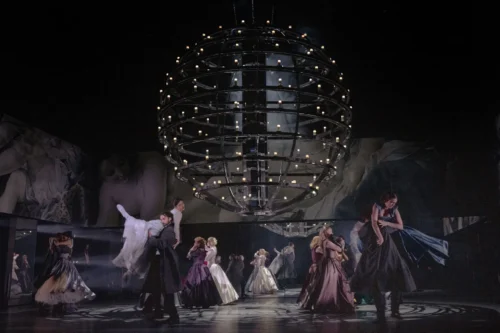
The ensemble of Les Liaisons Dangereuses (photo Sarah Lee)
This ground-breaking director has assembled a crackerjack cast to dance this cruel dance. It stars a formidable, power-playing pas de deux featuring the Marquise de Merteuil played by Lesley Manville (who appeared in the original production at the RSC in another role, forty years ago) and the Vicomte de Valmont played by Aidan Turner (of Poldark fame). Fueled by her revenge and his social ambitions, plus a shared love of predatory sport, they conspire for the Vicomte to seduce the pious Madame de Tourvel (Monica Barbaro) and Cecile de Volanges (Hannah van der Westhuysen), an innocent sixteen-year-old newcomer into their corrupt society.
What makes this production itself so seductive is its sensational theatricality. Rosanna Vise’s ravishing set is surrounded by erotic period paintings on three sides of the playing area, and a gigantic global chandelier that hangs over the spectacle (lighting by James Farncombe). An ensemble of silent, solemn servants in severe period uniform manipulates movable walls on wheels to create trysting places where Valmont can lure his prey. After each seduction scene, this imposing male ensemble breaks into dance (choreographed by Tom Jackson Greaves), joined by society women in stylish satins of the period (designed by Natalie Roar). Altogether, it’s an over-the-top spectacle.
As the sequences of seduction and dance unfold, they are reflected against a huge mirrored back wall stretching all the way across the stage. We in the audience see our own reflection in it, too. Intentionally, we’re made part of this decadent, destructive dance as well.
Although the cruel conspiring couple ultimately meet with an ignominious end, the dance still goes on. As an American watching this show in London, I was reminded of our own corrupt society and the Epstein scandal that is shaming our country today with the same destructive mix of power, manipulation, cruelty, and sex. Yes, indeed, the dance continues.
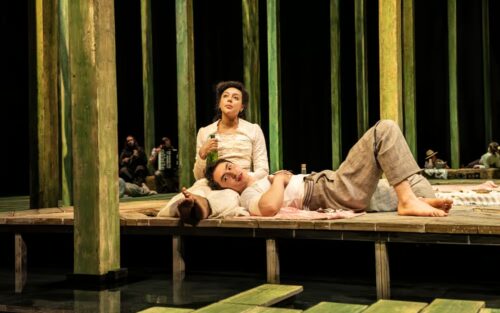
Adelle Leonce and Brandon Grace in Summerfolk (photo Johan Persson)
Also at the National Theatre, another daring director is filling the cavernous Olivier Theatre with a stunning dramatic vision. In this case, it’s of Summerfolk, Maxim Gorky’s rarely produced 1904 play about the privileged class in Russia passing an idyllic summer in the countryside, oblivious of the storm that’s gathering on their country’s historical horizon. To dramatize his vision of the play and its place in history, director Robert Hastie has assembled an enormous cast of two dozen actors in Act I, who—despite their number—seem small and insignificant in that vast Olivier space. Act One features the façade of a dacha owned by Varvara (Sophie Rundle), where this group has gathered to laze, laugh, and talk, talk, talk. Then comes the huge theatrical surprise. When the lights go up on Act II, the entire back wall of the Olivier Theatre’s huge thrust stage has vanished, and, in place of the dacha, a dense forest appears, so deep that it seems to go on forever, receding into darkness—like the unknown future looming ahead that will uproot centuries of Russian history and rock it to its core.
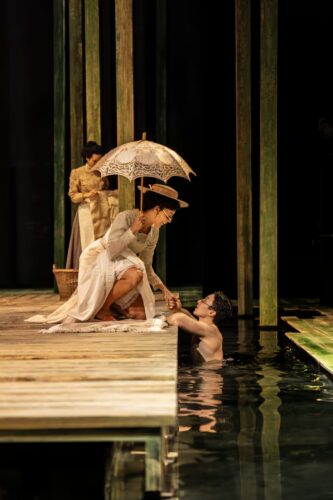
Rebecca Banatvala, Adelle Leonce, Brandon Grace in Summerfolk (photo Johan Persson)
This breathtaking theatrical surprise, thanks to the vision of director Hastie and his designer Peter McKintosh, gives crucial depth to Gorky’s endlessly talky satire featuring the oblivious Russian privileged class on the eve of enormous social and political change. To add to this vision, a real lake has been miraculously installed downstage (in which actors are bathing), reflecting the fathomless period of history into which these unsuspecting characters are about to plunge.
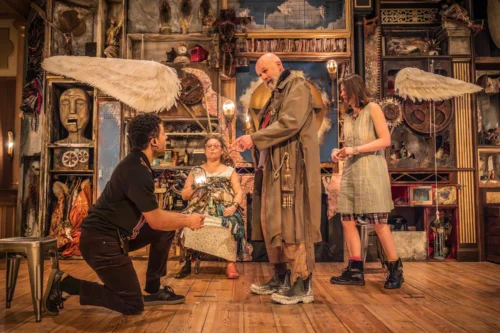
Tim Crouch and ensemble of The Tempest (photo by Marc Brenner)
Nearby at the Globe Theatre, director Tim Crouch is presenting his own radical dramatic vision of William Shakespeare’s The Tempest, in which he himself plays the leading character of Prospero the magician. As director, Crouch works his own “rough magic” (as Shakespeare calls it), turning the entire tiny, intimate Sam Wanamaker Theatre into his island where the play takes place. He divides the original text among his cast (Miranda, Ariel, Caliban) so that they all become narrators of the story. Moreover, he places other cast members in the audience itself, so that they are constantly climbing over spectators’ laps to get on stage (“Pardon me, madam, so sorry” becomes a new line in Crouch’s adaptation). The result: a Tempest that stirs up a storm—as its title suggests—of surprise, laughter, and audience participation, as we become part of the cast ourselves—thus providing a new and magical experience with this four-hundred-year-old play.
“We are the stuff that dreams are made of,” Prospero reminds us. When directors dare to dream big, as they are doing in London theatre this spring, the results are rich, revelatory… and magical.
✦ ✦ ✦ ✦ ✦ ✦ ✦ ✦ ✦ ✦
Les Liaisons Dangereuses
National Theatre, Lyttelton Theatre, London
ends on 6 June, 2026
Summerfolk
National Theatre, Olivier Theatre, London
ends on 29 April, 2026
The Tempest
Sam Wanamaker Theatre, Shakespeare’s Globe, London
ends on 12 April, 2026
✦ ✦ ✦ ✦ ✦ ✦ ✦ ✦ ✦ ✦