


Areas We Cover
Categories

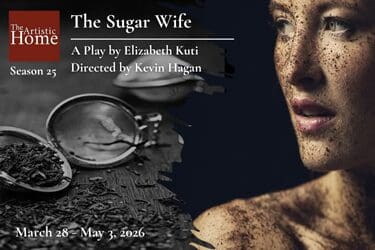
Theater Review: THE SUGAR WIFE (The Artistic Home at Theater Wit, Chicago)
by C.J. Fernandes | April 6, 2026
in Chicago, Theater
THIS SLOW-BURNING, DEVASTATING
DRAMA REFUSES EASY ANSWERS
The Sugar Wife is a gripping and complex examination of
morality and the individual’s responsibility towards society
The Sugar Wife is set in Ireland in 1850. That year is very important; the middle-class and poor were right in the midst of the Great Famine, while across the Atlantic, the Emancipation Proclamation was more than a decade away. In a mansion in Dublin, Hannah, the wife of tea and sugar merchant Samuel Tewkley, is making preparations to visit the destitute in hospitals and asylums. She and her husband are Quakers, and their religion demands from them service to the less fortunate. Having rid her mansion of opulence and aids to vanity, Hannah’s devotion to good works is the single most important part of her life: more important than her husband and more important than having children—they’ve been trying to conceive unsuccessfully for a decade, and while Samuel is still eager, Hannah withdraws more and more from the idea of having children and the act of conception itself. Samuel, an affable businessman, too busy to work alongside Hannah, compensates by being a philanthropist—an exceedingly generous one at that. Hannah keeps herself occupied with her good deeds. As a couple, they seem to have arrived at a steady state.
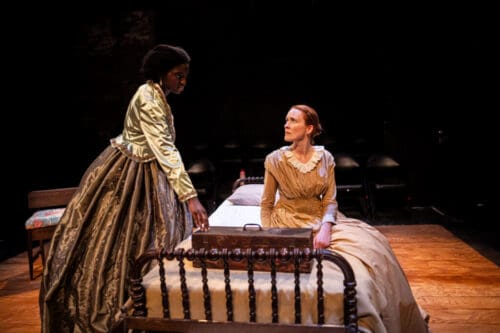
Ashayla Calvin and Annie Hogan
Into this delicate arrangement come Alfred Darby and Sarah Worth. Alfred is an industry scion from England who renounced his family fortune to travel with Sarah. Sarah Worth is a former slave from Georgia, who was purchased by Alfred and then released, making her a free woman. Now, with Alfred by her side, she travels the world, giving lectures about the practices of slavery. The Quakers, who were abolitionists since well before it was fashionable, have invited her to Dublin to give a series of lectures. Her hosts for 10 weeks: Hannah and Samuel Tewkley.
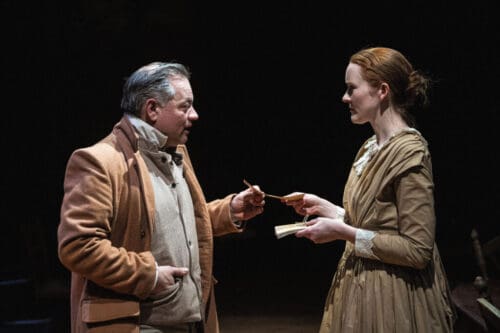
Todd Wojcik and Annie Hogan
Elizabeth Kuti’s The Sugar Wife premiered in Dublin in 2005 to considerable acclaim (and rightly so). The Artistic Home’s American premiere of the play at Theater Wit closes out their 25th season and comes with a murderer’s row of talent, both on stage and behind the scenes. Not content with taking on directorial duties, Kevin Hagan also serves as set designer; his set is appropriately austere, featuring beds at either end of the long space—one in a hospital, the other a guest room—and a large dining table at the center. Perpendicular to the main space is an enormous secretary and buffet that serves as Samuel’s office, across from which is a podium from where Sarah delivers a lecture. Seen from above, the set would resemble a cross. I’m not sure if that is intentional, but it is certainly apropos to the proceedings. When not performing, the actors sit among the audience, occasionally delivering dialogue from their seats, separated—always separated—by a vast space. Rarely have I seen distance used so well in a show. Late in the play, there is a moment when Sarah silently takes a step closer to Hannah while she’s confronting Alfred; the sense of solidarity was so overwhelming that I muffled a gasp at the beauty of the frame. No words could convey that, and crucially, it would not have worked without the work done by the cast and crew over the two hours prior.
Annie Hogan
This is a slow burn of a play, but it’s never less than completely absorbing, even as it builds to a gripping and devastating denouement. Ellie Fey’s lighting design frequently isolates the characters from each other, further deepening the chasms that separate them. And Petter Wahlbäck’s sound design is incredible, particularly during Sarah’s monologues, making them almost unbearable to hear.
A minor quibble: because the audience surrounds the actors, you are frequently in a position where one of the actors in a scene is obscured from you. This didn’t bother me too much because my favorite performance in the play came from an actor that faced me for the most part, but had I been seated across the way, I suspect I would have been a little annoyed.
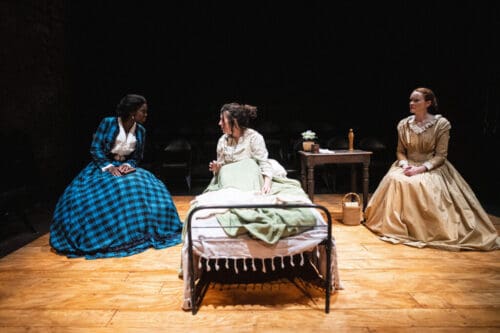
Ashayla Calvin, Kristin Collins and Annie Hogan
Back to the good stuff: oof, this cast! Annie Hogan (Hannah) and Ashayla Calvin (Sarah) are exquisite, in very different ways. Hogan has the more obviously demanding part: Hannah’s rigidity on the subject of morals and duties springs less from her religion than from the fact that she severely compromised on her beliefs when she married Samuel. Hogan is remarkable at letting us see the conflict within Hannah even as her behavior is proper to a fault, and when she lets loose, it’s a joy to watch. Sarah Worth is a tricky part: her rigidity is all about control, and Calvin gives a nuanced performance that only reveals its power in the final portion of the play. Her monologues are spectacularly delivered, and sitting right next to her podium, they unnerved me in ways I cannot articulate. Alfred Darby is the most conventionally constructed of the four characters: the flamethrower, or the agent of chaos. As played by John LaFlamboy, Alfred is a figure of lapsed entitlement, a man unredeemably damaged by his past, and on a lifelong journey of course-correction for the sins of his fathers, which he will never accomplish.
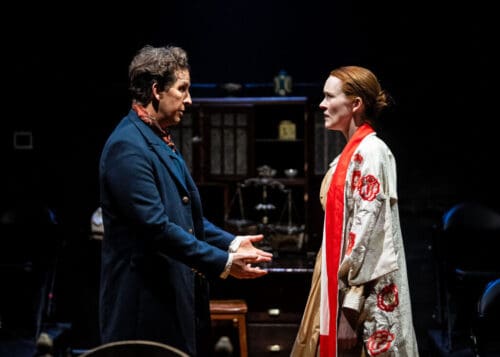
John LaFlamboy and Annie Hogan
My favorite performance came from Todd Wojcik as Samuel Tewkley. Samuel is the least civic-minded of the four characters, but he’s also the most optimistic and curious. Most of the tension in The Sugar Wife comes from one of Samuel’s actions—a morally reprehensible one by any metric—but unlike the other characters, Samuel has not only made his peace with it, he’s convinced himself that it was the right decision, and there is a queasy undercurrent to the text that doesn’t entirely dismiss that possibility. As Hannah and Alfred increasingly yield to self-torment, and Sarah erects a protective barrier between herself and the world, Samuel goes about his life with a practicality that enables him to put aside his personal misery and be a force of good in his small sphere of influence. And yet, this is only possible because of his egregious business practices. Wojcik is just marvelous here, giving a performance that’s as open and guileless as the others are withdrawn. Samuel believes he is a fundamentally decent person, and he just might be, but how can we reconcile this with what we know of his past? How can a person who is blithely unconcerned about his sins and privilege do more good than people who subject themselves and their actions to rigorous self-examination? And is there an unseemly element of narcissism in their self-flagellation?
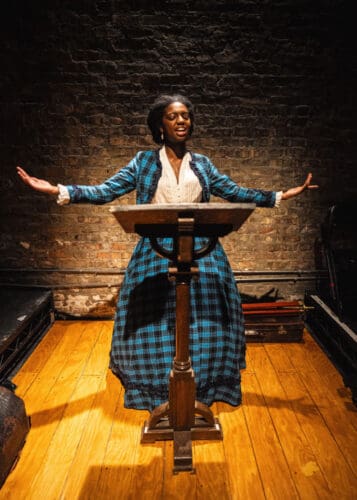
Ashayla Calvin
The genius of this play and production is that it refuses to provide any clarity; indeed, it willfully denies us catharsis. Sarah Worth and Alfred leave the Tewkleys as they came in, entirely unchanged. Samuel and Hannah, who began the play in a quiet if unremarkable equilibrium, end it in another sort of stasis; this one offers a smidgen of hope, but as the lights narrowed to a devastating final spot at the end of the space, I found myself focusing on Samuel’s face in the shadows, looking for a trace of optimism there but seeing only uncertainty, as the room faded to black.
✦ ✦ ✦ ✦ ✦ ✦ ✦ ✦ ✦ ✦
photos by Joe Mazza, Brave Lux Photography
The Sugar Wife
The Artistic Home at Theater Wit
1229 W. Belmont Ave., Chicago
Thu–Sat at 7:30; Sun at 3
three hours with intermission
ends on May 3, 2026
for tickets ($15-$35), visit The Artistic Home or Theater Wit
✦ ✦ ✦ ✦ ✦ ✦ ✦ ✦ ✦ ✦
