


Areas We Cover
Categories

4 DESIGN TRICKS FOR THEATER COSTUMES
4 Practical Costume
Tips for Period Theater
Creating stunning period theater costumes relies on four key strategies. These include adapting historical silhouettes with modern materials, designing for back row legibility, prioritizing performer mobility, and using layered garments to communicate character arcs.
These deliberate costume choices allow directors and designers to establish immediate psychological portraits and societal hierarchies before dialogue begins.
By treating historical apparel as a visual vocabulary rather than a rigid constraint, productions achieve powerful storytelling with elegant efficiency.
Consider the moment a king enters the stage in a medieval drama wearing full plate armor, but something is distinctly wrong.
The shoulder pauldrons sit awkwardly, and the muddied surcoat beneath reveals a dented helmet visor.
He has not spoken a word, yet the audience understands this man holds power he cannot quite carry. This is the promise of theatrical visual storytelling done well.
1. Let History Inspire the Stage
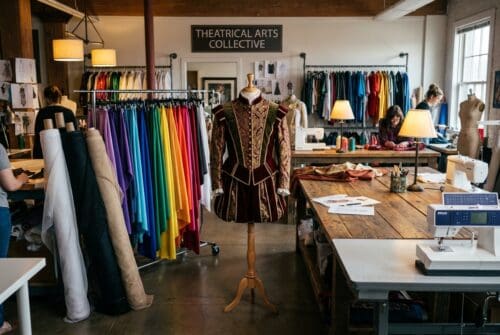
There is a persistent myth in historical costume design that accuracy and stage functionality directly conflict. In practice, the relationship is much more useful than a strict binary choice.
History is not a rigid rulebook for costume creators to follow blindly. Instead, it serves as a robust visual vocabulary for designers.
Period costume interpretation always begins with thorough research. The silhouette of a Tudor doublet or the structure of a medieval kirtle encodes vital information about class and labor.
However, authentic historical construction often fights the modern stage environment. Original garments feature heavy materials that do not breathe under high-wattage theatrical lighting.
The solution that working designers consistently return to is the silhouette framework approach. This method preserves the historical outline while substituting modern performance-grade materials beneath.
To implement this efficiently, costume departments often look to specialized suppliers to build out their period vocabulary.
Utilizing accessible resources for pieces like versatile medieval armor from Medieval Collectibles allows a production to secure authentic visual foundations easily.
Historical accuracy serves a meaning rather than dictating the entire process. If a specific period detail reinforces character psychology, designers will fight to keep it.
If a heavy fabric fights the performance, they cut it without guilt. The stage always remains the final arbiter of what works.
| Pro Tip: Prioritize the silhouette over historical accuracy for period pieces. Using modern, breathable fabrics under an authentic outline ensures the audience sees the era while performers remain comfortable and focused. |
2. Design for the Back Row
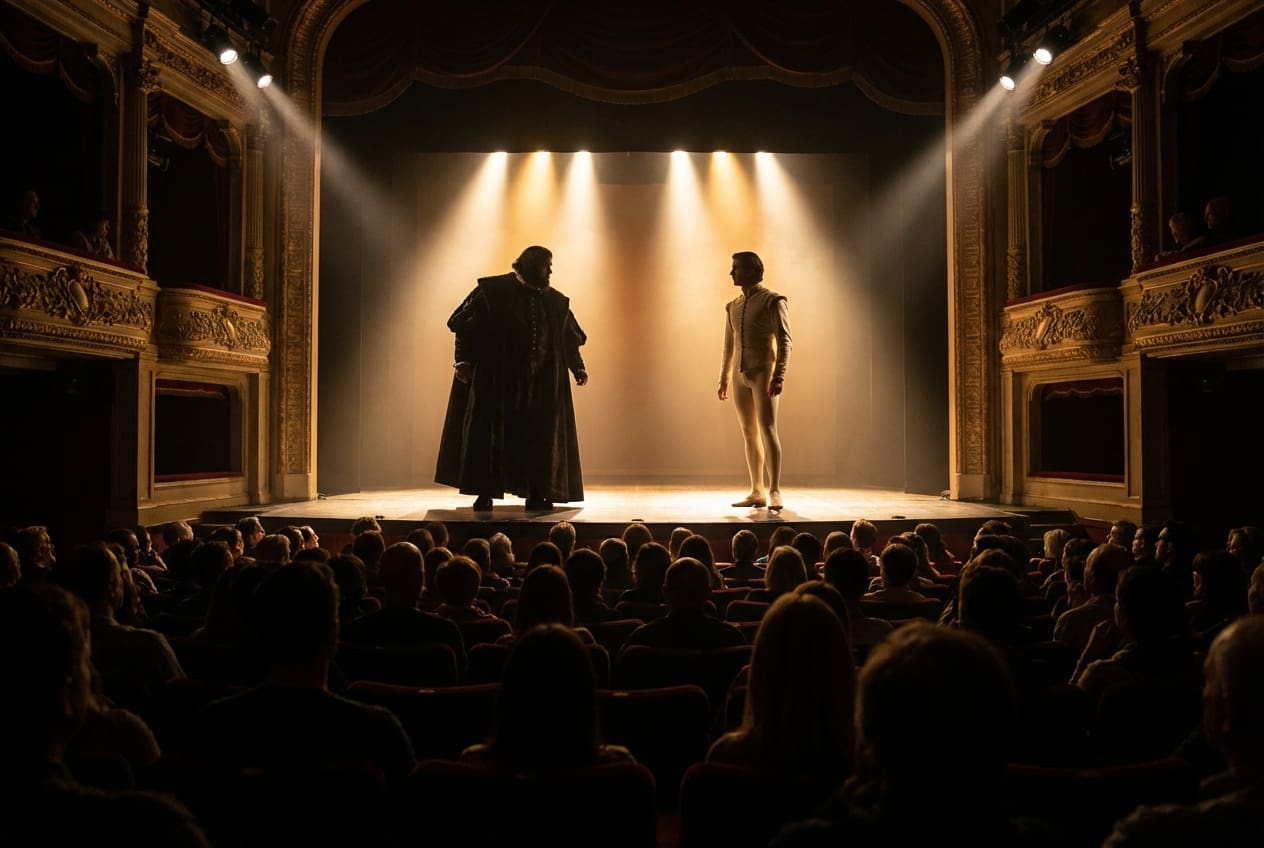
Live performance carries the uncomfortable reality that nuanced facial expressions disappear around row ten of a proscenium house. Beyond that physical threshold, the audience primarily reads shape and movement.
Silhouette becomes the first and most durable unit of theatrical communication. Proportion and tonal contrast carry the dramaturgical argument that dialogue will later articulate.
A lord’s sweeping surcoat against a peasant’s close-fitting layers communicates hierarchy before anyone opens their mouth.
This is why Shakespearean costuming has historically relied on exaggerated silhouettes as a storytelling shorthand.
When subtle nuance cannot travel, designers must aim for immediate visual legibility. Every garment must establish its purpose clearly from a distance.
Color blocking functions as dramaturgical shorthand in precisely this highly visible way. Strong shapes and deliberate restrictions of the palette force visual clarity onto the stage.
Every design choice must justify itself against a ruthlessly simplified visual field. A useful technique is viewing the costumed performer under a stage light from the back of the house.
If the character’s social position and psychological state are not immediately legible, the design needs more work.
Every element on stage actively competes for the audience’s attention. A well-designed costume wins that competition by making its argument incredibly clear. The audience should simply understand the character instantly.
3. Mobility Dictates Strong Stage Performances
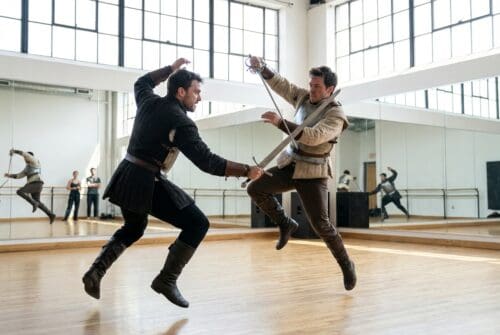
A historically stunning costume that restricts an actor’s instrument is simply a trap. This truth becomes especially sharp in productions featuring sword combat or extended choreography.
Fight directors, movement coaches, and costume designers must function as a unified creative unit. When collaborations break down, it usually shows up as compromised physicality.
Poor movement design leads to action that is entirely too careful. A combat sequence will lack commitment because the performer cannot fully lean into the action safely.
Stage armor presents a specific set of physical challenges that deserve direct attention. Weight distribution in a poorly fitted breastplate will throw a performer’s center of gravity forward.
This awkward balance subtly alters stage presence and exhausts core muscles. Restricted shoulder rotation makes choreographed sword work incredibly dangerous.
Helmet visibility issues can sever spatial awareness on a stage populated with other bodies. Performers need full mobility to safely navigate complex stage setups.
The practical solution is full movement rehearsals in costume, scheduled well before tech week. A performer should draw a sword, fall to the floor, and embrace another character while being fitted.
Measuring someone while they simply stand still is never enough. Mobility-conscious costuming is the condition under which the garment actually performs its dramaturgical function.
| Important: Never assume a costume fits until the performer completes a full movement rehearsal. If a piece restricts sight or range of motion, it compromises both the actor’s safety and the performance’s impact. |
4. Armor and Layers Speak Silently
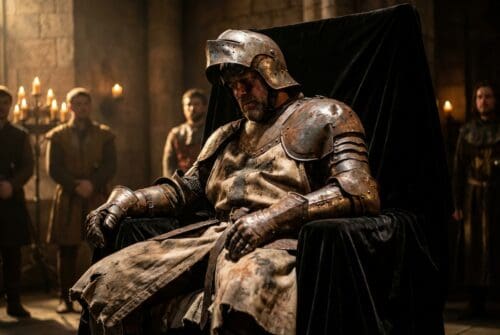
Armor may be the most semantically loaded tool in a costume designer’s kit. It speaks instantly to martial authority, institutional power, and vulnerability masked as strength.
The metal shell highlights the tragic gap between a figure’s aspirations and their actual condition. Layered garments encode character arcs with an efficiency that dialogue simply cannot match.
Consider what an ill-fitting chest piece communicates in the final acts of a tragedy. The armor does not confer authority, but rather reveals the desperation of the attempt.
A lord’s armor, famously donned too late and worn without conviction, shows hollow military authority. These visual cues establish the psychological stakes of the performance.
The number of visible layers strongly communicates class and social standing. A garment’s state of repair tells the audience everything about a character’s actual circumstances.
A deliberate act of removing protective gear mid-play can function as a massive visual turning point. These acts carry the same dramaturgical weight as a major monologue.
Every acquisition and construction decision must be driven by strict thematic intention. The main question is never simply what a particular piece looks like.
Designers must consider what it means for a specific character at a specific moment. Layered pieces are powerful arguments about power, conflict, and fate.
The Bottom Line
Return to the opening image of the king in a battered plate standing at the threshold. Nothing about that striking theatrical image was an accident.
The misaligned pauldron, muddied hem, and dented visor were all deliberate design choices. Each strategy explored here contributed to making that single entrance carry an entire character arc.
Effective period theater costumes operate as vital acts of communication. Historical detail serves meaning, silhouette serves clarity, and construction serves performance.
These are not competing values, but rather a single integrated framework for the stage. When a production aligns them fully, audiences effortlessly understand the character before a word is spoken.
| Author Profile: Medieval Collectibles is the leading online retailer of authentic medieval replicas and fantasy collectibles for history enthusiasts, reenactors, and collectors worldwide. |
