


Areas We Cover
Categories

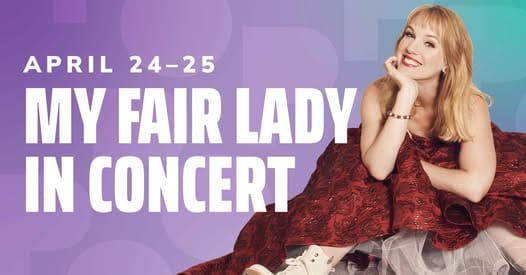
Theater & Concert Preview: MY FAIR LADY IN CONCERT (Pacific Symphony in Costa Mesa)
by Michael M. Landman-Karny | April 9, 2026
in Concerts / Events, Los Angeles, Theater
THE RAIN IN SPAIN, UNRESTRAINED
At full symphonic scale, My Fair Lady finally
sounds the way it was written to be heard
George Bernard Shaw got what he deserved. He spent decades refusing to let anyone set Pygmalion to music, having been burned once already by an operetta adaptation of Arms and the Man that he considered a desecration. When he finally died in 1950, the rights cleared, and Lerner and Loewe also did what Shaw had blocked for years: they found the musical that was always latent in the material. The resulting My Fair Lady ran for 2,717 performances, put the cast recording on the Billboard charts for 480 weeks, and turned the play Shaw was most protective of into the thing he is now most remembered for. In addition, Shaw’s argument against sentimental endings lost.
Pacific Symphony Pops brings My Fair Lady In Concert to the Renée and Henry Segerstrom Concert Hall on April 24-25, 2026, with Broadway soprano Analisa Leaming as Eliza Doolittle and Trevor Martin as Henry Higgins. Supporting characters will be played by Evan Bertram, Jackson Hurt, Michele McConnel and Martin Fisher. Principal Pops Conductor Enrico Lopez-Yañez oversees the series; Adam Turner conducts.

Rodgers and Hammerstein attempted to adapt Pygmalion it as a musical, but abandoned the project as unadaptable; they felt that Shaw’s style of writing intellectual dialog and the emotionless character of Henry Higgins did not lend themselves to a musical. Lerner and Lowe overcame these problems by leaving Shaw’s dialogue largely intact, and working under the notion that Higgins must be played by a great actor, not a great singer. Thus, they wrote the role especially for Rex Harrison, and adopted the idea that Higgins should not sing outright, but talk on pitch, less an expression of emotions than ideas. (R&H later advised a young Julie Andrews to take the role of Eliza Doolittle if it was offered to her.)
The collaboration between Lerner and Loewe was contentious and unrepeatable, and you can hear both facts in the finished work. Lerner brought literate, character-focused American book-writing; Loewe, Vienna-trained and steeped in operetta, supplied harmonic sophistication that kept the score from sliding into mere charm. The show opened at the Mark Hellinger Theatre on March 15, 1956, directed by Moss Hart, who reportedly agreed to take the job after hearing only two songs. Rex Harrison’s Henry Higgins was the central performance problem: a man who spoke-sang his way through the score in a mode that had no real precedent. Orchestrator Philip Lang developed techniques to let the melody ride clearly above the orchestra without overwhelming Harrison’s pitched patter, an approach that shaped everything about how the score sits in a room. Harrison was so unnerved by the live orchestra at the first preview that he locked himself in his dressing room and refused to go on. He came out less than an hour before curtain. The show ran six years.

“Rain in Spain” – Original full sheet musical score for My Fair Lady (Library of Congress)
The original orchestrations, shared between Lang and Robert Russell Bennett, are the production’s least-discussed asset and arguably its most durable one. Bennett had scored Oklahoma!, South Pacific, and The King and I before arriving here; Lang would go on to Hello, Dolly! and Mame. The strings in “I Could Have Danced All Night” don’t merely accompany, they pressurize. The brass writing in “Get Me to the Church on Time” hits with a weight a reduced Broadway pit cannot replicate. Bennett and Lang built a score calibrated for expansion, and at full symphonic strength the difference is not subtle. The orchestrations function almost as a character in their own right. Put a full symphony onstage and what was always structural becomes visible.
This matters more than it once did. Broadway pit orchestras have been shrinking for decades, replaced incrementally by keyboard synthesizers programmed to approximate what live players used to do. The 2018 Lincoln Center revival restored the original Bennett-Lang arrangements with a 29-piece orchestra and reminded audiences how much had been quietly lost. What Pacific Symphony offers on April 24th and 25th is something rarer still: these orchestrations played at full symphonic scale, in a hall acoustically built to let them expand, with no approximations and no shortcuts. The overture alone, at full strength in the Segerstrom, will tell you something about what Loewe actually wrote that no Broadway pit of the last thirty years has been able to say. That is not a small thing.

Conductor Adam Turner
Loewe’s harmonic language repays the attention. “I’ve Grown Accustomed to Her Face” is not a showtune: it traces Higgins’s self-deception in real time through a melodic line that refuses to resolve where comfort would expect it to. The orchestration holds its breath accordingly. Against that, “A Little Bit of Luck” is pure comic machinery, the Viennese operetta tradition weaponized for Cockney vaudeville. The distance between those two numbers is not a stylistic inconsistency. It is the score’s whole argument about what Vienna and London, refinement and vulgarity, actually share.
Analisa Leaming brings a resume that spans Broadway (The King and I, Hello Dolly!, School of Rock) and operatic platforms including the Kurt Weill Festival in Germany, where she performed with the Deutsche Staatsphilharmonie Rheinland-Pfalz. The Kurt Weill Festival engagement is the relevant credential here: a composer whose vocal writing lives exactly at the border between speech and song is the right preparation for a role that asks a singer to make that border disappear.
Shaw lost the argument. At Segerstrom, you will hear exactly why he was wrong.
✦ ✦ ✦ ✦ ✦ ✦ ✦ ✦ ✦ ✦
My Fair Lady In Concert
Pacific Symphony’s Pops Series and UIA
in partnership with Black Tie Broadway
Renée and Henry Segerstrom Concert Hall, Costa Mesa
April 24 and 25, 2006 at 8
for tickets (from $50), call 714.755.5799 or visit Pacific Symphony
✦ ✦ ✦ ✦ ✦ ✦ ✦ ✦ ✦ ✦
