


Areas We Cover
Categories

Dance Review: SYLVIA (American Ballet Theatre at Segerstrom Center)
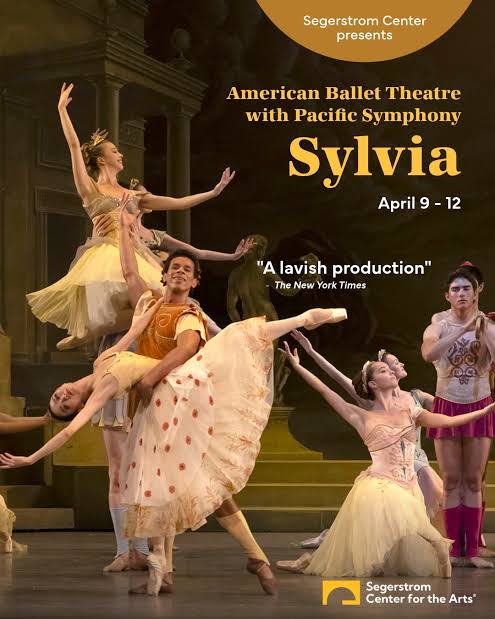
by Michael M. Landman-Karny | April 11, 2026
in Dance, Los Angeles, Regional, Tours
DELIBES TAKES THE LEAD
In ABT’s return of Ashton’s Sylvia, the best
performance at Segerstrom wasn’t onstage

Léa Fleytoux and Tyler Maloney
Frederic Ashton’s Sylvia arrives at Segerstrom Center for the Arts after nine years away from American Ballet Theatre’s repertory, with the Pacific Symphony in the pit. Start there. Ormsby Wilkins conducted, and he set the terms of the evening before a dancer crossed the stage. The strings in the Act I prelude were not warming up, they were establishing authority. When Léo Delibes is played with that kind of precision, the hierarchy shifts. The dancing remains. It simply stops being the main event.
The ballet itself dates to 1876, when it premiered at the Palais Garnier with choreography by Louis Mérante. The production faded quickly. The score did not. Writing after hearing Sylvia in Vienna, Pyotr Ilyich Tchaikovsky called it the first ballet in which the music was not merely principal but decisive, then added that, had he known it earlier, he might never have written Swan Lake. The remark has lingered because it feels true. Delibes does not decorate the stage. He organizes it. The motifs track character and momentum with unusual clarity, and the orchestration is not background but argument.

Takumi Miyake and Chloe Misseldine
Ashton came to the score decades later and treated it accordingly. His 1952 version for the Royal Opera House, as a vehicle for Margot Fonteyn, follows the outline of the original but tightens its focus, pushing the ballet toward movement rather than myth. What survives now is not a continuous tradition but a reconstruction, assembled from fragmentary record and memory. The ballet carries that history lightly, but it carries it.
The story is, to be direct about it, ridiculous. Eros presides over a forest clearing while his statue stands nearby in nothing but a well-placed leaf. Aminta, a shepherd with voyeuristic instincts, hears Sylvia and her brigade approaching and removes his clothes before hiding in the bushes. No explanation is offered. It is simply the logic of this world, and the ballet declines to justify it.

Reece Clarke as Aminta
Sylvia enters leading her huntresses across a bridge overhead, bows drawn, legs cutting through the air in grand jetés that establish the tone of Act I: speed, disdain—and pleasure in both. Aminta reappears, inexplicably clothed again, declares his love, and is ignored in favor of a shot at Eros’s statue. He steps in front of the arrow and dies. Eros animates, shoots Sylvia, and returns to stone. Sylvia survives, removes the arrow, and decides she is in love. The plot proceeds by momentum rather than logic.
Orion, who has observed all of this from above, kidnaps Sylvia and installs her in his cave, a setting that leans unapologetically toward Le Corsaire: torches, minions, rejected offerings. Sylvia adapts quickly. She returns in reduced costume, dances him into submission, steals back the arrow, and calls for rescue. Eros arrives in a boat that seems to have drifted in from Sleeping Beauty. They depart through the foliage.

American Ballet Theatre’s Sylvia (Photo by Rosalie O’Connor)
Act III restores order through Bacchic celebration, interrupted by Orion’s return and final failure. Diana intervenes, elevates him to a constellation, briefly blocks the marriage, then relents. The ballet ends as these things tend to end, with collective approval and little interest in how it was earned.
Strip away the mythology and what remains is a study in love as force rather than feeling. Violence fails. Precision succeeds. And in a quiet inversion of Sleeping Beauty, it is the woman who carries the narrative weight while the man waits to be located. Sylvia is the engine. Everything else orbits.

Chloe Misseldine as Sylvia
On opening night, Chloe Misseldine as Sylvia makes that imbalance visible from the outset. She enters and throws her horn into the wings with force, and from that point forward the performance is driven at full tilt. She pushes everything, including the moments that resist being pushed. A stuttering step meant to suggest vulnerability is taken past refinement into something closer to exposure. Sometimes it holds. Sometimes it frays. The risk is the point. The classical passages are bright and quick, but the emotional ones do not fully settle. They pass through her rather than transform her. What remains is not a complete Sylvia, but a volatile one, and the volatility has its own pull.
Calvin Royal III does more for Aminta than the ballet is designed to allow. The role is written as a function, not a character, and it usually stays that way. Royal resists the flattening. His phrasing is unforced, his line unhurried, and for once the shepherd reads as someone who exists outside the mechanics of the plot. His Act I solo, often a placeholder, becomes the only moment in the ballet where stillness carries weight.

Catherine Hurlin as Sylvia and Calvin Royal III as Aminta
Cory Stearns avoids the obvious trap in Orion, which is to lean into spectacle. The power is there, but it is shaped rather than displayed. He treats the character less as a brute than as a man accustomed to control and briefly unsettled when it slips. That reading is more interesting than the usual caricature, and it registers.
Carlos Gonzalez, a suitably buff Eros, makes the smartest choice available to him. He dances the role straight. The temptation is to decorate it. He refuses. The footwork is exact, the musicality aligned with the score, and he never asks the audience to like him. In a ballet that tends toward excess, that restraint becomes structural. It holds the proportions together.

Carlos Gonzalez as Eros
I have seen Ashton’s Sylvia before, and my position has not changed. It is too fussy, too mannered, too caught between styles to sit comfortably in the repertory. It is not Swan Lake, and it does not pretend to be, but it has not found a stable alternative identity. The nine-year gap between revivals feels less like neglect than an admission. ABT keeps bringing it back because it wants the ballet to belong. The ballet keeps resisting the invitation.
And yet something has shifted in this revival. The absurdity is no longer managed. It is allowed. The ballet breathes for it.
The problem remains one of texture. Ashton’s wit is so consistent that over three acts it flattens into a single tone. The Act III pizzicato solo lands because it breaks that pattern, meeting Delibes at full force. The comic duet for Orion’s minions works for the same reason. But these are exceptions. The choreography is always intelligent. It is not always enough.
One moment in Act III, before Sylvia enters, gathers real pressure: the corps advancing in rhythm, the orchestra shifting into a barcarole, the stage filling before anything has happened. It is a small sequence, and it does more than most of what surrounds it. It works because Wilkins lets it breathe, pulling back just enough that when the phrase resolves, the room feels it.
The score is the reason to go. Léo Delibes did not write accompaniment. He wrote propulsion. The music does not follow the stage. It drives it. Wilkins knows this, and on Thursday night he conducted accordingly. The pit did not support the evening. It owned it.

✦ ✦ ✦ ✦ ✦ ✦ ✦ ✦ ✦ ✦
unless indicated, photos by Nir Arieli
Sylvia
American Ballet Theatre
Segerstrom Center for the Arts
600 Town Center Drive, Costa Mesa
ends on April 12, 2026
for tickets, call 714.556.2787 or visit scfta.org
✦ ✦ ✦ ✦ ✦ ✦ ✦ ✦ ✦ ✦
