


Areas We Cover
Categories

Film Review: GUNFIGHTER PARADISE (Written and Directed by Jethro Waters)
by C.J. Fernandes | April 13, 2026
in Film
SOUTHERN GOTHIC,
STRANGE AND STICKY
A surreal indie that doesn’t quite
hold together—but lingers anyway
★★½☆☆

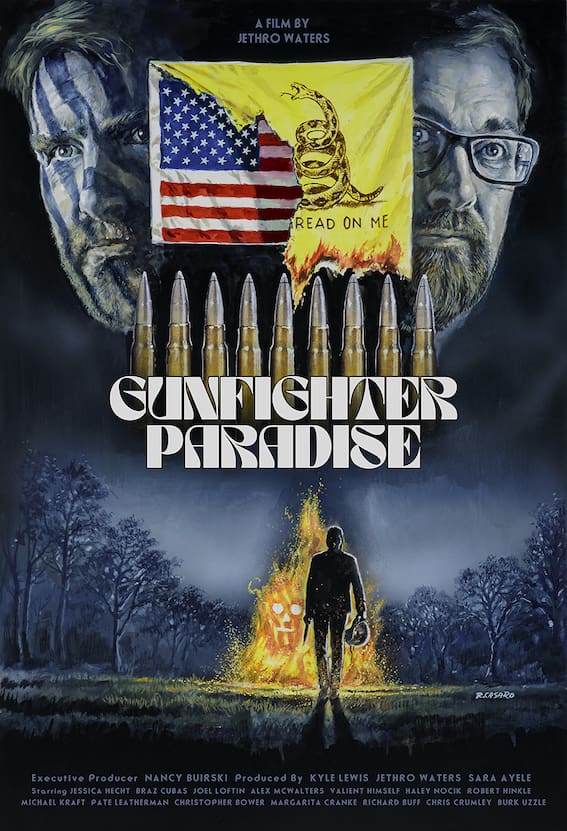
Gunfighter Paradise, the narrative feature debut of Jethro Waters, is a surreal little film, strangely beguiling almost in spite of itself. Waters, who won a regional Emmy for his documentary F11 and Be There, has crafted a sort of satire, sort of Western, sort of gothic, and sort of thriller that never quite settles down, but is no less absorbing for that.

Strongly influenced by the films of the Coen Brothers—particularly No Country for Old Men and Blood Simple—the movie opens with a portentous voiceover talking about God and the Southern way of life, accompanied by an arresting credits sequence detailing the manufacture of homemade bullets. Our speaker is a camo-painted shooting instructor who goes by the name Stoner. Stoner is walking home to North Carolina carrying a green suitcase, the contents of which are eventually revealed. Rattled by the death of his mother (Jessica Hecht, present here in voice only), he moves into his childhood home. What follows is a series of events where, in between hallucinations in which he hears the voice of God, he is visited by an assortment of oddballs, each one a Southern cliché; all the while, a surprisingly dapper killer makes his way toward Stoner and his homestead.

Gunfighter Paradise is a true labor of love: in addition to directing duties, Waters also wrote the script, served as his own DP, produced, scored, and edited the film—and I’m almost certain that that’s him playing the lead role under the stage name Braz Cubas. This DIY ethos extends to multiple people on the crew, most of whom wear multiple hats, including Joel Loftin, who turns in a naturalistic, low-key performance as a utility tech who becomes Stoner’s only friend.
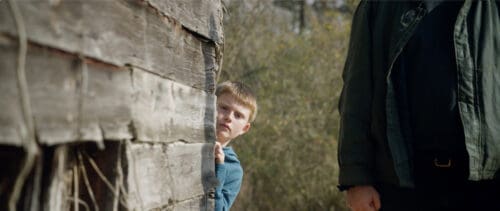
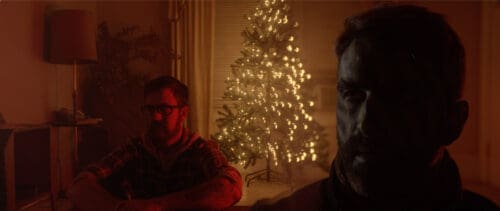
Waters has a remarkable eye for a well-constructed frame. There are several sequences of stunning visual beauty, and the location shots are gorgeous. Where he falters is in the writing department. His script throws up a number of intriguing ideas but never quite knows how to carry them through to a satisfying conclusion. As a result, the film develops an episodic, choppy rhythm. Some of these work better than others—the Civil War reenactors are a hoot, and the conversations between Stoner and his brother (Valient Himself) are the best-written scenes of the movie—but others, particularly the parts with the MAGA neighbor, lean in too hard on Southern stereotypes. There’s a fine line between satire and parody, and the neighbor’s scenes cross over too frequently into the latter.

I’m also not quite sure of his talents as an actor, but that seems deliberate. Stoner’s face remains obscured by paint for the duration of the movie, his dialogue is stilted, and the delivery is not much better. It works because of the contrast with Joel Loftin, who doesn’t seem to have any acting credits aside from this role; if not an actor by trade, he probably should look into becoming one. He has a relaxed, affable screen presence that grounds both Stoner and the movie.

I’m inclined to cut this movie a lot of slack because it is so surpassingly strange; a fever dream of a Southern gothic, steeped in violence and Christian guilt, it gets its hooks in you and doesn’t let go. Waters has considerable chops behind the camera, and there’s no denying his singular vision. Given time and opportunity, his writing will catch up. He’s definitely a director to watch.
✦ ✦ ✦ ✦ ✦ ✦ ✦ ✦ ✦ ✦
Gunfighter Paradise
Waters Film
released on March 2, 2024 (United States)
United States | English | color | 93 minutes
for screenings, visit Gunfighter Paradise
✦ ✦ ✦ ✦ ✦ ✦ ✦ ✦ ✦ ✦
