


Areas We Cover
Categories hhhh

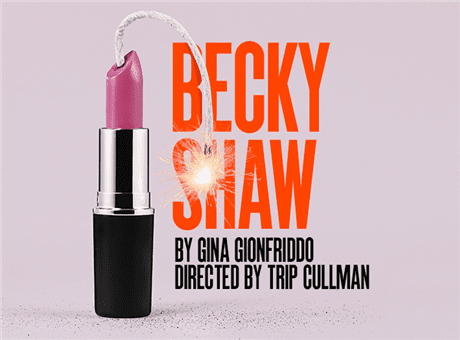
Broadway Review: BECKY SHAW (Helen Hayes)
by Carol Rocamora | April 14, 2026
in New York, Theater
LOVE, LIES, AND
LETHAL CHARM
Gina Gionfriddo’s comedy of dysfunction
refuses easy labels—and lands every blow
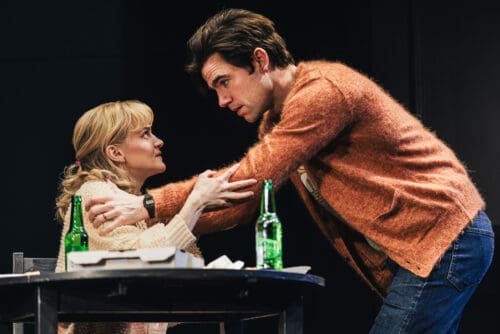
Madeline Brewer and Patrick Ball
“Rom-com?” No. “Meet-cute”? Far from it.
Sitting through Becky Shaw at the Helen Hayes Theater on Broadway last night, laughing my head off, I struggled to define the genre of this captivating work by Gina Gionfriddo. And I’m still struggling. All I know is that it’s one of the sharpest, zaniest comedies I’ve seen in years about love and relationships in the current Age of Emotional Dysfunction.
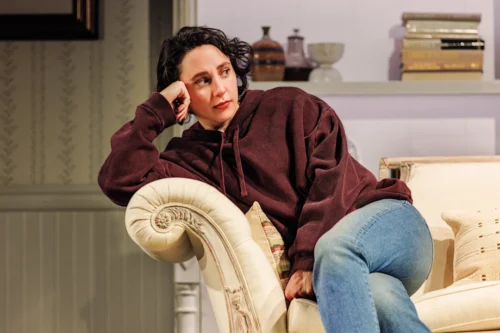
Lauren Patten
Let’s start with the colorful, complicated, quirky characters, whose behavior borders on the bizarre. In scene one, set in a New York hotel room, we meet Suzanna, a graduate student in psychology who is having a nervous breakdown. It’s four months after her father’s death; she’s deeply depressed, and all she wants to do is watch horror movies and drink hot chocolate. She’s been summoned to an urgent family reunion about their current financial crisis by Max, the family’s money manager, who is also her adopted brother (well, sort of… her father fostered him from the age of ten, saving him from his own father, a white-collar criminal).
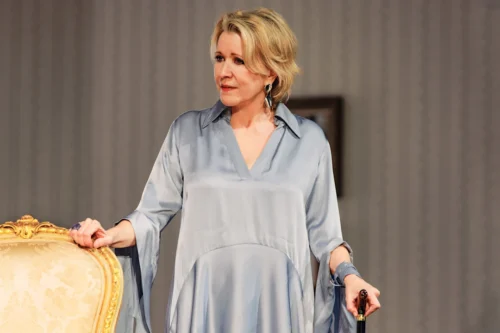
Linda Emond
Now in their mid-thirties, Suzanna and the overprotective Max have an unbreakable bond based on decades of living together and suffering through her parents’ difficult marriage. (It turns out that Suzanna’s father Richard was bisexual, having an affair with Yoshi, his accountant, who mismanaged his money.) But the problem they are facing now is Suzanna’s mother, Susan (Linda Emond). A widow in her sixties, suffering from MS, Susan has taken the family’s housepainter Lester as her lover (half her age). As Max describes Lester, he’s an “alternative redneck” who aspires to be a filmmaker. Susan wants to invite Lester to the dinner meeting, but Suzanna won’t have it, so a mother/daughter meltdown ensues. As Max describes that relationship: “It’s like the Middle East. Bad situation, not gonna change.” (Yes, their similar names are intentional; this playwright loves making mischief and mayhem at every opportunity.)
To console Suzanna, Max agrees to watch porn together (one of their shared activities growing up), and by the end of scene one they’re making love (for the first time).
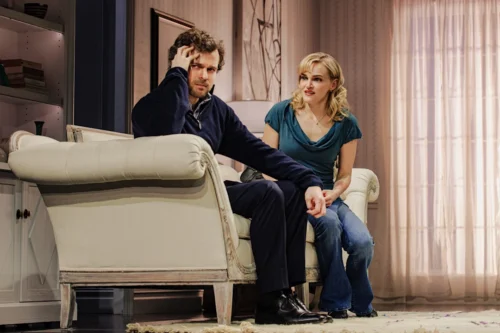
Alden Ehrenreich and Madeline Brewer
If that isn’t crazy enough, just wait until scene two. It’s eight months later, and Suzanna is now out of her “sad Buddhist phase,” as Max calls it. She has married Andrew, whom she met on a ski vacation (she doesn’t ski), and they’re living in Providence. Andrew is four years younger, a former barista now working in an office, also an aspiring novelist—so sweet and self-effacing that everyone forgets his last name. He cries when watching porn and has a weakness for saving suicidal women.
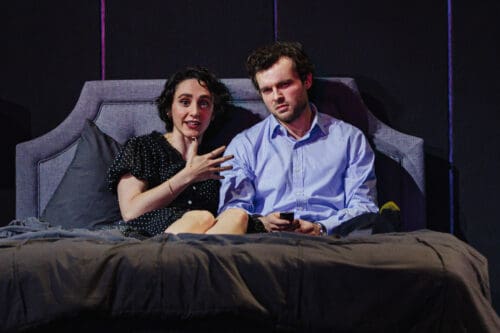
Lauren Patten and Alden Ehrenreich
The compassionate Andrew has arranged a rendezvous between Max and one of his fellow office temps named Becky Shaw, whom he describes as a “delicate melancholic in a transitional life space.” (Our devilish playwright has named her after the title character in Thackeray’s 1848 novel Becky Sharp, about a penniless social climber conniving to gain position and snare a rich man—and this new Becky resembles her to a “t”.) Pretty but penniless (she doesn’t even have a cell phone), estranged from her family, and a Brown dropout, she appears in a frilly frock that prompts the cynical Max to say: “WOW: You look like a birthday cake!”
What transpires is “The Blind Date from Hell”—a nightmarish event causing all the characters’ lives to change. Becky and Max are robbed at gunpoint. Then they have sex. But in the aftermath, Max won’t receive her phone calls. Distraught and suicidal, Becky appeals to the gullible Andrew for support. As Max predicts: “Andrew hears ‘I want to hurt myself’ like a f—ing mating call!”
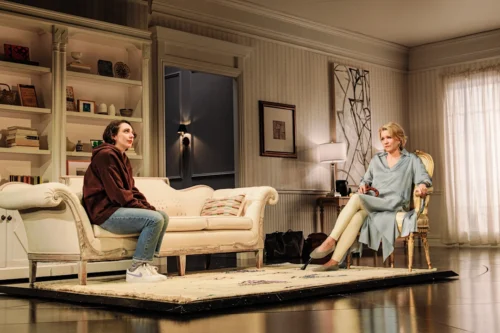
Lauren Patten and Linda Emond
Subsequently, like her namesake, Becky shows off her star manipulative skills, enticing the softhearted Andrew to move in with her (temporarily) and protect her (after she did indeed cut herself). Becky even appeals to Susan, now trying to save Lester, who is in jail for mail fraud.
In the final scene, featuring all five characters, Becky stages a manipulation so deft and daring that it will leave you stunned—and desperate to know the consequences. No spoiler alert: it must be yours to discover.
Suffice it to say, this unconventional, entertaining play—about love, family, getting what you want versus getting what you need—is unique. Trip Cullman directs this superb cast (on David Zinn’s flexible set) with skill and precision. As Suzanna, Lauren Patten is today’s Everywoman in her 30s, floundering, wanting to be independent but craving endless support. As Andrew, Patrick Ball is the do-gooder we all know and love. As Becky, Madeline Brewer is positively scary as the predator/manipulator, posing as the innocent victim.
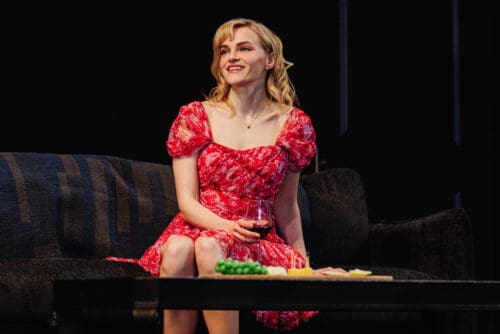
Madeline Brewer
In a spiky, spirited performance, Linda Emond’s Susan gives the key lines on the play’s themes, as she advises Becky: “A relationship is a deal between equals. It’s a mutually advantageous bargain.” “You think marriage and family require absolute honesty. They do not.” “Goodness and incompetence too often go hand in hand in men.” “Learn to lie. Lure with candy.”
Ultimately, the play belongs to Max, the loyal family fixer, the one character who truly and deeply loves but can’t quite make a relationship (with Suzanna) happen. As played by the incomparable Alden Ehrenreich, the trapped look on his face in the play’s final moment is unforgettable.
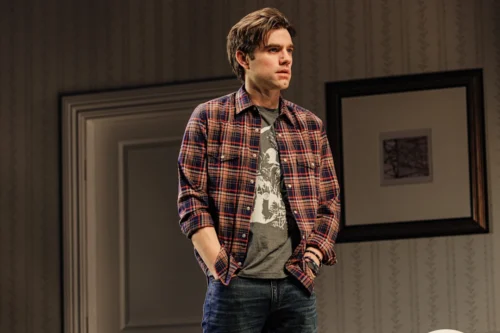
Patrick Ball
Gionfriddo’s pithy, stinging dialogue is delivered by the cast with such straight-faced frankness that their truths and insights are startling. Like the line: “No one respects a woman who forgives infidelity. It’s why Hillary Clinton will never be president.”
In the end, back to the question of genre: comedy? comedy-drama? comedy of manners? black comedy? None of the above. The unique tone of Becky Shaw has light Coward-esque Private Lives moments; it also has dark moments like Albee’s Who’s Afraid of Virginia Woolf?
But never mind. Suffice it to say, in this hilarious/serious play about love and family, you will find, as Suzanna says, “pockets of joy.”
✦ ✦ ✦ ✦ ✦ ✦ ✦ ✦ ✦ ✦
photos by Marc J. Franklin
Becky Shaw
Second Stage
Helen Hayes Theater, New York
ends on June 14, 2026
for tickets, visit 2st
✦ ✦ ✦ ✦ ✦ ✦ ✦ ✦ ✦ ✦
