FOUNDING FATHERS,
FOUND WANTING
A promising historical premise undone by uneven writing
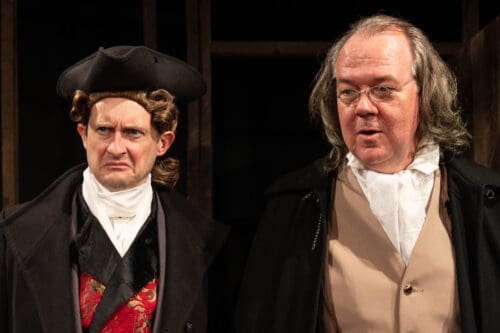
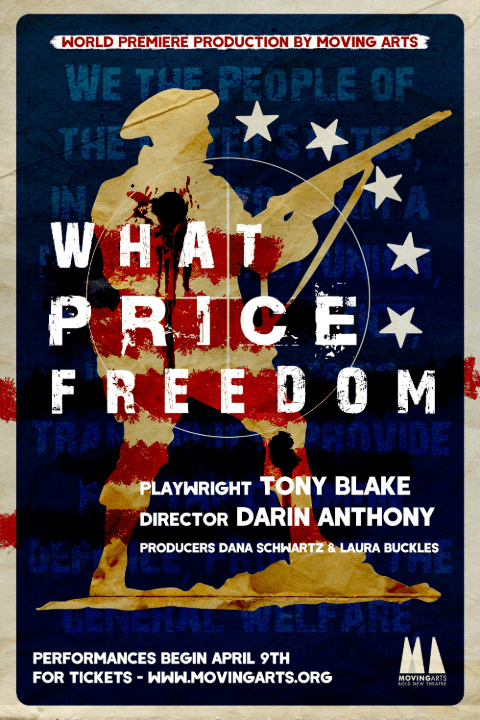
What Price Freedom, by Tony Blake, having its world premiere at Moving Arts Theatre, recounts one of the more unusual moments in the course of the American Revolution: when John Adams (destined to be the second president of the United States) and Benjamin Franklin, early American Renaissance man (destined to be the face on the $100 bill), were forced to share a bed.
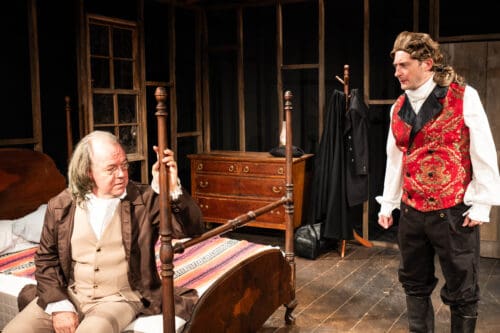
In July of 1776, the Continental Congress issued the Declaration of Independence, announcing the separation of the thirteen colonies from Great Britain. Two months later, that same Congress decided—against Adams’ protests—to send Adams, the 70-year-old Franklin, and 27-year-old Edward Rutledge of South Carolina to Staten Island to engage in a last-ditch effort to keep peace with the mother country. (Spoiler: it didn’t work.)
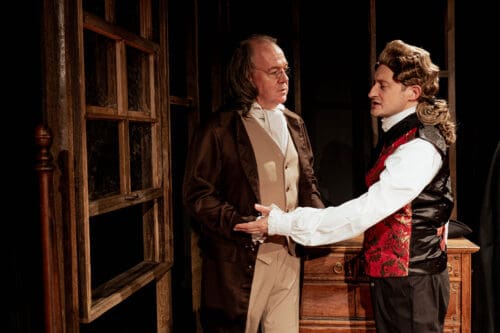
What Price Freedom relates how, on that journey, the trio was forced to stay the night in New Jersey, where they obtained only two small rooms at the rustic Indian Queen Tavern. Both Franklin (Rob Nagle) and Adams (Brandon Bales), who shared a dislike for Rutledge, ended up also sharing a room—and a bed—an episode which Adams relates in his diary in prickly detail.
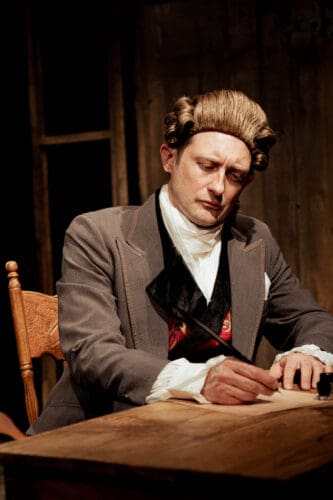
This incident holds great potential as a subject for dramatization. Sadly, Blake’s work does not fully realize it, and the production’s two main failings must both be attributed to the writing.
The first is construction. It’s as if Blake collected the numerous bon mots and adages uttered by these two founding fathers and then proceeded to write his play by seeding them in wherever the whim took him. Thus, there is nothing naturalistic about the flow of dialogue, and each proverb and axiom arrives with the delicacy of a speed bump.
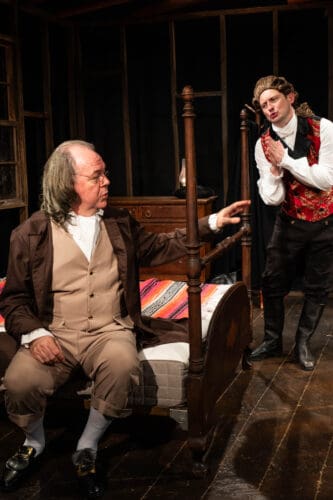
Then there is the problem of the writer addressing what he sees as the lack of conflict within the historical narrative. The two men, according to Adams, argued over a trivial issue, but Blake invents a major crisis and intrudes it into his rendering of events. Questionable as this is, Blake mishandles this incursion by introducing it as two offstage events, which Adams reports. Both announcements arrive on stage with the subtlety of the Lost in Space robot flailing its arms while broadcasting, “Danger, Will Robinson, danger!” and then, without maintaining a whisper of tension, are completely forgotten.
Director Darin Anthony (also Moving Arts’ Artistic Director) is to be commended for seeking a historical production that speaks to the times we are presently enduring, but he has failed to address the problems of the piece itself. Rob Nagle, who I know to be a superb actor, stumbles about the stage, as does Brandon Bales, but I am confident they’ll find their stride as the show continues its run.
Mylette Nora’s costumes and the set and lighting by Justin Huen are to be commended. Otherwise, for theater and for history, I give What Price Freedom a C-.
✦ ✦ ✦ ✦ ✦ ✦ ✦ ✦ ✦ ✦
photos by Eric Pargac
What Price Freedom
Moving Arts Theatre
3191 Casitas Avenue, Los Angeles
Fri, Sat, Mon at 8; Sun at 4
ends on May 3, 2026
for tickets ($15–$33), visit Moving Arts
for more shows, visit Theatre in Los Angeles
✦ ✦ ✦ ✦ ✦ ✦ ✦ ✦ ✦ ✦



Although I am not a playwright nor involved in theatre, I am an avid theatergoer who attends productions throughout the city. I subscribe to the Ahmanson, Taper, Geffen, Playwrights Arena, Artists at Play, Pacific Resident Theatre and, frequently, Moving Arts Theatre. I humbly particularly disagree with one statement in this review… Rob Nagle does not “stumble about the stage” and is one of the best actors in LA’s independent theatres.
This play illustrates how our nation’s Founders preserved democracy by ultimately appreciating the necessity of compromise. The dialogue is brilliantly written, with all the cleverness of Franklin contrasting Adams’ Ivy League, more privileged perspective. It is accurately historically based, with a number of quotes seamlessly woven into the dialogue. The actors’ performances were brilliant. My goodness – they actually looked their parts and were thoroughly convincing in their fluid exchanges in every detail of expression. Very well directed. I loved this play.