


Areas We Cover
Categories

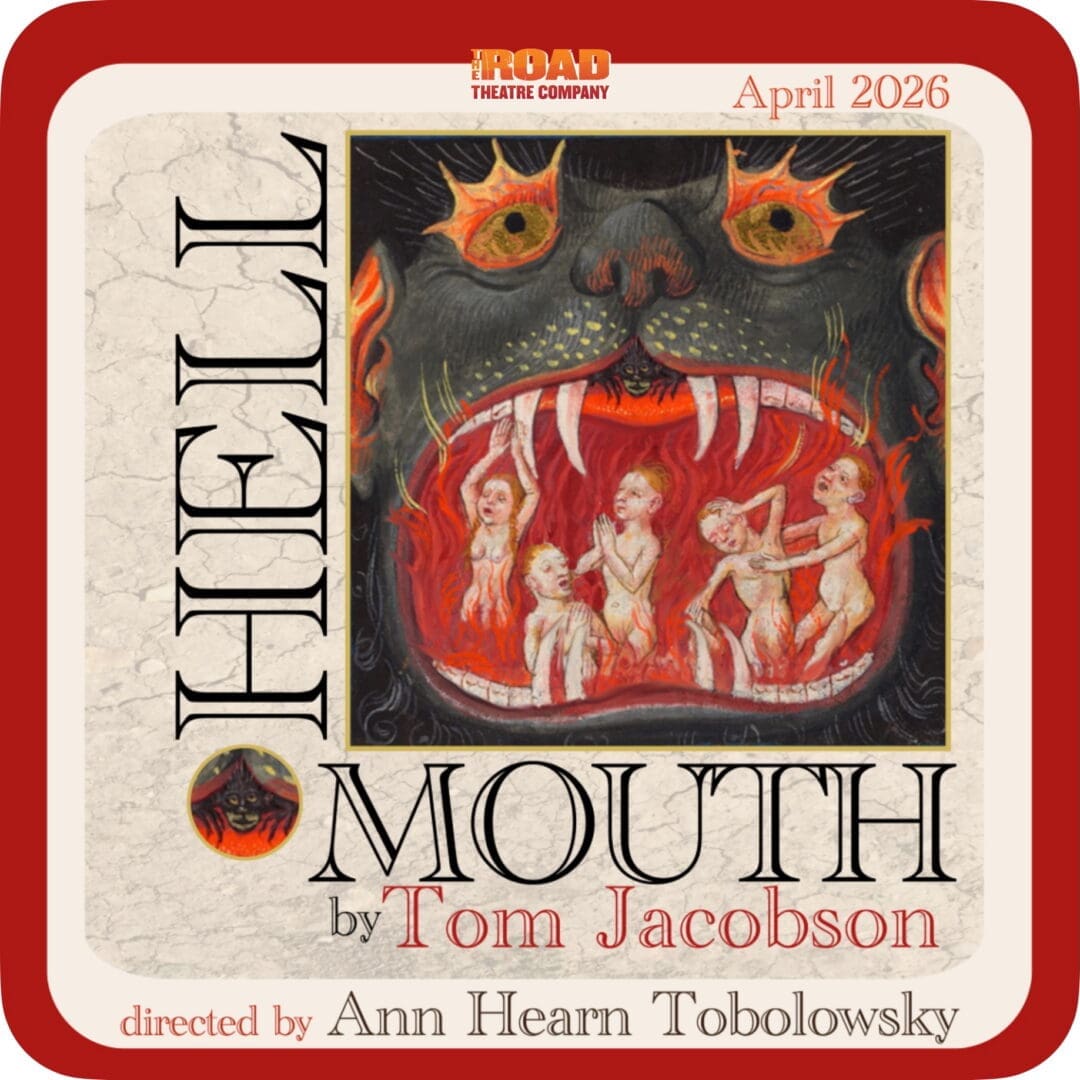
Theater Review: HELL MOUTH (The Road Theatre Company, North Hollywood)
by Michael M. Landman-Karny | April 19, 2026
in Los Angeles, Theater
A HELL OF A MOUTHFUL
A play where grief, faith, and ambition collide
—and silence carries the weight
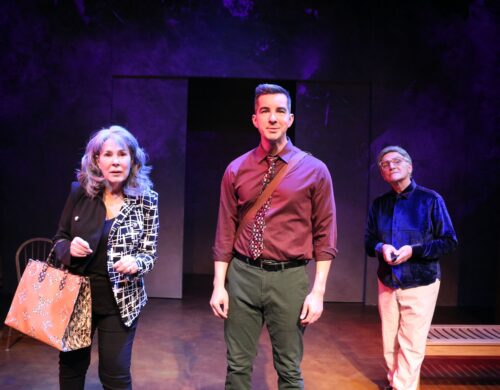
Taylor Gilbert, Danny Lee Gomez and Tony Abatemarco (photo: Lizzie Kimball)
Jacobson knows that the domestic and the exalted do not occupy different rooms. Hell Mouth, now receiving a luminous production at The Road Theatre Company, opens on a son cleaning his dying father and pivots, in a single shift of light, to a Los Angeles argument about a possibly undiscovered Caravaggio. The pivot is not a contrast. It is Jacobson’s thesis. Grief and ambition move through the same scenes, press on the same characters, and resolve—or fail to—in the same breath. What matters turns on whether anything can be given in time.
Tim Josephson (Danny Lee Gomez), curator, dutiful son, would-be operator, has flown to Oklahoma City to relieve his mother Lois, who has been caring alone for his father Russell through the indignities of late-stage cancer. The first scenes are exercises in unsentimental love: the logistics of caregiving, the small comedies of exhaustion, the tenderness between people who say what needs doing rather than what they feel. Director Ann Hearn Tobolowsky allows these scenes their full weight, resisting any early impulse toward elegy. Russell, played with impeccable stillness by Tony Abatemarco, is not a symbol. He is a man, and Jacobson insists on the full particularity of that fact. That insistence sounds obvious until you notice how rarely productions sustain it. This one does, and it resets the stakes of everything that follows.
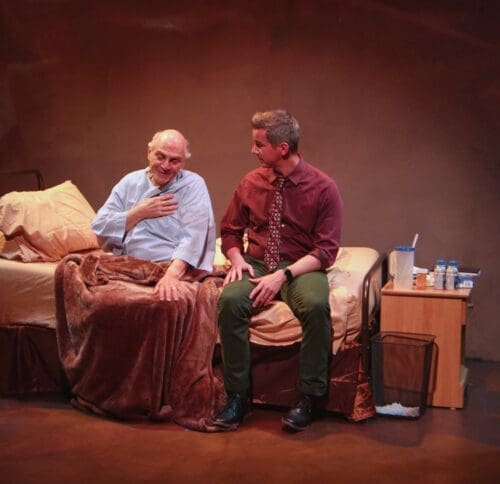
Tony Abatemarco and Danny Lee Gomez (photo: Robert Sturdevant)
Russell’s interior life is established without explanation. Tim sits with his mother as she reads his father’s manuscript aloud, punctuation and all, while he checks the edits against the page, stopping her gently over a misplaced comma. On its surface, it is a task. What it is underneath is translation: a son learning his father’s mind while he still has time to learn it. Russell’s book, with its vision of a heaven capacious enough to admit even the least forgivable, hovers at the edge of the scene—present but unargued, absorbed into the work of the afternoon the way a long-held belief becomes indistinguishable from character.
Into this comes Raymond Spencer (also played by Abatemarco), an aged British fashion critic of legendary cruelty who may possess an unknown Caravaggio of uncertain provenance. Where Russell imagines a heaven capacious enough for the least forgivable, Spencer inhabits a world in which grace has ceased to be a practical category. His nastiness is real, but what matters is the loneliness beneath it: forty-seven years with a man named Evan, and since Evan’s death, no remaining language for ordinary life. The cruelty is not affect. It is method—the only way he knows to hold the world at a distance without accounting for himself.
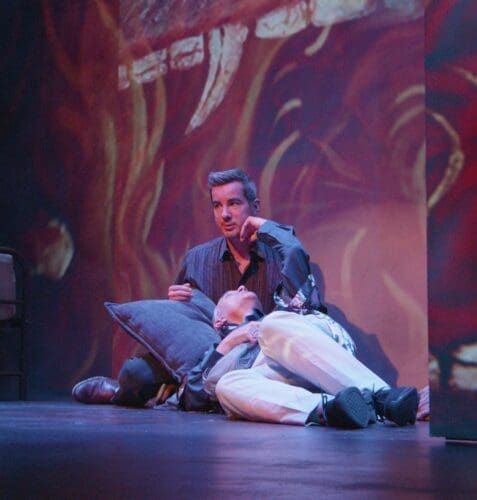
Danny Lee Gomez and Tony Abatemarco (photo: Robert Sturdevant)
Samara Buchsbaum arrives fluent in the grammar of Beverly Hills philanthropy, urgency and graciousness so intertwined it is impossible to separate them. Taylor Gilbert does not play her as a type, and Jacobson does not write her as one. Her appetite for the next thing is built on a loss she does not discuss and has not resolved. She keeps moving because the alternative is to stop. When she encounters Tim, who means every word he says, she recognizes something she has worked hard to outrun.
Spencer is introduced to Tim through a tour of the museum’s Provençal retable, an elaborate carved narrative of Christ’s life that Tim explains to a man who claims to know nothing about European art but demands to be told everything. Jacobson has never written a lecture that was only a lecture. The scene is comedy and seduction and a lecture all running simultaneously, and what makes it work is Tim’s total inability to modulate. He falls in love with research. He blurts. He has no mechanism for showing less enthusiasm than he feels, even when the room would reward it. In a theatrical landscape that rewards polish over conviction, that transparency is both his greatest liability and the play’s refusal to apologize for him.
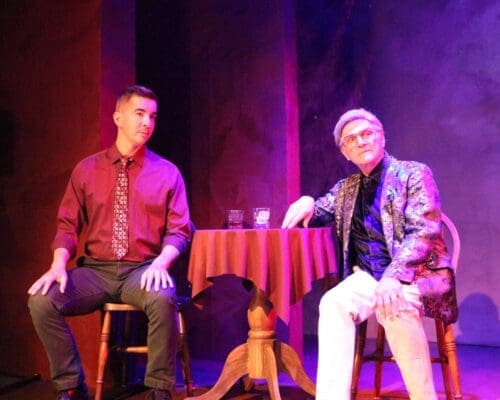
Danny Lee Gomez and Tony Abatemarco (photo: Lizzie Kimball)
Lighting (Derrick McDaniel) and staging (Mark Mendelson) press the Caravaggio parallel into the room itself: darkness compresses, light isolates, figures emerge and recede as if selected. Nicholas Santiago’s projections run alongside the action as a second text, flashing religious imagery, Old Master paintings, and pop-cultural detritus that frame the characters’ spiritual predicament without illustrating it. They slow and cease at dramatically pointed moments. That cessation is where their weight lands hardest.
Spencer has survived decades on perfectly maintained style—cruelty as armor, nastiness as method. Tim’s transparency confuses him and then, by degrees, undoes him. When the two sit in a piano bar listening to a cabaret singer—Spencer rigid, hands wrapped around his glass, Tim leaning forward as if proximity might solve something—they talk around everything that brought them there, circling grief without naming it. The scene is quieter than anything around it and lands harder.
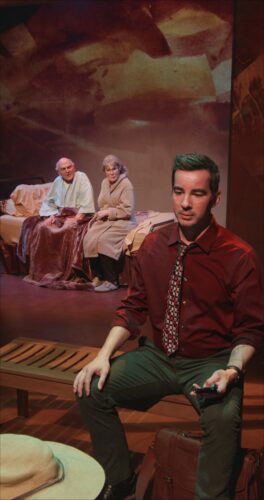
Tony Abatemarco, Taylor Gilbert and Danny Lee Gomez (photo: Robert Sturdevant)
Lois (also played by Gilbert) has been competent so long that competence has become the only register she trusts. The doubling of Lois and Samara is not incidental: Jacobson has written both women as people who lost something they do not name and kept moving anyway, one by managing every detail of Russell’s dying, the other by staying a step ahead of her own grief, and a single actor playing both makes the echo audible. When Tim arrives, the relief Lois will not allow herself to feel sits just below every exchange: who handles the church volunteers, how to rotate the night shifts, whether to call hospice. Her scenes with Tim are among the finest things Jacobson has written. They are also, characteristically, funny, with the specific humor of people who will say anything to avoid saying the one thing.
Jacobson’s lineage is not hard to trace. The stripped theatrical grammar recalls Wilder; the refusal to separate private grief from theological argument runs through Kushner; the circling tenderness and cruelty between men is Albee’s language; the survival strategies of queer life under pressure are McNally’s; and the Oklahoma scenes carry the pressure of what goes unsaid that Shepard made a discipline of. Jacobson borrows freely and then moves past all of them. What distinguishes him is not method but temperament. Where Albee and Kushner press on the wound, he asks whether it can heal, and by whom, and whether the answer changes anything. Russell’s vision of a heaven capacious enough to admit even the least forgivable is not a quirk of character. It is the play’s structural argument. Forgiveness here is not an idea. It is the only response left available to the specific losses the play places in front of us.
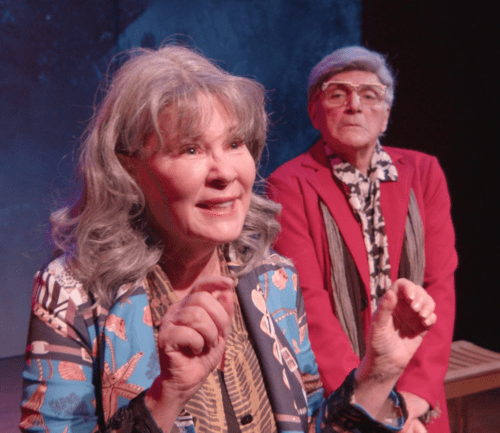
Taylor Gilbert and Tony Abatemarco (photo: Robert Sturdevant)
The script is not without its seams. There are moments when information the play needs the audience to have arrives too directly—lines that register as explanation before they settle into character. They are brief, and the production moves through them quickly, but they mark the boundary between what the play knows and what it still feels the need to say.
Hell Mouth comes down to a simple imbalance: Tim means everything he says, and Spencer has spent years meaning nothing at all. Jacobson has built his career on characters whose survival depends on the roles they perform, but here those roles fail. What replaces them is not clarity. It is something unfinished—a self still deciding what it believes. When that surface gives way, neither man holds.

Tony Abatemarco (photo: Lizzie Kimball)
Over decades of exacting, idea-driven work—Crevasse, Bunbury, The Twentieth-Century Way—Jacobson has kept his ambition and his craft in the same room for thirty years without either one winning. That work has remained, for reasons unrelated to quality, largely within Southern California. Hell Mouth feels like the culmination of those preoccupations, the play in which they finally cohere. The continued confinement of Jacobson’s oeuvre to Southern California now feels less like circumstance than neglect.
This is also Jacobson’s most emotionally direct work, his craft fully in service of the plainest human things: a son cleaning his terminally ill father, a widow trying to eat, an old man confronting, too late, what kindness might cost. Beneath all of it is a play about judgment—not the grand theological kind that Russell writes toward, but the smaller daily reckonings by which we measure one another and ourselves. Who is worth our time. Who is forgivable. Who is beyond reach. By the end, those distinctions begin to collapse. What remains is something harder and, in this production, something close to devastating: not whether anyone is saved, but whether they were loved in time.
The first act ends on Russell’s silence—a silence that knows more than Tim does, and loves him anyway. You feel the weight of it before you understand it, and then the scene is gone. Hell Mouth finds Jacobson working at full strength, and this production meets him there.
✦ ✦ ✦ ✦ ✦ ✦ ✦ ✦ ✦ ✦
Hell Mouth
The Road Theatre Company
NoHo Senior Arts Colony, 10747 Magnolia Blvd. in North Hollywood
Fri & Sat at 8; Sun at 2
ends on May 24, 2026
for tickets ($17-$39), call 818.761.8838 or visit Road Theatre
for more shows, visit Theatre in LA
✦ ✦ ✦ ✦ ✦ ✦ ✦ ✦ ✦ ✦

Beautiful review. Worth keeping. Thank you.
You are a great reviewer, Michael: thoughtful, insightful, with a clear, unpretentious style that both informs the audiences and intelligently critiques the creatives. You are the sort of reviewer (sadly in very short supply these days) who is actually a final element of the creative process. Thank you. This review only makes me even more frustrated at having to miss HELL MOUTH because of my current employment in BRIGADOON, for which you wrote another exemplary review. Keep up the good work!
Thank you, Geoffrey.
I will advocate hard for a play that earns it. The house I sat in was tepid: three people up at the ovation. One critic found it “too intellectual and esoteric”. I thought it was the first Tom Jacobson play where he actually lets something bleed through.