


Areas We Cover
Categories

Music Obituary: MICHAEL TILSON THOMAS
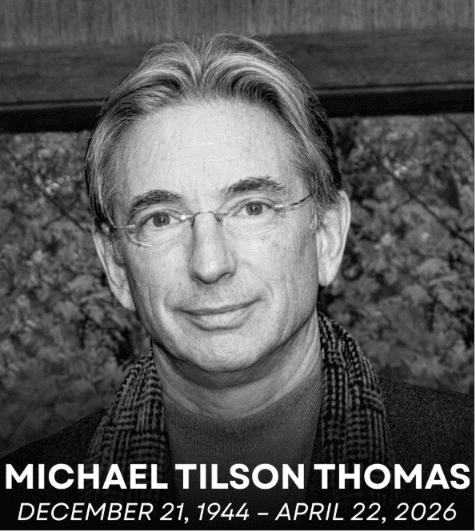
by Michael M. Landman-Karny | April 23, 2026
in Extras, Music
MAESTRO OF THE AMERICAN SOUND
Michael Tilson Thomas, conductor, composer, and decades-long champion of American music’s place in the canon, died April 22, 2026, at his home in San Francisco. He was 81.
The man never met a podium he couldn’t own. Watch him work and you see someone who learned early that conducting isn’t just about keeping time. It’s about making a room full of musicians believe they’re part of something that matters. His San Francisco Symphony players will tell you: MTT doesn’t just rehearse, he evangelizes. Not in the pulpit pounding way, but with the kind of intensity that makes you lean forward in your chair.
Born into a family where performance was as natural as breathing, his grandparents Boris and Bessie Thomashefsky were legends of New York’s Yiddish theater. Tilson Thomas inherited their sense of timing and their understanding that art should grab you by the collar. His father, Ted Thomas, worked as a stage manager and later in Hollywood. His mother, Roberta, established the research department at Columbia Pictures. Everyone in the house made things.
At twelve, playing oboe in his junior high orchestra, he met an eleven-year-old cellist named Joshua Robison. They stayed friends through high school, lost touch, reconnected in New York years later. By 1976 they were partners. They married in 2014 after nearly forty years together. Robison died February 22, 2026, two months before Tilson Thomas, following complications from a fall. Friends said the two shared something beyond partnership. One whole, dependent on each other for different things. Neither would have survived well without the other.
At twenty four, conducting the Boston Symphony after William Steinberg collapsed mid concert at Carnegie Hall in October 1969, he discovered what he was built for. The program that night included a new double concerto by Robert Starer and Strauss’s Till Eulenspiegel. Harold Schonberg wrote in the Times the next day that a tall, thin young man came on stage with an air of immense confidence and authority and showed that his confidence was not misplaced. The orchestra didn’t hesitate. Neither did he. As Steinberg recuperated, Tilson Thomas conducted thirty-seven more concerts that season.
But it was his work for American composers that defined him. Gershwin and Bernstein weren’t just names on programs under his baton. They were arguments for a specifically American sophistication. His Rhapsody in Blue recordings capture something beyond the usual jazz meets classical narrative. There’s an edge there, a darkness threading through the sparkle. His West Side Story performances crackle with urban menace rather than Broadway nostalgia.
Bernstein spotted the younger conductor’s potential after their first meeting in 1968, following Tilson Thomas’s Koussevitzky Prize win at Tanglewood. Lenny became mentor and measuring stick both. The relationship was never tidy. Bernstein reportedly told The New York Times Magazine in 1971, “I don’t fling the word genius around lightly, but I fling it around about Michael. He reminds me of me at that age, except that he knows more than I did. Not only music, but things like the functions of the brain, cerebrology, physics, biochemistry.” The hunger was mutual and permanent.
His Mahler had a particular quality. Where other conductors went for monumental weight, Tilson Thomas found the neurotic edge, the sense that the music was always about to fly apart and somehow held together anyway. The San Francisco Symphony’s complete Mahler cycle, recorded over his tenure, captures that balance. The symphonies sound like arguments with themselves.
San Francisco suited him when he took over as music director in 1995. The city’s appetite for risk matched his own programming instincts. He commissioned new works the way other people buy groceries. His American Mavericks festivals in 2000 and beyond brought Charles Ives, Ruth Crawford Seeger, and Henry Brant to audiences who’d never heard their names. He didn’t treat these composers as curiosities. He treated them as the real thing. When the festivals hit Davies Symphony Hall, you heard Ives’s colliding marching bands and Crawford Seeger’s microtonal string writing as if they’d been written yesterday, not seventy years ago. The performances made the case that American modernism had its own rigor, its own beauty, and didn’t need to apologize for either.
His multimedia experiments, including the PBS series Keeping Score, treated audiences like adults capable of following complex musical arguments. The Stravinsky episode remains a masterclass in making the difficult accessible without dumbing it down. He used archival footage, reenactments, and on camera conducting to dissect the Rite of Spring‘s power. The series felt more like late night jazz riffing than a musicology lecture.
He never made theater of his private life, but he never hid it either. In a profession where many still calculated the cost of visibility in the 1970s and 1980s, Tilson Thomas simply lived openly. “If you’re gay in this profession,” he once observed, “you’re used to watching how people listen. You read the silences. That’s not a bad skill for a conductor.” He and Robison became fixtures in San Francisco’s musical and civic life at a time when being visible as a gay couple still carried risk in many American cities. The first Symphony Pride concert in 2017 happened because they’d been there all along, uncompromising and unmistakable.
His rehearsal style could pivot from forensic to theatrical in a single phrase. Musicians remember him stopping mid Mahler to announce: “It’s a funeral march, not a traffic jam. Let it breathe like it means something.” Other times he’d mimic a pop star’s vocal inflection to illustrate a phrase’s shape, then immediately drill into the technical problem underneath. He kept everyone slightly off balance and completely engaged. He walked off stage at the Hollywood Bowl once to protest noise from a police helicopter hovering overhead. When he returned in 2007 to conduct Mahler’s Eighth in the same venue, he announced jokingly, “Now where were we?”
The New World Symphony in Miami Beach stands as perhaps his most lasting institutional achievement. He co-founded it in 1987 as a laboratory where young musicians learn not just technique but how to think about what they’re doing. More than twelve hundred alumni have passed through. His recording catalog includes complete Mahler cycles, Copland’s ballets, scores by composers the European houses routinely ignore. Twelve Grammys over his career. A National Medal of Arts. Kennedy Center Honors in 2019. The numbers matter less than what they represent: five decades of making the case for American music’s sophistication.
His compositions include From the Diary of Anne Frank, premiered with Audrey Hepburn as narrator in 1990, and Meditations on Rilke, a work about mortality he conducted at Disney Hall in January 2022 after his first brain surgery. The piece takes on weight when you know what he was facing. Wistful reflections on life and death as he turned seventy-five, now read as preparation for what came next.
In August 2021, he announced publicly that he had been diagnosed with glioblastoma multiforme, an aggressive brain cancer. He underwent surgery, returned to conducting with a reduced schedule, and kept working. In February 2025, he announced the tumor had returned. His final performance came April 26, 2025, at Davies Symphony Hall. A belated eightieth birthday celebration. He conducted Britten’s The Young Person’s Guide to the Orchestra and Respighi’s Roman Festivals. At the end, he said what conductors rarely get to say: “At that point we all get to say the old show business expression, ‘It’s a wrap.’ A coda is a musical element at the end of a composition that brings the whole piece to a conclusion. A coda can vary greatly in length. My life’s coda is generous and rich.”
What he left behind resists easy summary. A sound that proved American music didn’t need European validation. A career that showed you could be openly gay in classical music before that was safe or common. Twenty-five years in San Francisco that turned an excellent orchestra into one that belonged in conversations about the best in the world. He made American composers sound like they mattered because he believed they did. The recordings will argue his case long after the man who made them is gone.
