


Areas We Cover
Categories

BEHIND THE CURTAINS: WHY EVERY THEATER CREW NEEDS EMERGENCY READINESS
WHAT HAPPENS WHEN
THE SHOW CAN’T GO ON
Spotlight on Safety:
Why Stage Managers Are Getting Certified
Live performances are entirely unpredictable. While stage managers constantly prepare for missed cues and broken props, true medical emergencies in a packed theater require real readiness. Getting certified in First Aid and CPR ensures arts students and event staff can handle crowd crises safely when the unexpected happens.
What Happens When the Spotlight Fades and Panic Sets In?

You know the feeling perfectly. The house lights dim, the audience goes quiet, and the curtain finally rises. Theater is all about beautifully controlled chaos. But what happens if an actual emergency breaks out in the middle of a sold-out show?
Imagine an older patron collapsing in the front row. Picture a crew member taking a nasty fall from the catwalk into the wings. Who steps up to help? Relying on a random doctor being in the audience is a massive, unnecessary gamble. For theater staff and event planners, securing a proper BLS Certification is just as critical as calling the right lighting cues. It gives you the immediate skills to act fast when the script gets completely thrown out the window.
What Makes Live Events So Vulnerable to Medical Emergencies?
A theater is a wildly unique environment. It is generally dark, heavily crowded, and very loud. If someone experiences a cardiac arrest or a severe allergic reaction in the middle of a performance, getting emergency medical services (EMS) into the building takes critical time.
Paramedics have to physically navigate confusing backstage corridors, heavy fire doors, and panicked crowds just to reach the victim. You simply cannot wait for the ambulance to fix everything.
The first few minutes of a medical crisis are the absolute difference between life and death. If a stage manager, usher, or box office attendant knows how to perform CPR or use an AED, they bridge that terrifying gap. They keep the situation calm and manageable until the professionals actually arrive on the scene.
What Are the Most Common Backstage Injuries?
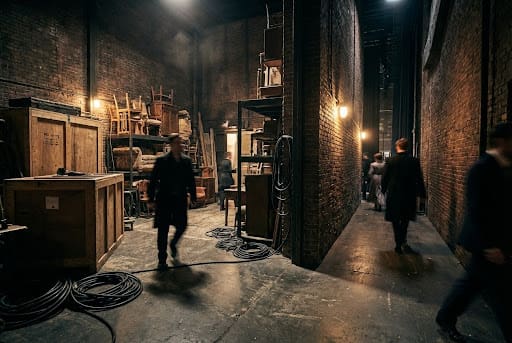
The performing arts are surprisingly physical. Actors routinely perform complex choreography, intense stage combat, and rapid costume changes in pitch-black backstage wings. Meanwhile, riggers and technicians are working high above the stage with heavy lighting instruments.
All of this fast-paced activity creates a perfect storm for physical accidents. Sprained ankles, deep cuts from set construction tools, and sudden head injuries from low-hanging set pieces happen much more often than you think. Even seemingly minor incidents require immediate, confident attention to prevent them from becoming serious liabilities. Knowing how to properly dress a wound or stabilize a fall victim keeps the creative environment safe for everyone involved.
Why Should University Arts Students Care About First Aid?
Take a walk through any lively university town. In places heavily populated by arts and event planning students—like the vibrant theater community in Guelph—you will find countless independent productions, pop-up events, and packed lecture halls. Students are the very backbone of these local productions.
If you are studying stage management, directing, or event coordination, you are learning how to be a strong leader. Real leaders do not freeze or panic when things go wrong. Having Basic Life Support (BLS) or Standard First Aid training on your resume makes you an incredibly valuable asset to any production company. It shows cautious directors and producers that you are completely serious about the safety of your cast and crew. You quickly become the person everyone trusts when things go sideways.
How Do Busy Production Crews Make Time for Certification?
Let’s be completely honest about the industry. Tech week is a nightmare. You are usually running on lukewarm coffee and zero sleep, tweaking audio cues until two in the morning. Adding a formal training course to that specific schedule sounds entirely impossible.
Thankfully, modern certification has caught up with reality. You do not have to sit in a boring classroom all weekend anymore. Blended learning allows you to complete the theoretical modules online at your own pace. You can learn about airway management or severe choking hazards on your laptop during a dinner break.
After that, you just attend a brief, in-person skills session to physically practice on mannequins. It is WSIB-approved, highly effective, and actually respects your limited time.

Are You Ready to Protect Your Cast and Crew?
The show must go on, but only if it is genuinely safe to do so. Medical emergencies are scary, but they are significantly less scary when you know exactly what to do. Whether you are running a massive university showcase or a small community play, you owe it to your team to be prepared. Stop assuming someone else will step in to handle it.
If you are looking for first aid training near the University of Guelph campus, the Water Street and Gordon Street intersection, or other areas close to our facility, then you may reach out to Coast2Coast First Aid/CPR – Guelph in that area.
For more info and articles like this visit: https://www.c2cfirstaidaquatics.com/
Frequently Asked Questions
What is the best first aid course for theater staff and ushers? Standard First Aid & CPR Level C is typically the best choice for general theater staff. It covers a wide range of emergencies, including adult and child CPR, choking, bleeding, and sudden medical emergencies like seizures or allergic reactions.
Do event planners actually need Basic Life Support (BLS) certification? While CPR Level C is great for the general public, BLS is specifically designed for high-performance team dynamics and fast-paced environments. Event planners working massive festivals or high-risk crowds often benefit from the advanced, team-based rescue techniques taught in BLS.
How long does it take an arts student to get certified? With the blended learning format, it takes half the traditional time. You complete a few hours of self-paced online theory at home, followed by a single day (or half-day) of in-class practical skills training.
Is CPR training legally mandatory for stage managers? This depends heavily on the specific venue, employer, and local Occupational Health and Safety (OHS) regulations. However, even if it is not legally mandated for a small indie production, it is universally considered a best practice for anyone in a supervisory role.
Does my Red Cross certification ever expire? Yes. In Canada, a standard Red Cross First Aid and CPR certification is valid for three years. BLS certifications usually require annual renewal to ensure your rapid-response skills stay sharp and up-to-date.
