


Areas We Cover
Categories

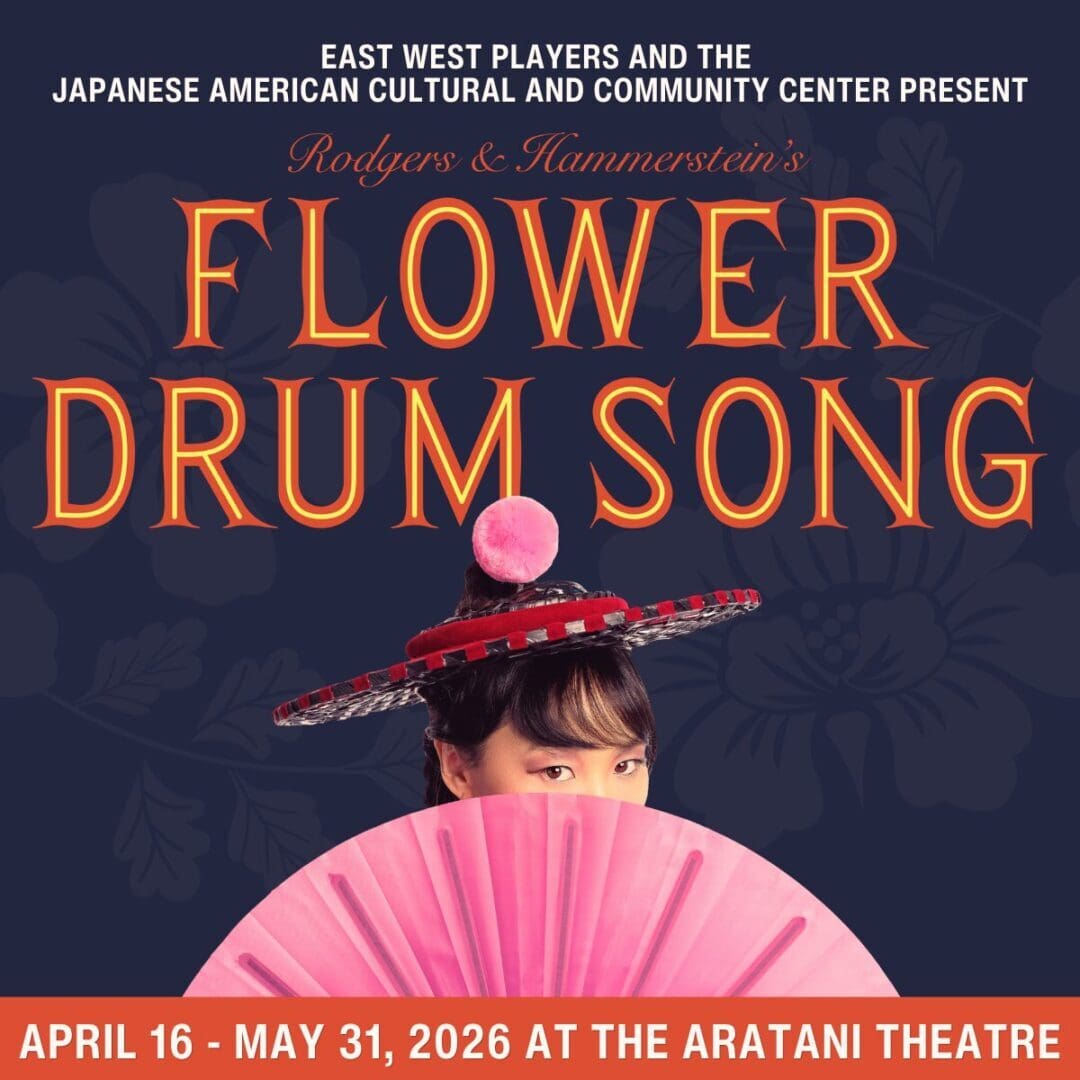
Theater Review: FLOWER DRUM SONG (East West Players & JACCC at the Aratani Theatre)
by William C. | April 27, 2026
in Los Angeles, Theater
A NEW BEAT ON
AN OLD DRUM
A vibrant revival powered by
talent, spectacle, and cultural pride
Crazy Talented Asian Americans!
“To create something new, we must first love what is old.”
– Mei-Ling from Flower Drum Song
I fell in love with East West Players and JACCC’s co-production revival of Rodgers & Hammerstein’s Flower Drum Song, with a book by David Henry Hwang. On its own, Flower Drum Song is a Broadway classic. For those unfamiliar, it debuted on December 1, 1958, at the St. James Theatre, starring Miyoshi Umeki, Pat Suzuki, Larry Blyden, Juanita Hall, and Ed Kenney. The show ran for 600 performances. Hwang’s rewrite returned the musical to Broadway in 2002, with a revival starring Lea Salonga, Sandra Allen, and Jose Llana.
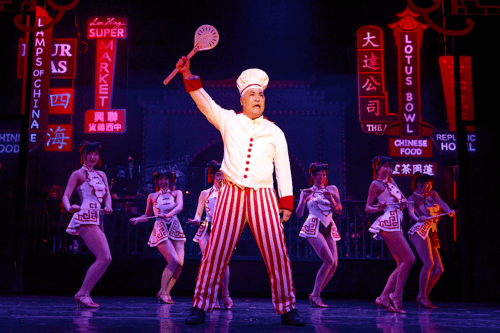
Marc Oka and (L-R) Esther Lee, Gemma Pedersen, Ai Toyoshima, Sally Hong, Hillary Tang, and Emma Park
Now, the latest revival opens on the Aratani Theatre stage with Scott Keiji Takeda as Ta, Grace Yoo as Mei-Li, Krista Marie Yu as Linda Low, Emily Kuroda as Madam Liang, Marc Oka as Wang, Gedde Watanabe as Chin, and Kenton Chen as Harvard. Directed by East West’s Artistic Director Lily Tung Crystal, this production spares no expense on costumes, set, or marketing.
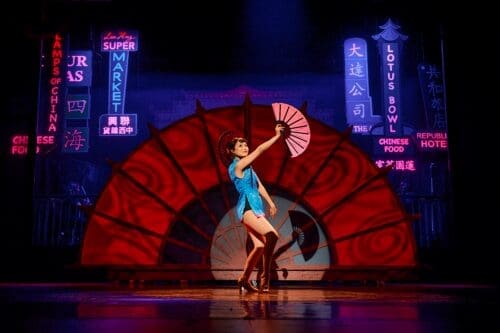
Krista Marie Yu
There’s something for everyone. If you love Asian-American talent, this cast can rival any. Who knew Emily Kuroda, Mrs. Kim from Gilmore Girls, could sing? Kuroda was truly surprising with her talent. Fans with the original LP can relive the score at the intimate Aratani Theatre, ideal for this show. Unlike vast venues like the Pantages or Segerstrom Center, where decent seats cost a fortune and the cast looks tiny, here every seat is close to the performance.
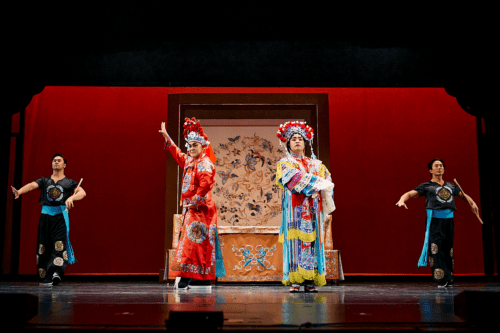
Brian Shimasaki Liebson, Marc Oka, Scott Keiji Takeda, and Joven Calloway
Hats off to Lily Tung Crystal for bringing show-business glamour back to East West Players with this revival. Her acumen in understanding what will bring the audience, from casting choices to ad purchases in Little Tokyo Station and iconic show design, is evident. This is a new East West, hungry for new audiences and engagement with theatre lovers. Perhaps Crystal is following Mei-Li’s advice; she is creating something new with love for something old. And I am truly here for it.
But, Willie, what went on on stage, you ask? Okay, okay, hold your horses.
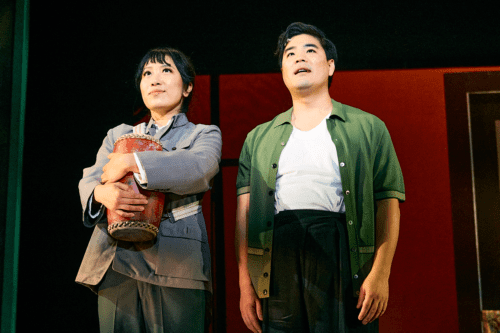
Grace Yoo and Scott Keiji Takeda
Our lovebird pair, Scott Keiji Takeda and Grace Yoo, expressed genuine affection for one another on stage. This pair is not only perfectly comfortable busting out Peking Opera choreography at a moment’s notice, but they also have well-developed voices and good, clear diction. Krista Marie Yu as Linda Low is truly a showstopper. Not only does she embody the personality of a diva, but her genuine, kind-hearted nature truly shone through her stage presence. I had “Don’t Marry Me” stuck in my head after the show, mainly due to Marc Oka and Emily Kuroda’s delivery. I don’t remember laughing so much. As the elders of the cast, Kuroda and Oka certainly brought the kind of glamour and expression that can only come from years of performing on stage.
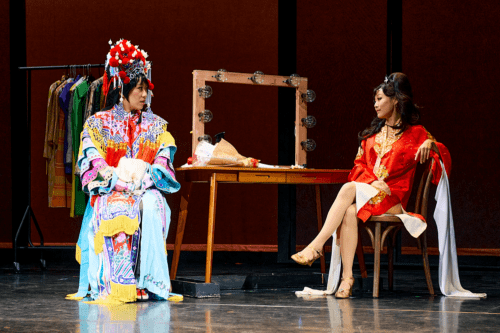
Grace Yoo and Krista Marie Yu
I would be remiss not to mention Gedde Watanabe, who absolutely killed it in “My Best Love.” Watanabe, who just delivered an award-worthy performance of “Someone in the Tree” in EWP’s Pacific Overtures in 2024, continues to teach the audience about the depth of musical theatre through his delivery. The combination of quick wit, absurd humor, and sentimentality makes Watanabe a treasure of our time.
Kenton Chen excels as Harvard—no notes on his sass. The ensemble impresses with crisp choreography and remarkable Asian-American talent, not just for their kung fu skills but for their overall performance quality.
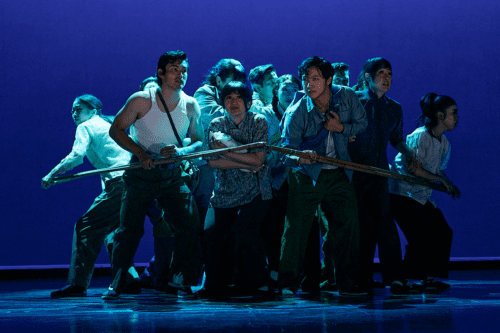
Emma Park, Cooper Lee Bennett, Gemma Pedersen, Hillary Tang, Haoyi Wen, Sally Hong, and Ai Toyoshima
The design team that Tung has assembled is a little uneven. Chen-Wei Liao’s scenic design is rich in color tones. The on-stage band reveal is certainly effective. However, the execution has dampened the overall experience. From the snag on the upstage cyc cloth to Mandarin Chinese translation errors to poor Chinese penmanship, the scenic design distracts from the experience. I also did not love Jiyoun Chang’s lighting design. There are too many moments when the ensemble dancers were dancing in the dark. Also, stage left clearly has a coverage problem. Chang’s color palette choices were mostly on point and well-researched in line with Peking aesthetics. The biggest winner on the team is Ruoxuan Li, whose costume design is simply jaw-droppingly gorgeous. From the Peking Opera headdress variations on Linda Low to the Chop Suey showgirls, you can tell Li had both a generous budget and a ton of fun working on the project. Bravo, Li!
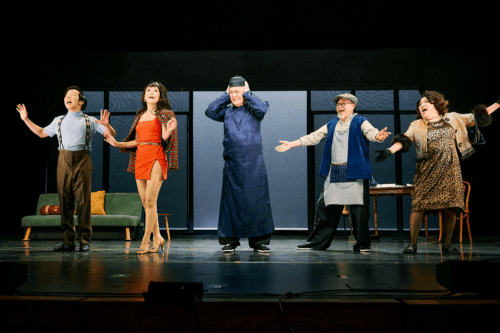
Kenton Chen, Krista Marie Yu, Marc Oka, Gedde Watanabe, and Emily Kuroda
Brian Hsieh’s sound design is perfectly serviceable in the Aratani Theatre. The space is not particularly friendly to concerts, in my experience, but the voices were clearly delivered and heard. My major issue concerns the orchestra’s size and instrumental choices. It is clear that the budget savings came directly from the orchestra. A majority of the time, the band sounds thin. The band could really use one or two more strings to fill out the sound. Also, using a banjo to replace the pipa’s sound is a wild choice. I am certain that Marc Macalintal did his best with the available budget, but the orchestra needed more resources to achieve the sound Hammerstein intended. It would also have been better if the orchestra had genuine Chinese musicians instead of just a few doublers in the midst.
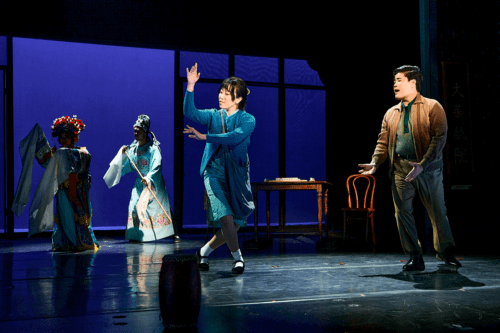
Ai Toyoshima, Brian Shimasaki Liebson, Grace Yoo, and Scott Keiji Takeda
Overall, the show is a success. I am giving this show a wholehearted recommendation. I want to leave this review with the words of David Henry Hwang.
“When I was a kid, I generally had this policy of avoiding plays or movies or TV shows with Asians because they always made me feel kind of icky, but Flower Drum Song was an exception in the sense that you had an actual love story between an Asian man and an Asian woman, which you still don’t see much of today… this is just my own theory—Hammerstein with Carmen Jones… it was part of their principles or their agenda to be able to present this other minority group as being Americans like everybody else.”
So come on out and celebrate this American piece of artwork, because East West Players are helping us once again find that vision of American pluralism.
✦ ✦ ✦ ✦ ✦ ✦ ✦ ✦ ✦ ✦
photos by Mike Palma
Flower Drum Song
East West Players & JACCC presents
Aratani Theatre at the Japanese American Cultural & Community Center
244 S. San Pedro St, Los Angeles, CA 90012
Thurs at 7:30; Fri & Sat at 8; Sat at 2; Sun at 1
ends on May 31, 2026
for tickets ($59–$99), call 213.625.7000 or visit EWP
for more shows, visit Theatre in LA
✦ ✦ ✦ ✦ ✦ ✦ ✦ ✦ ✦ ✦

There are about 500,000 Mandarin speakers in the Great LA area and yet an Asian-American theatre company relied on Google Translate? And they couldn’t find someone that can play a Pipa?
For a company that prides itself on Asian-American representation, these are major missteps.
Did anyone ever think that there might be a reason Flower Drum Song is so rarely produced? Could it possibly be that it is not a very good show with mediocre songs and dull plot? My Grandmother had an expression she loved to invoke. “You can only polish a turd so much!” Well the current production from East West Players isn’t a complete turd but it certainly doesn’t leave you clamoring for more. It’s a real snooze fest! The love birds, Yu and Takeda, have beautiful voices and zero chemistry. The updating of Harvard as a cookie-cutter stereotypical screaming Queen and giving the character the parting song in full drag is so off base and puzzling. The supporting cast is all fine but uneven. The costumes and sets go from Glam-Fab to drearily dull — and don’t get me stated on the lighting. At $160 for the best seats in the house this is not worth the trip to Little Tokyo!
On a side note … I find pre-show “Land Acknowledgment” speeches insulting and demeaning. Unless you’re advocating giving the Native Americans the land we stole back to them I think you should keep your mouth shut and quit with the empty meaningless blather. These speeches were all the rage several years ago and practically every theatre jumped on the bandwagon. Thankfully most have abandoned making them. East West Players unfortunately have not, and their version takes it to the next level and drags it on forever. It’s time to put this overtly “woke” practice back to sleep.
Thank you. I was close, professionally and personally, to the Chinese-American painter who created the opening titles for the 1961 film of Flower Drum Song. And several years later, by request, I became logistically involved with the production of the documentary film To Whom it May Concern regarding Nancy Kwan (Linda Low). I am so pleased to see such great effort has been successfully spent on this production.