


Areas We Cover
Categories

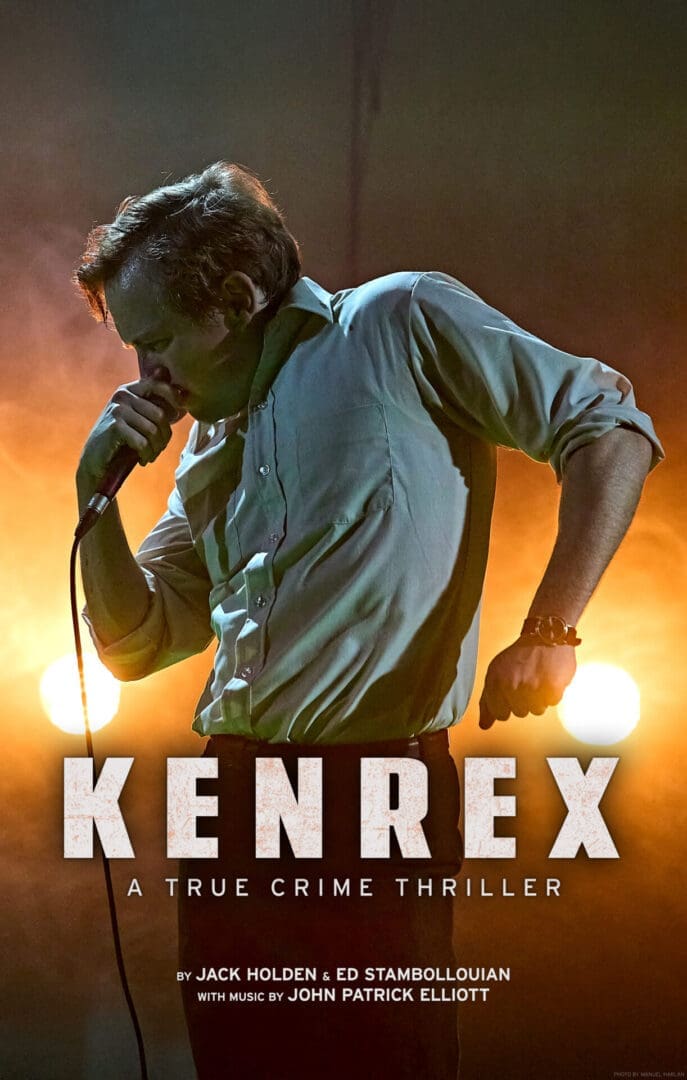
Off-Broadway Review: KENREX (Lucille Lortel)
by Carol Rocamora | May 1, 2026
in New York, Theater
A COMMUNITY PUSHED
PAST THE LAW
An electrifying solo tour de force that turns a
town’s nightmare into gripping theater.

The largest Off-Broadway cast this season—over a dozen roles—may well be at the Lucille Lortel Theatre. Remarkably, they’re played by one actor.
That’s only one reason you should see the amazing Jack Holden in KENREX, the astonishing import from London which opened last Sunday. It’s also among the scariest, creepiest crime stories told on any stage in recent years—and it’s a true one.
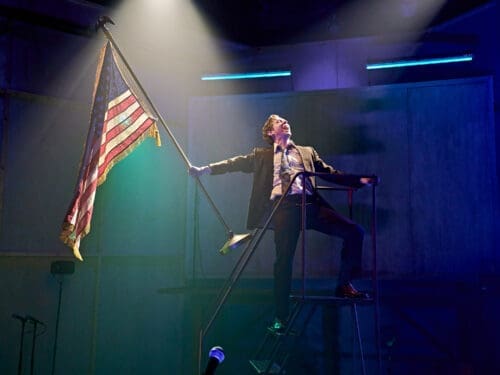
Set in July 1981, KENREX takes place in Skidmore, Missouri, population 400. Our Town it’s not. This blue-collar community of farmers, truckers, and mechanics doesn’t even have a sheriff. What it does have is an out-of-control local bully who terrorizes the townsfolk. The fifteenth child in a migrant family of sixteen, Ken Rex McElroy—construction worker, cattle rustler, grain thief, auto thief, arsonist, gunslinger—has been arraigned twenty-one times and never convicted, thanks to his wily local lawyer, Richard McFadin. Credit is also due to Ken Rex’s intimidation tactics, which include rattlesnakes, guns, fires, a ferocious dog, and other threats against neighbors who might implicate him.
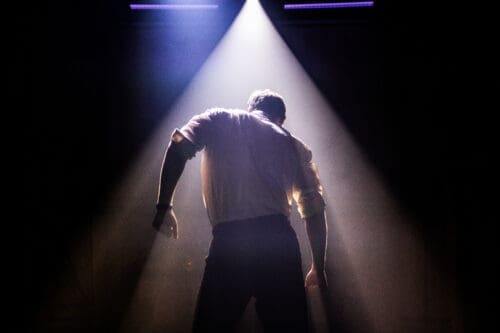
The events leading up to July 10, 1981—and what happens to Ken Rex on that day—form the dramatic arc of the story. We meet the townsfolk—each vividly drawn by Mr. Holden. Along with McElroy and McFadin, they include Tim Warren, the preacher; Ida, the bartender; Lois Bowenkamp, the grocery clerk, and her husband Bo, the butcher; Romaine, the barroom brawler; Janet Goode, the baker; Ron, the auto repair shop owner; Glen, the elementary school teacher; Mayor Steve Peter; Trena, a high school freshman; the Judge; and David Baird, Nodaway County’s prosecuting attorney, who narrates the story.
The number of crimes Ken commits—and his conflicts with community members—escalate with unbearable intensity until July 10, when he is finally brought to trial on an attempted murder charge. A crowd of fifty agitated townsfolk gathers in the heart of town to await the hearing. Then the news comes: McFadin has once again manipulated the system to postpone it. The enraged crowd takes Ken Rex’s fate into its own hands.

John Patrick Elliott
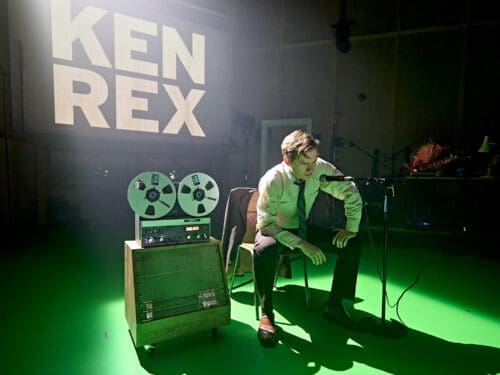
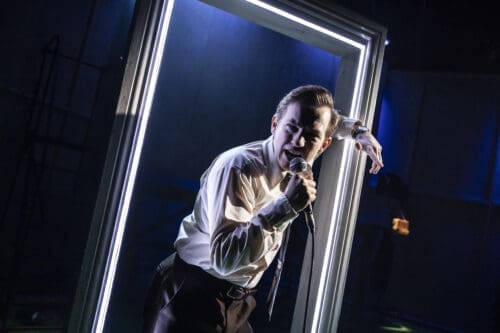
The marvel of this production lies in Holden’s performance and the production’s sensational theatricality, as directed by Ed Stambollouian (co-authoring with Holden). Anisha Fields’s set features a tape recorder center stage, into which the narrator dictates the story. John Patrick Elliott, instrumentalist and composer, sits stage left behind a music stand. He plays original country music on guitar and keyboard, accompanying the narration and crescendoing to a deafening volume alongside the violence (sound design by Giles Thomas). Holden is in constant motion—dashing across the stage, dancing to the music, and shifting two large doorframes (neon-lit by Joshua Pharo) that serve as set and prop. The cumulative effect is electrifying.

Jack Holden’s solo performance is a daring, dazzling tour de force. Dressed in neutral, non-descript trousers and shirt (a costume that never changes), he uses precise physical and vocal techniques to differentiate the many characters. As Ken Rex, for example, he hunches one shoulder, contorts an arm, and clenches his fists to embody the character’s violence. He delivers Ken Rex’s lines with a threatening growl, then shifts to a higher register for female roles. His performance recalls recent virtuoso solo turns: Sarah Snook in The Picture of Dorian Gray, aided by inventive projection technology, and Andrew Scott in Chekhov’s Vanya, who similarly relied on physical transformation.
Curiously, the play’s ending is inconclusive, raising the question of why this story is being retold at all. “There is no justice” seems to hover as an implied moral.
But there may be another reason. Is Ken Rex a parable of a small town as a microcosm of America—a land of lawlessness and violence? That thought lingers in the final moments, with chilling irony, as John Patrick Elliott sings “O Shenandoah,” a nostalgic homage to an idealized Heartland: “Away, we’re bound away/Across the wide Missouri.”

✦ ✦ ✦ ✦ ✦ ✦ ✦ ✦ ✦ ✦
photos by Manuel Harlan
KENREX
Lucille Lortel Theatre, 121 Christopher Street, New York, NY
Tues–Sat at 7; Sat at 2; Sun at 3
ends on July 27, 2026
for tickets, visit Kenrex the Play or Lortel
✦ ✦ ✦ ✦ ✦ ✦ ✦ ✦ ✦ ✦
