


Areas We Cover
Categories

INTERMISSION CONVERSATIONS MOVED ONLINE AND STAYED THERE
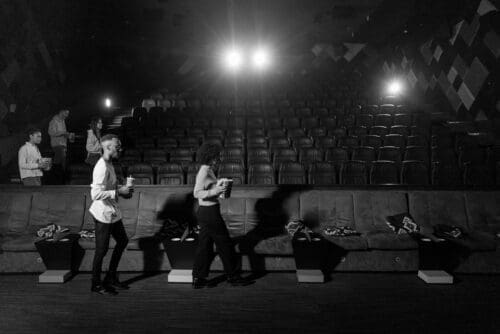
The fifteen-minute interval used to be where the audience really watched the show. Patrons would file out into the lobby, find a friend, look for the bar, and start the conversation. What did you think of that first act, did the staging work, was the second-row sightline as bad as it looked. The exchange happened in real time with the people you came with, plus whatever overheard fragments you picked up while crossing the room. That has not entirely disappeared, but a lot of it has moved to phones, and a meaningful slice has stayed there even after the curtain rises again.
This is not the same observation people made a few years ago about phones at the theater. The use of phones during the act itself is still mostly fought back, with reasonable success. What is new is the way the interval has shifted. The lobby still exists. The bar still serves overpriced drinks. The conversation, increasingly, is happening on Threads, on group chats, and on small theatre-discussion Discords that fill up during the break.
What the Lobby Conversation Used to Do
The interval conversation served several functions that nobody quite named at the time. It gave the audience a way to stretch, to compare reactions, and to settle the body before sitting back down for another ninety minutes. It also acted as a low-key social pressure on the production. A play that lost the lobby during the first interval rarely recovered in the second act, regardless of what happened on stage.
The other function was informational. People learned what they had just watched by listening to other people talk about it. The young patron next to you commenting on a costume choice would shift your reading of a scene without intending to. The older couple comparing notes on the lighting cue would point you at something you missed. The room was a low-noise feedback loop that most audiences relied on without realizing it.
What the Phone Did to the Interval
Once smartphones reached saturation, the interval shifted toward the screen. The shift was gradual through the late 2010s and then more abrupt around 2021 and 2022, when the audiences who returned to indoor theater after the lockdowns brought stronger online social-media habits with them. Many of those habits stuck.
The visible result is that a substantial fraction of the audience now spends part of the interval scrolling through reactions to the same production from other patrons, sometimes including reactions to the very performance in progress. Some patrons post their own thoughts before the second act starts. Others coordinate with friends in different cities who saw the same touring production on a different night. The conversation has become asynchronous and translocal in ways the lobby could never produce. The local reviews that anchor specific productions, like the San Francisco theatre review archive that tracks current Bay Area runs, now share attention space with these intermission-posted comments in real time.
What That Means for Productions
For producers and theater operators, the shift creates a new feedback channel that runs faster than the morning-after reviews. A production can read the room online during the actual interval, and a smart marketing team will be doing exactly that. A weak first act, an actor’s swing performance, or a sound balance problem can be detected through audience posts in the fifteen-minute window between halves.
The productions that read this signal early treat it the way they used to treat audience reaction at first preview. The ones that do not are usually a step behind, finding out the next morning what their audience already told the internet at intermission. The pattern is most visible at touring productions, where the comparisons between cities show up almost instantly.
Where the Conversations Actually Live
The intermission conversation does not concentrate on the largest platforms. Small theatre Discords, group chats, and topic-specific subreddits hold most of it. Twitter and Threads carry the louder voices, but the slower, more considered exchange runs in the smaller rooms. The structure resembles the old usenet rooms or early forums, with a stable group of regulars who recognize each other by handle and discuss productions across long runs.
A few of those communities resemble platforms designed for sustained one-on-one or small-group attention rather than feed scrolling. The shape is similar to what you find over on LustMatch, where a session runs longer than a typical scroll. Theatre discussion online has the same quality of sustained dialogue, even though the subject is completely different. The pattern, of a room with a longer attention window, recurs across very different content categories.
What Producers and Critics Are Doing With This
Professional critics have started reading the intermission conversation as a separate channel from the formal review. A few outlets openly reference audience reactions captured during a production’s run alongside the staff write-up. Producers increasingly quote audience members in their press materials, the same shift touring rock bands made twenty years ago.
The reviews themselves have not gone away. A long-running production like the recent Romeo and Juliet at the Curtain in Jersey City still gets its full editorial treatment from regional critics, and that coverage still drives the bulk of the production’s regional brand. What has changed is the layer underneath, where the audience builds its own running commentary in parallel to the formal review.
What the Lobby Still Does
The physical lobby is not done. It still serves the social function of bringing the local audience together for a few minutes, and the patrons who came with friends still talk to those friends. What has changed is that some of the most articulate intermission commentary has migrated into rooms the production cannot see directly. Whether that is a loss depends on which part of the experience the production values most.
For most theatre operators, the practical answer is to watch both spaces. The lobby tells the truth about how the local audience is feeling. The screen tells the truth about how they are talking about it. Those two truths are usually adjacent but not identical, and the productions that watch both end up better calibrated.