


Areas We Cover
Categories

Theater Review: CRIME AND PUNISHMENT (TUTA Theatre / Chicago)
by C.J. Fernandes | May 16, 2026
in Chicago, Theater
GUILT TRIP
TUTA Theatre turns Dostoevsky’s sprawling
masterpiece into a feverish psychological horror
story of conscience, damnation, and salvation
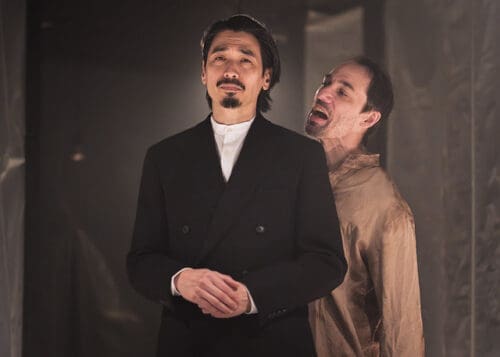
Huy Nguyen, Clifton Frei
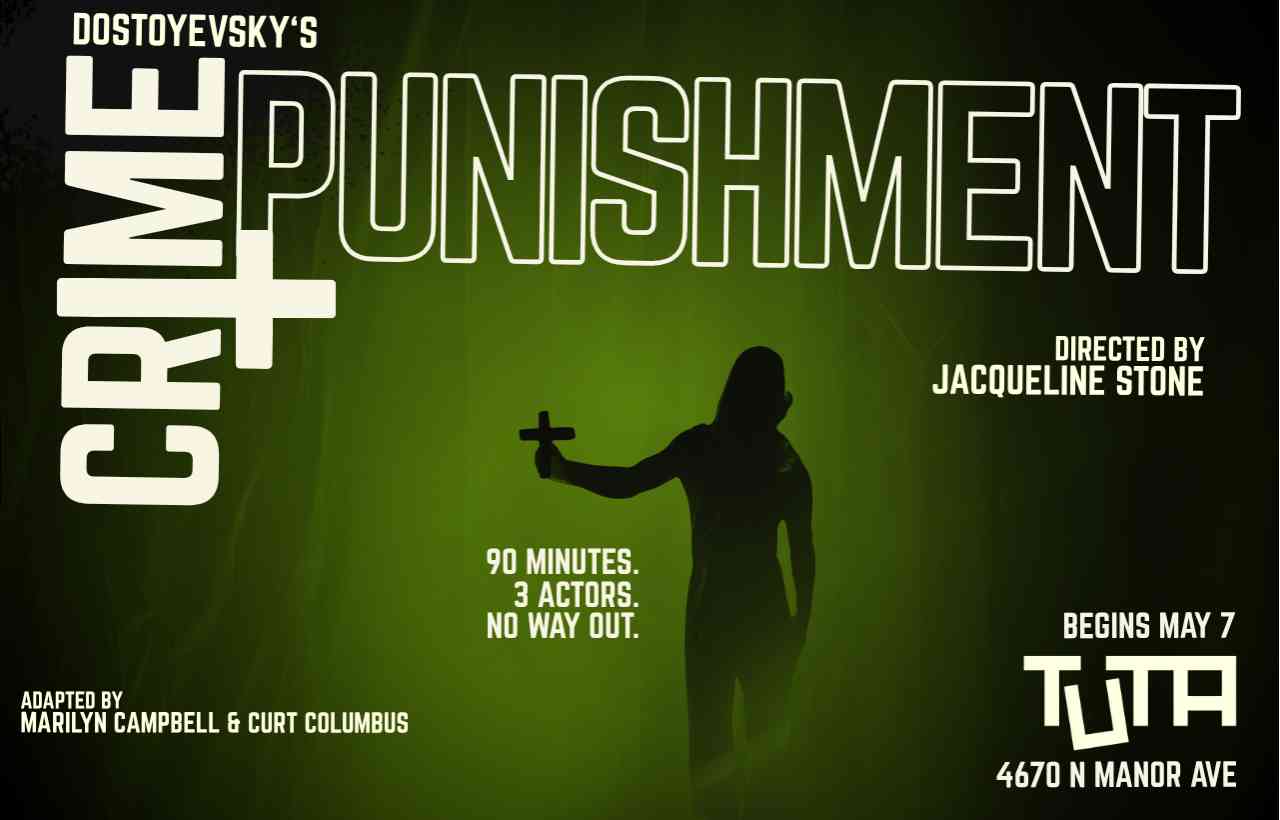
Fyodor Dostoevsky’s masterpiece Crime and Punishment runs around 700 pages and involves close to two dozen significant characters. TUTA Theatre’s production uses as its text a 2003 adaptation by Marilyn Campbell and Curt Columbus: this version involves three actors playing six characters, and runs a lean 90 minutes.
One of these things is not like the other. Or is it?
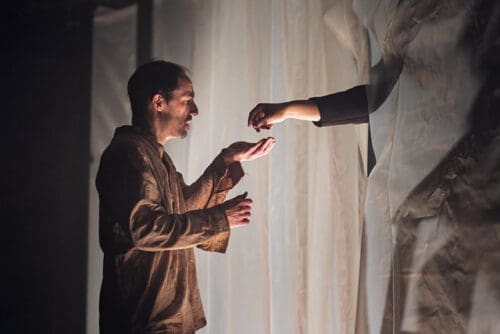
Clifton Frei, Felix (arm)
This powerful adaptation skips the “Crime” portion of the novel, focusing entirely on the “Punishment.” In Tatiana Kahvegian & Keith Parham’s unsettling set, an elevated path winds its way towards the audience. Both sides of the path are obscured by sheets of plastic. Characters will occasionally unzip portions of the plastic to step onto the path, and exit the same way, leaving the impression of an increasingly rent fabric, a lovely metaphor for the deteriorating state of Raskolnikov’s mind. The halogen lighting is soft and indirect, further obscured by mist, and sound designer Stefanie M. Senior’s rhythmic bassline adds to the dream-like feel. There’s a brief crash of sound, the lights flicker for a few seconds, and suddenly Clifton Frei’s Raskolnikov stands in front of us, dressed in shabby clothing and barefoot, his feet dirtied by the loamy soil of the path. His appearance comes on like a jump scare in a fright flick. Appropriate, because Raskolnikov is trapped in a horror story, albeit one of his own making.
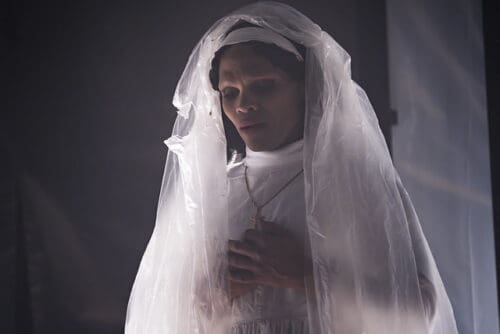
Felix
A pawnbroker, Alyona Ivanovna, and her sister Lizaveta have been brutally murdered with an axe. There are no suspects thus far, but a young man, Raskolnikov, has come forth of his own accord to talk to Porfiry, the detective in charge of the investigation. Raskolnikov, an impoverished but bright student has descended down a path of nihilism; positing — in print — that truly brilliant men are not beholden to the rules of law and morality that govern the mediocre. Raskolnikov has convinced himself that Alyona, to whom he is in considerable debt, is a parasite, and eliminating her is a benefit to society at large. But having disposed of her, he is stricken by doubt and guilt. Per his beliefs, he should not be having these feelings. So, is he a mediocrity like the people he despises? Or is his thesis wrong?
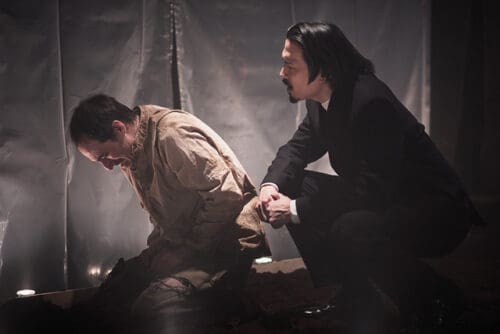
Clifton Frei, Huy Nguyen
The above interpretation is not as neatly binary as it would seem but rather is a rhetorical précis of an enormously complex work. And in that respect, Columbus and Campbell’s adaptation is very nearly précis-like in its minimalism. Stripping down the novel to its central philosophical conundrum has the unfortunate effect of losing the buildup that leads to the murders as well as the intricate relationships between the characters, but what it loses in detail, it gains in emotional intensity. It’s not controversial to say that as brilliant as the novel is, it is not an easy read, and depending on the translation can even be a bit of a slog.
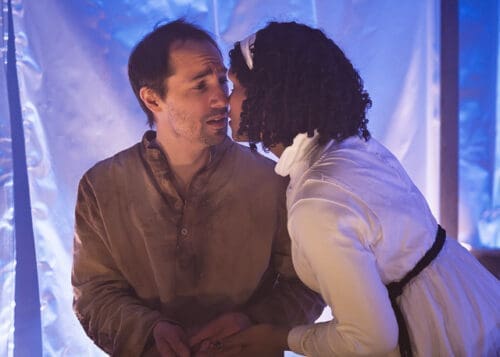
Clifton Frei, Felix
The thriller-like tone of the text is amplified by Jacqueline Stone’s taut direction and Parham’s and Senior’s light and sound design, respectively, to the point that the production frequently plays as psychological horror rather than a slow-burning morality tale. Offsetting this are the supporting performances by Huy Nguyen (primary role: Porfiry; secondary role: Sonia’s father, Semyon) and Felix (primary role: Sonia; secondary roles: Alyona Ivanovna, and her sister Lizaveta). Nguyen is heartbreaking as the alcoholic Semyon, acutely aware of his deficiencies yet unable to do anything to correct them. His performance as the kindly detective Porfiry, however, is this production’s ace in the hole. Unlike Semyon, a failed parent, Porfiry functions as a surrogate father to Raskolnikov, gently leading him to his epiphany and motivated primarily by a desire to save the young man’s soul. Porfiry’s fundamental decency is the most crucial element of this production. Without it, the play would not work.
Huy Nguyen, Clifton Frei
In contrast to Nguyen’s naturalistic performance, Felix’s take on Sonia is more unconventional, presenting her in almost an idealized light. Forced into prostitution to feed her family, the deeply religious Sonia is resigned to her hellish existence, clinging to her faith even as she despairs of her own salvation. Felix pitches Sonia as an archetype, creating an interesting parallel with their portrayal of Lizabetta, who occupies the “virgin” role in the virgin-whore complex. The light design enhances this interpretation, softening to soothing whites for Sonia and Virgin Mary blues for Lizabetta until the colors start to blend into each other.
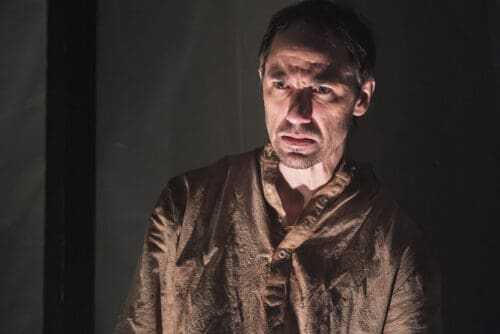
Clifton Frei
As Rasolnikov, Clifton Frei is nigh perfect. On stage for the duration, Frei’s performance falls somewhere between the other two actors in terms of realism. As he swings back and forth, doing intellectual battle with Porfiry and emotional battle with Sonia, Frei gives us a ferocious, hypnotic, and dryly funny performance that sinks its teeth into the audience and never lets go. It’s an astonishing accomplishment and I really cannot praise it enough.
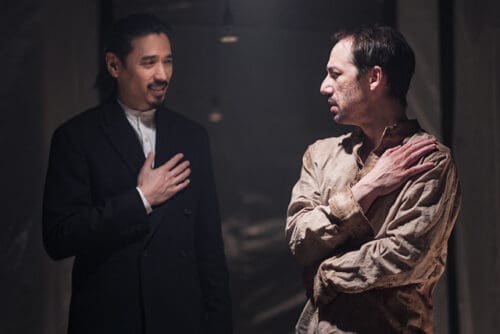
Huy Nguyen, Clifton Frei
During a conversation between Raskolnikov and Sonia, there’s a gorgeous set-piece that evokes the philosophical concept of regressus ad uterum — the desire to return to the womb — and this, along with Felix’s take on Sonia, made me rethink the play as a whole, seeing the supporting characters not as they are in the novel, but as Raskolnikov wants them to be — idealized to the extreme limits of their characters. Raskolnikov is trapped in a feverish nightmare from which there seems to be no escape. The battle here is not for his life — he will hang, one way or another — but for his eternal soul.
There is potentially only one way out. It may not work, but it is his only hope for salvation. It just requires him to take the first step onto the path.
Easier said than done.
✦ ✦ ✦ ✦ ✦ ✦ ✦ ✦ ✦ ✦
photos by Logan and Candice Conner, Oomphotography
Crime and Punishment
TUTA Theatre, 4670 N. Manor Avenue
Thurs and Sat at 7:30; Sun at 3
ends on June 28, 2026 EXTENDED to August 23, 2026
for tickets, (pay-what-you-choose $20-$100), visit TUTA
for more shows, visit Theatre in Chicago
✦ ✦ ✦ ✦ ✦ ✦ ✦ ✦ ✦ ✦
