


Areas We Cover
Categories

Theater Review: EXIT THE KING (A Noise Within / Pasadena)
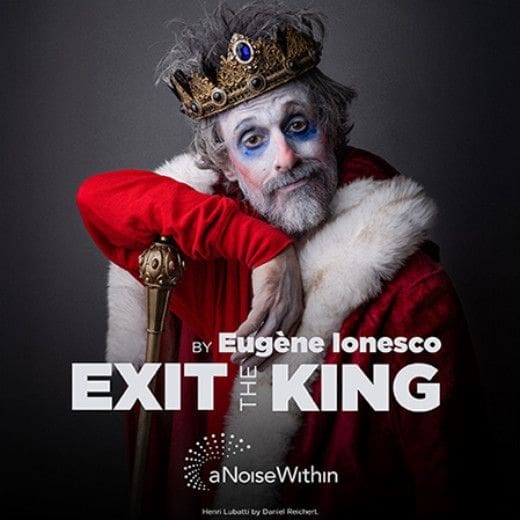
by Ernest Kearney | May 17, 2026
in Los Angeles, Theater
LONG LIVE THE ABSURD
Michael Michetti’s visually stunning
staging transforms Ionesco’s meditation
on death into a thing of eerie beauty

KT Vogt, Henri Lubatti, Erika Soto and Lynn Robert Berg
It is rare, nowadays, when a play by the Romanian Godfather of absurdist theatre, Eugène Ionesco, is staged, and rarer still when it is staged well.
That happy convergence can be currently experienced at the A Noise Within’s production of Exit the King directed by Michael Michetti.
Translated by Donald Watson, Exit the King—or in French, the language Ionesco preferred to write in, Le Roi se meurt—was composed in 1962, during which the playwright was undergoing serious health issues that forced him to confront his own mortality.
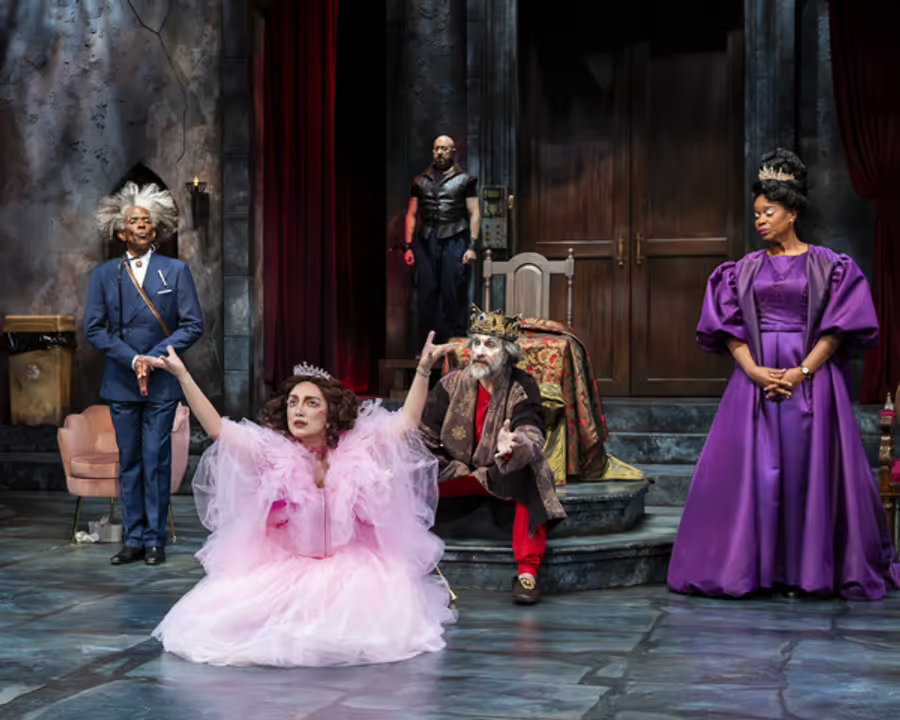
Ralph Cole Jr., Erika Soto, Lynn Robert Berg, Henri Lubatti and Joy DeMichelle
This perhaps explains some of the play’s unique aspects when compared to the body of Ionesco’s work. Its construction is both slightly more classical and its concept somewhat less absurdist than other plays by the playwright, lacking the farcical, vaudevillian aspects so notable in his The Bald Soprano [1] (La Cantatrice chauve), and the surrealism found in his 1959 classic Rhinoceros (Rhinocéros) which closes with a stage swarming with horn-nosed Rhinocerotidae.
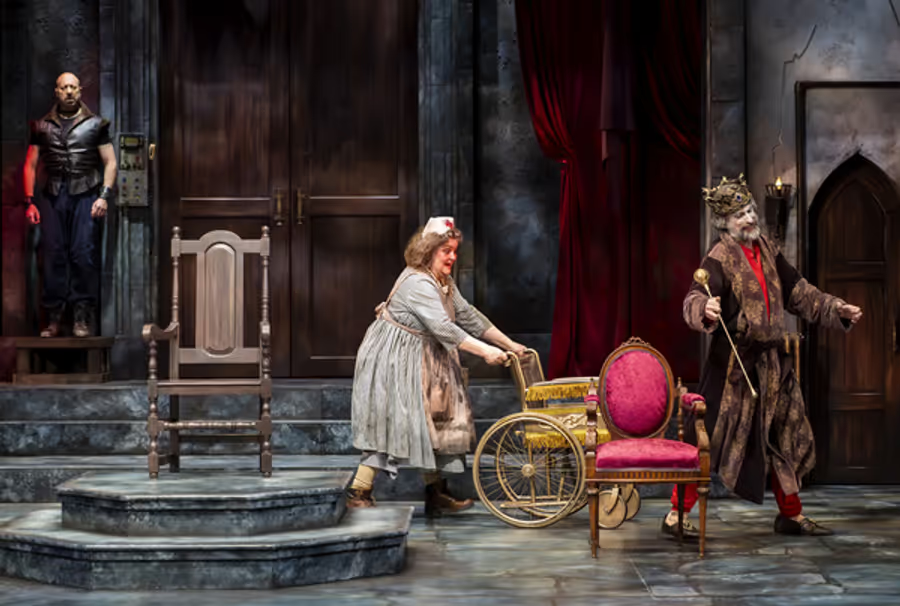
Lynn Robert Berg, KT Vogt, Henri Lubatti
Exit the King could be described as Shakespearean, if the Bard had embraced a more pronounced avant-garde shading.
Set in some unnamed kingdom, all is not well in the royal court. King Berenger the First (Henri Lubatti), a monarch who is accustomed to ordering the sun to shine, usually hedging his bet by doing this during daylight hours, is faced with the inevitability of his own end, and even after a reign and lifetime stretching over hundreds of years, bemoans he is too young to go.
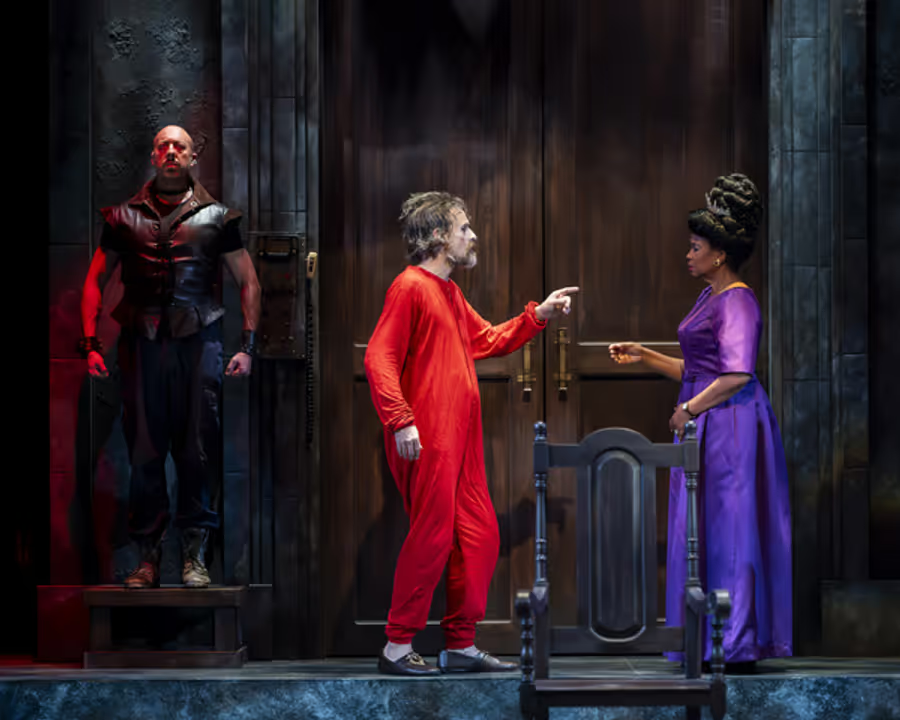
Lynn Robert Berg, Henry Lubatti, Joy DeMichelle
As his life ebbs and both his kingdom and castle crumbles into a vast void about him, by his side stand two Queens; the newer and younger of the pair, Queen Marie (Erika Soto), serves as a life affirming cheerleader encouraging her peerless lord to keep sucking breath, lecturing him that “exit” and “die” are just words, and reminding him how pretty she is. Reason enough to live, she thinks. Queen Marguerite (Joy DeMichelle) the older, original royal consort, in league with the court doctor (Ralph Cole Jr.), struggles to make the ailing monarch accept the inevitable—she dismisses all the histrionics displayed over it as “Nothing but hope on their lips and tears in their eyes.” In other words, useless.
Since every sovereign needs minions, Ionesco provides them in microbial fashion: two long-suffering retainers—the bent-over, waddling Juliette (KT Vogt), who scurries about at the beck and call of her betters, meaning every other character on stage; and the booming-voiced Major-domo and Guard (Lynn Robert Berg).
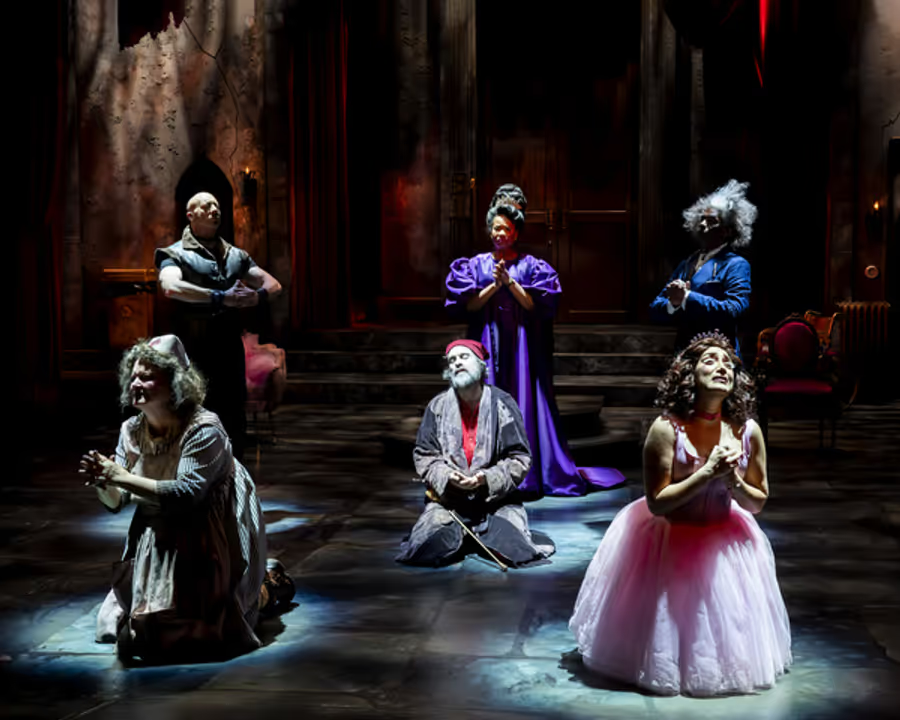
(front) KT Vogt, Henri Lubatti, Erika Soto, (back) Lynn Robert Berg, Joy DeMichelle, Ralph Cole Jr.
As one who likes their “Absurdity” with a capital “A”, this production did not disappoint, but what was surprising was the breathtaking exquisiteness of Michetti’s staging, necessitating a tip of the hat with great flourish to the artistry of Angela Balogh Calin (costumes) and Tony Valdés (wigs\make-up), and the fusion of the skilled craftsmanship of Tesshi Nakagawa (scenic), Jared A. Sayeg (lighting), and Jeff Gardner (sound).
Even if one spoke not a word of English, this mounting would still be a delight to behold. It goes without saying the superlative cast assembled on the stage contributes mightily to that experience of satisfaction. DeMichelle, Soto, Cole, and Vogt display a craft and talent for which one might assume the term “flawless” was coined, while Berg obtains the perfection Ionesco sought in posing his character as the omniscient chorus commenting on the universe fading before us.

Henri Lubatti
But at the core is Lubatti’s exceptional performance (aided by clowning consultant Matt Walker). “Berenger” is a role that bears a great burden. The character appears in four of Ionesco’s absurdist morality plays. He is the author’s Everyman (Elckerlyc), a synthesis of Little Tramp, Wandering Jew, and Charlie Brown. He is the suffering Christ bearing the cross of human fragility and folly as he drags the burden of Richard III’s horse, Schrödinger’s cats, and all the rest of life’s perplexities to Golgotha. Lubatti carries that burden with a stunningly graceful sincerity and a searing humanity.
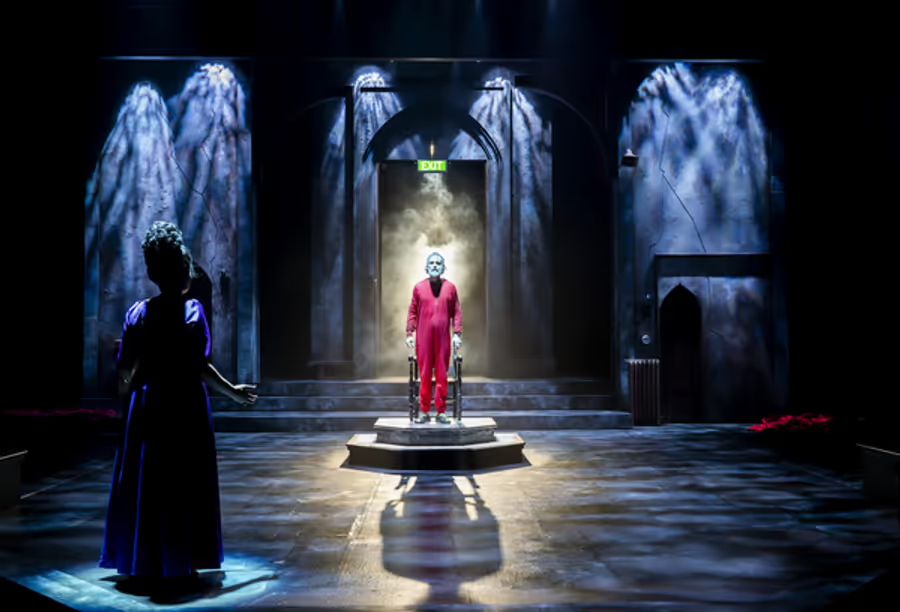
Joy DeMichelle and Henri Lubatti
Exit the King expounds the philosophical viewpoint of solipsism and likely provided the framework for Stephen King’s novella The Life of Chuck, as well as the criminally neglected 2024 film version of the same name (directed by Mike Flanagan and starring Tom Hiddleston and Mark Hamill). Solipsism emphasizes that we can only be certain of the existence of one’s own mind, and that when we die, the “world” we know likely dies with us.
At the end of Michetti’s staging, king, kingdom, and reality disintegrate into death’s empty void with Lubatti slowly disappearing into a deepening darkness surrounded by towering uncaring wraiths.
It is an image whose terror is only diminished by its beauty.
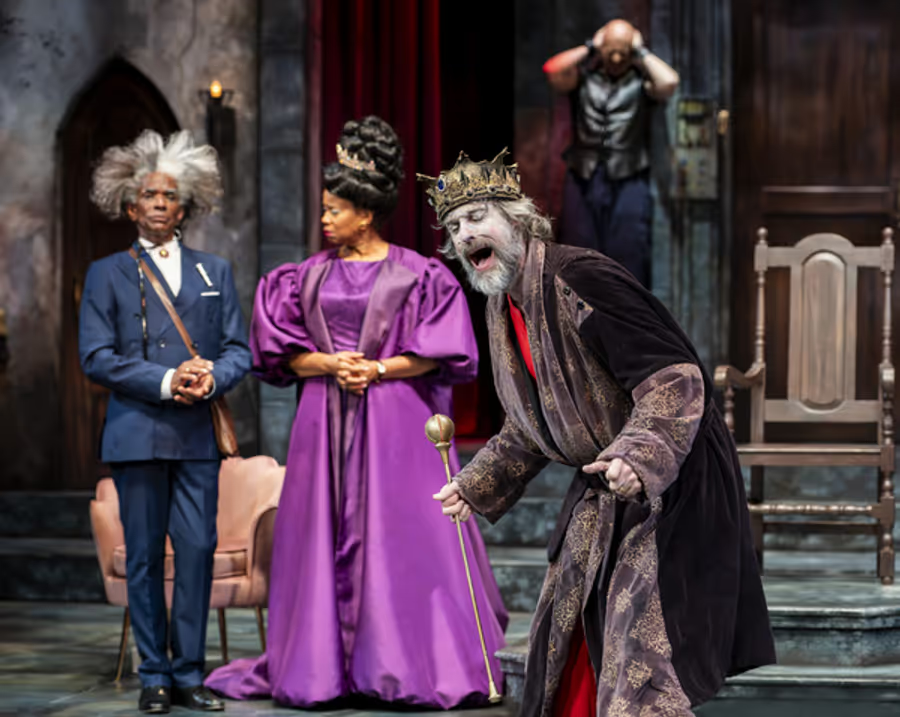
Ralph Cole Jr., Joy DeMichelle, Henri Lubatti and Lynn Robert Berg
✦ ✦ ✦ ✦ ✦ ✦ ✦ ✦ ✦ ✦
photos by Craig Schwartz
Exit the King
A Noise Within
3352 E. Foothill Blvd. in Pasadena
Thurs–Sat at 7:30; Sat & Sun at 2
ends on May 31, 2026
for tickets (starting at $41.75, including fees), call 626.356.3100 or visit A Noise Within
for more shows, visit Theatre in LA
✦ ✦ ✦ ✦ ✦ ✦ ✦ ✦ ✦ ✦
[1] First produced in Paris in 1950, a subsequent Parisian production has been running since 1957 at the Théâtre des Noctambules, bestowing on the play the honor of longest continuous run in a single theatre.
