


Areas We Cover
Categories

Theater Review: BRIGADOON (Pasadena Playhouse)

by Michael M. Landman-Karny | May 18, 2026
in Los Angeles, Theater
BRIGADOON EARNS ITS MIRACLE
Pasadena Playhouse’s revelatory new production
treats Lerner and Loewe’s fable not as nostalgia,
but as a question of faith, sacrifice, and survival
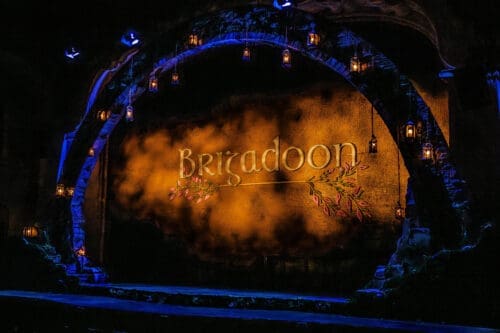
Brigadoon at Pasadena Playhouse
Dormancy is a survival strategy. Seeds use it. Bears use it. A village in the Scottish Highlands uses it in Brigadoon, which premiered on Broadway in 1947 — the year after the Second World War ended and the year before the State of Israel was founded. Alan Jay Lerner was a Jewish New Yorker. Frederick Loewe, born in Berlin to a Jewish operetta singer, had arrived in America at twenty-three. Their fable about a village hiding from violence pressing in from outside was no abstract thought experiment. In Brigadoon, a Scottish village vanishes into the mist each night and returns for only one day every hundred years, the result of a miracle the old minister bargained for to protect his people from violence pressing in from outside. A stranger who stumbles into the village may remain there forever, but only if he loves someone enough to surrender everything else in his life. One day awake; the rest of his life forfeited. That is the bargain. The question underneath it has not aged. What are you willing to give up for something that lasts? Most of the century since Lerner posed it has been spent answering: less than we thought.
Alexandra Silber’s new book for the Pasadena Playhouse, directed and choreographed by Katie Spelman, is a full rewrite, not a touch-up. The score is intact, every Loewe melody and Lerner lyric in place. Around the songs Silber has built a substantially different play. Tommy Albright and Fiona MacLaren are now in their forties rather than their twenties. Jeff Douglas, the wisecracking sidekick of the original, is a recent widower whose grief is the second engine of the evening. The village’s wise elder, Mr. Lundie in Lerner, is now the Widow Lundie, played by Tyne Daly at eighty. Meg Brockie, originally a frisky dairymaid, has become Keeper of the Culture. Most important, the violence outside Brigadoon is no longer abstract. The bargain has a body count. The Pasadena Playhouse has staged the most serious Brigadoon of my lifetime.
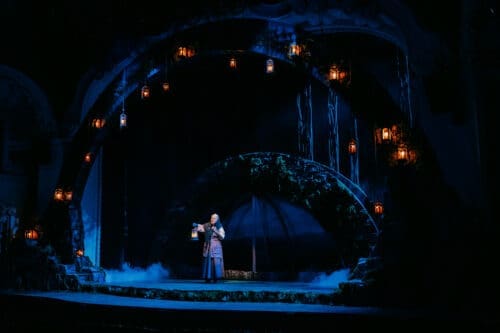
Tyne Daly
Five in the morning in a Highland forest. Tommy Albright (Max von Essen) and Jeff Douglas (Happy Anderson) are lost. Their phones have no signal. The maps they brought do not match the ground. Tommy is forty, well-dressed, well-paid, quietly suffocating. Jeff is a few months a widower and a few drinks past dignified. The mist breaks and they hear singing across the valley. They walk toward it and find a village that is not on any map, on a market day in a century that ended three hundred years ago. Tommy meets Fiona MacLaren (Betsy Morgan) at her father’s woolens stall. Something happens in the look between them that does not look like flirtation. It looks like the click of a key into a lock both of them have been carrying without knowing. Jeff meets Meg Brockie (Donna Vivino) at her tavern and is told, against his will, that grief can sit at a bar with a fiddle in the corner. The town is preparing for a wedding. Jean MacLaren (Kylie Victoria Edwards), Fiona’s younger sister, is marrying Charlie Dalrymple (Daniel Yearwood), the golden boy of the village. Charlie’s lifelong rival Harry Beaton (Spencer Milford), the wool merchant’s son, has loved Jean since they were children, and the wedding is undoing him. By midday Tommy and Fiona have walked into the heather. By late afternoon Tommy finds the MacLaren family Bible left open on a table and reads an entry recording Fiona’s birth and Jean’s marriage to one Charles MacPherson Dalrymple, dated 1726. The Charlie about to walk into the church that evening shares the bridegroom’s name. The Fiona he has just left in the heather was born in the early 1700s. That is where I will stop describing what happens. The rest is the bargain, and the bargain is the show.
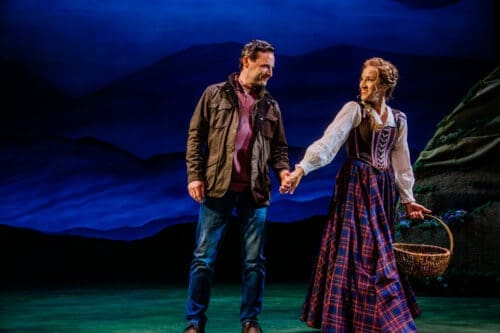
Max von Essen and Betsy Morgan
Strip the mist and the tartan and the time-slip device and the show makes its case through music with no fat on it. Loewe writes short melodic lines that go where they need to go and stop. “Almost Like Being in Love” moves at the gait of a man taking the stairs two at a time. The phrase does not pause to admire itself. “Waitin’ for My Dearie” is built on repetition the way a vow is built on repetition. The melody reshapes itself just enough each pass to keep belief from curdling into delusion. “The Heather on the Hill” is the score’s statement piece, and Loewe stays disciplined even there. The line opens, lifts, and lands. Lerner’s lyric leaves space the music can fill. Neither one tells you how to feel about the heather. They show you, and they trust you to keep up.
Darryl Archibald’s music supervision and Brad Gardner’s conducting give the original Ted Royal orchestrations the air they need. Twenty-two players in the pit, including a full string section. Hearing actual strings under a Lerner-and-Loewe score in 2026 is a joy I had forgotten to expect. Regional theater used to take this for granted before synthesizers taught a generation to settle for less. Archibald has arranged and orchestrated a new sung prologue for Tyne Daly that earns its keep. An onstage cèilidh band, the Scots word for a traditional music-and-dance gathering, sits visibly on the side of the playing space with bagpipes folded into two numbers. The village has a sound now, not just a costume. Spelman’s choreography takes its line from Agnes de Mille without copying her, which is the right call. De Mille built the original dances to carry information the book could not. Spelman lets the dances do that job here, particularly in a second-act sword dance led by Spencer Milford and a funeral dance built around Jessica Lee Keller’s Maggie Anderson, both of which arrive late in the show.
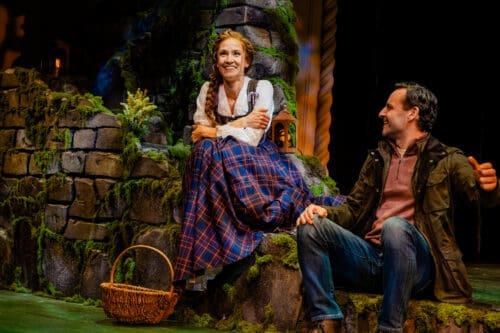
Betsy Morgan and Max von Essen
Betsy Morgan, a Broadway veteran of Kimberly Akimbo, The King and I, and A Little Night Music, is the production’s vocal center. She sings the way someone speaks when they have something to say, lines arriving fully formed rather than displayed. She also plays the role with a heat the part has rarely had. Early on, when Tommy calls the village “the backwoods,” Morgan’s spine straightens before her face does, and the correction lands hard enough to earn Silber’s best new line: “what matters tae ye, the world has given ye, an’ what matters to me, the world has tried to take away.” She does not soften it. Max von Essen, the Tony-nominated star of An American in Paris, plays Tommy’s cowardice as cowardice. This is the only way the part works at forty. A twenty-two-year-old Tommy is undecided. A forty-year-old Tommy is the man undecidedness made. Von Essen’s singing has the polish you expect, but also a useful ache under it; he does not sell Tommy’s songs as romantic declarations so much as belated recognitions. Happy Anderson, in the non-singing role of Jeff, does most of his work with the corners of his mouth and the lower register of his voice. He gets a laugh, then he does not get a laugh, then he gets a laugh again, and the audience does not notice until later that he has walked them down a flight of stairs into something they did not plan to feel.
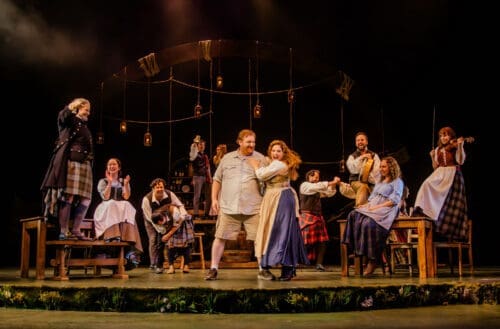
Happy Anderson, Donna Vivino and Ensemble
Donna Vivino’s Meg is the production’s comic engine and the first place the show lets its grieving second protagonist sit down. Vivino sings with the same bright, tough intelligence she brings to the comedy, turning Meg from a comic detour into one of the evening’s sources of oxygen. Tyne Daly, Tony winner, six-time Emmy winner, working since 1961, plays the Widow Lundie like a person who has been waiting for someone to finally ask the right question. When she explains the village’s bargain to Tommy late in the first act, she does it the way doctors deliver real diagnoses, slowly, without affect, watching to see if the patient can stand it. Daniel Yearwood and Kylie Victoria Edwards make Charlie and Jean genuinely fond of each other, which is harder than the wedding-scene cliché suggests. Spencer Milford’s Harry dances like a man who has been told all his life that he is the wrong shape for the room he was born into, and is finally too tired to keep apologizing for it.
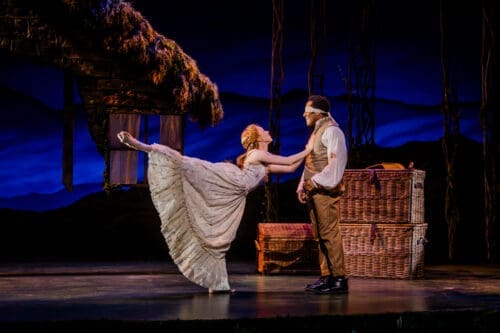
Kylie Victoria Edwards and Daniel Yearwood
Jason Sherwood’s sets are at the scale and finish of a touring Broadway production. The money is on the stage. A large rocky bridge, the geographic and structural pivot of the show, sits with the weight of real masonry and pays off in two of the evening’s most consequential scenes. Meg’s Scottish pub is built the way pubs are actually built, with the dense crowdedness that turns a room into a public space rather than a stage set. A high-end New York cocktail bar arrives later, all dark wood and brass and the low light bars use when they want you to stay for another. Jaymi Lee Smith’s lighting moves between those three worlds without strain. Raquel Adorno’s tartans and dresses are tailored to read from the back of the house, which is what tailoring is for. The hundred-year-old Pasadena Playhouse stage shows its limits in a few clunky transitions. None of it breaks the spell. The design team has built a Brigadoon that earns the music.
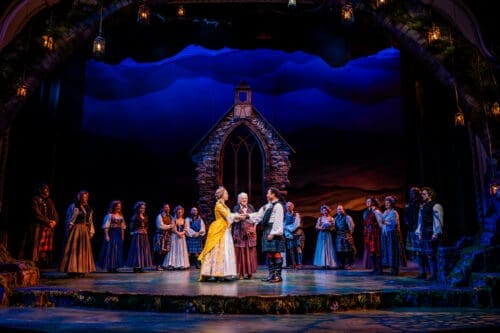
Ensemble
What Silber’s revisal earns, and the reason the production lands, is the rewrite of Jeff. In Lerner he is a foil whose disbelief makes Tommy’s belief glow by contrast. Silber has given him a reason not to believe, and the reason sits inside the same conceptual room as Brigadoon itself. Jeff had a love that was supposed to last and it did not. He has come to Scotland to drink through what is left of him. By the time he is at Meg’s bar with his trousers split and a fiddle in the corner, the play is building a second protagonist underneath the first, a man who is being asked the show’s central question and has already had it answered for him by a disease he could not negotiate with. Anderson does not underline this. He lets it happen at the edges of scenes. The original play does not have this character. The revisal is built on him.
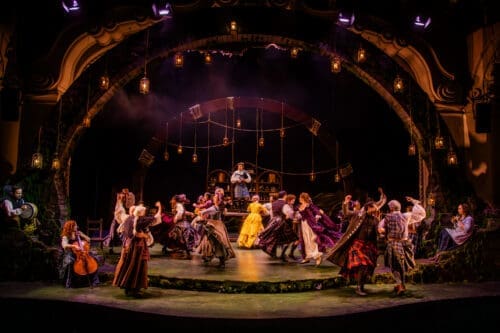
Ensemble
The other changes work because they cost something. Maggie Anderson’s silence used to be a delicate character note. Now it is the consequence of historical violence, and Jessica Lee Keller’s funeral dance in the second act becomes the production’s emotional ceiling rather than a decorative interlude. Fiona at forty is a different argument than Fiona at twenty-two, and Morgan plays the difference. “Waitin’ for My Dearie” sung by a woman who has actually waited is a harder and better song than the one sung by a girl who has just begun. The Widow Lundie’s exposition scene, structurally the show’s old soft spot, now does real work because Daly plays it as a woman who has paid for what she is about to explain. Forsythe’s sacrifice, which Lerner only implied, is named: he asked for the miracle and was separated from his people as the price. That naming sharpens the bargain the rest of the show is built on.
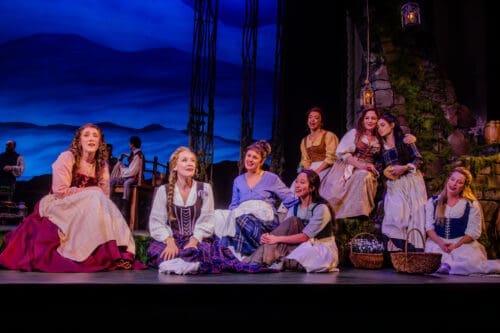
Betsy Morgan and Ensemble
What this revisal does not quite manage is the question Lerner’s original was actually answering: Is faith a form of love? Can love compel a miracle? In Lerner, those are the same question, because faith and love are the same currency, and the show’s outcome is settled by what the central character believes. Silber has split that currency. The character who carries the show’s question of belief is no longer the character who pays its emotional cost. Jeff does the spiritual work. Tommy collects on it. The man who changes most is not quite the man the ending rewards. The Widow Lundie’s closing line about grace covers the gap beautifully. Jeff has paid the price the theme is asking about. The script is one draft away from noticing what it has done with that ledger, and the production is good enough to make you notice it for them.
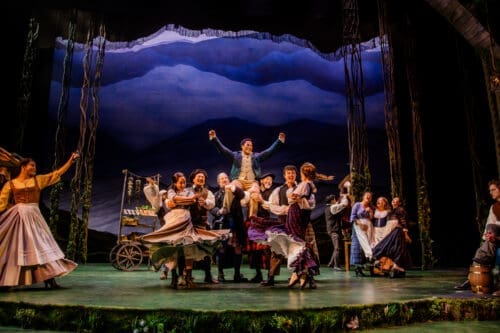
Ensemble
The other place the next draft should look is the Scots language. Silber clearly loves it. There are no surtitles at the Pasadena Playhouse, and every unfamiliar word that slips past the audience is simply gone. Meg’s extended tavern scene with Jeff turns, in its second half, into something perilously close to a vocabulary lesson: haiverin’, haud yer wheesht, numpty, skoosh. Vivino is charming enough to almost sell it. She should not have to. The scene stops the show for instruction at the very moment it should be accelerating toward the wedding. The audience does not need a glossary. The audience needs the rapport between two grieving people. That rapport is what tells us Jeff might survive what he came to Scotland carrying. Cut the lecture. Trust the words to land in context. Lerner trusted his audience to understand “forfochen” from the way it was used. Silber should too. The accents are mostly excellent, though one or two performances tip so far toward authenticity that intelligibility begins to suffer.
I will say nothing about how the show ends except that it arrives exactly where the bargain has been pointing from the first scene, and that Spelman stages the final image with a restraint the script itself does not always trust. The audience around me was tearing up. So was I. Some of that came from the production. Some came from the bones of the musical itself, which are far sturdier than the discourse around Brigadoon has admitted for decades. A fable about what you would give up for something that lasts is not a quaint thing to put on a stage in 2026. It is the thing the rest of the culture has stopped being willing to ask. Silber asked it. Pasadena Playhouse staged it. The result is the first regional production in years that justifies the expense and ambition of reviving a large-scale Golden Age musical, and the first new book of Brigadoon in my lifetime that takes the show’s central question seriously enough to be worth arguing with.
I hope there will be another draft of this script, because there should be. Cut the Scots lectures. Even out the ledger between the two men the show is now asking us to carry. Let Jeff receive more of the emotional credit he has earned. The rest can stay: the rewoken village, the silent dancer, the widow who has paid for what she knows. Brigadoon is a show about dormancy, about the parts of a life put under glass in order to survive. Anybody who has spent the last several years watching a culture chew through things that used to be load-bearing understands the trade. The miracle in Lerner’s village is that it learned how to sleep without dying. The miracle of this production is that someone in Pasadena remembered how to wake it up.
✦ ✦ ✦ ✦ ✦ ✦ ✦ ✦ ✦ ✦
photos by Jeff Lorch
Brigadoon
Pasadena Playhouse, 39 S. El Molino Ave. in Pasadena
ends on June 14, 2026
for tickets, call 626.356.7529 or visit Pasadena Playhouse
for more shows, visit Theatre in LA
✦ ✦ ✦ ✦ ✦ ✦ ✦ ✦ ✦ ✦

Great review. Very well-written and insightful, with the sort of constructive critiques that are the hallmark of a reviewer-as-collaborator rather than reviewer-as-wise-cracking-enemy. Thank you.
Geoffrey, thank you. Critics in Los Angeles operate under a particular suspicion: that showing up with standards is an act of hostility. The attacks tend to follow a script. You’re not a supporter. You’re not a cheerleader. You’re a problem to be managed.
I can speak for myself and for a handful of colleagues I trust. The job has two purposes and they’re not in conflict. Help a reader decide whether a ticket is worth buying. Hold the work to a standard worth meeting. Neither of those is an attack. Both of them are the work.