


Areas We Cover
Categories

Theater Review: TARTUFFE, OR, THE CHARLATAN (The Conspirators / Chicago)
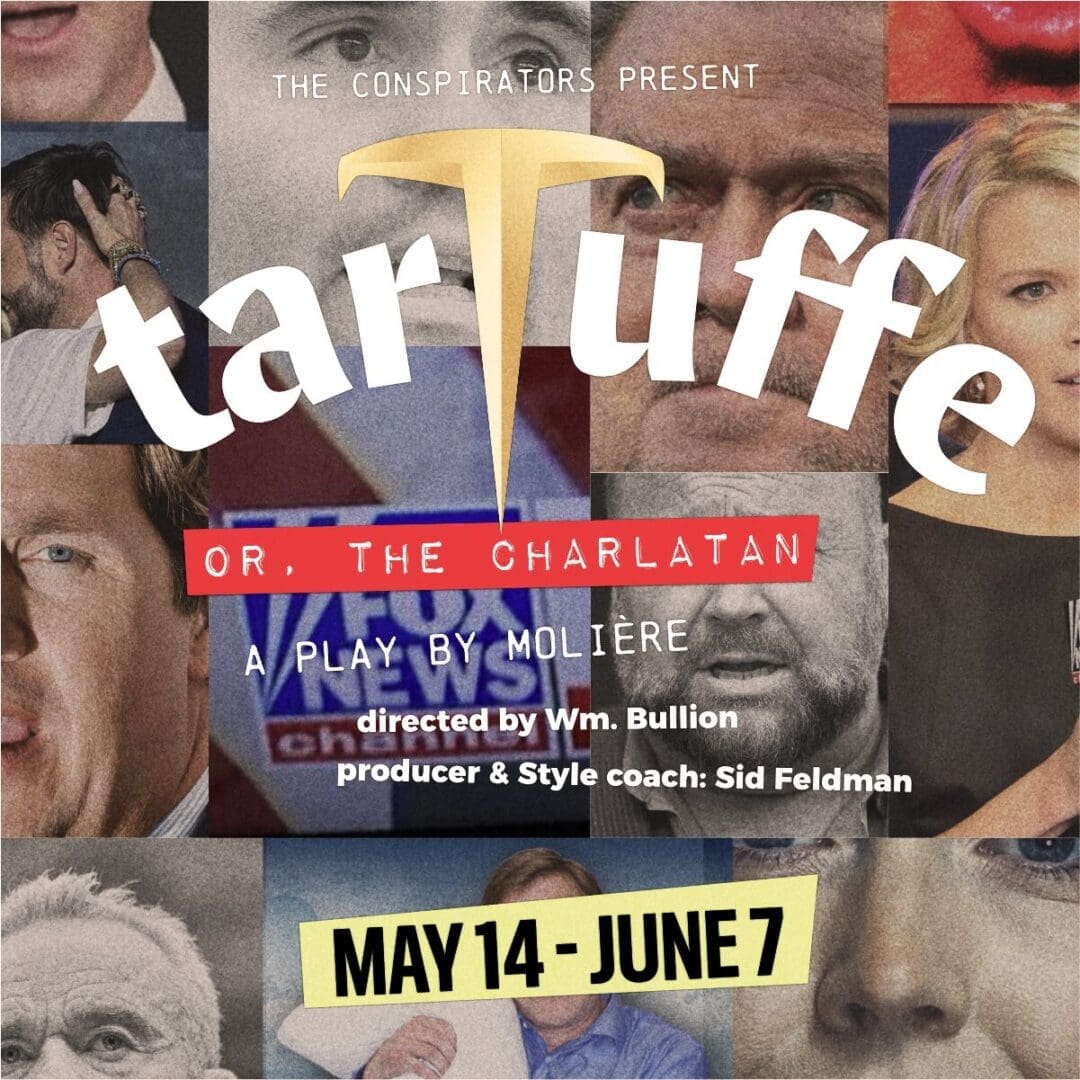
by C.J. Fernandes | May 23, 2026
in Chicago, Theater
PUNK, PRAYER,
AND PURE CHAOS
The Conspirators’ neo-commedia
take on Molière finds fresh
mischief in a timeless satire
What could be better than a saucy, irreverent, seventeenth-century French farce? How about a saucy, irreverent, seventeenth-century French farce performed in the twenty-first century, that marries a punk aesthetic to a modern interpretation of a sixteenth-century Italian dramatic tradition, and is set to a New Wave soundtrack from the late twentieth century?
If that previous sentence gave you a headache or made you want to run for the hills, fear not; here’s all you need to know about The Conspirators, a company of deranged—in the best possible way—actors and The Style, which is their stock in trade.
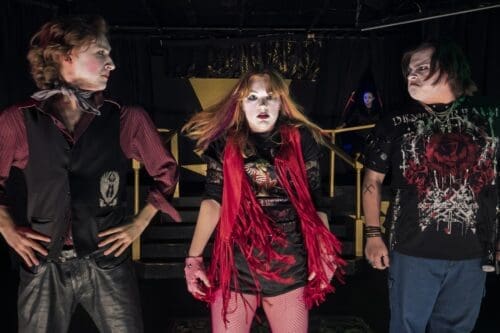
Jacob Dorris, Riley Marie Fortin and Anthony Raúl Soto
The Conspirators are a neo-commedia dell’arte troupe. They perform in elaborate kabuki-esque make-up, with deliberately artificial blocking. With all performers facing forward, an actor delivers their lines straight to the audience. Once a line is spoken, the cast turn their heads as one to face the recipient of the line, who then delivers their own piece of dialogue and so on. The delivery is overly dramatic and draws from multiple performance traditions; put Henry DelBello’s Orgon in a different costume and he could be delivering attakatha verse in South India; Oline Hale’s Elmire is mime-like in appearance but (relatively) naturalistic in performance; and Tucker Privette’s Dorine is straight out of the British drag tradition both in costume—enormous fake breasts and all—and affect. This should be, at the very least, chaos.
I have never watched The Conspirators before, so I have no idea how they pull off their other shows, but Molière’s Tartuffe, or, The Charlatan suits them perfectly. The intricate rhymes and bawdy humor of this vicious send-up of the gullibility of the rich and the hypocrisy of the Pharisees of the world flow out of the actors like they have been speaking it all their lives.
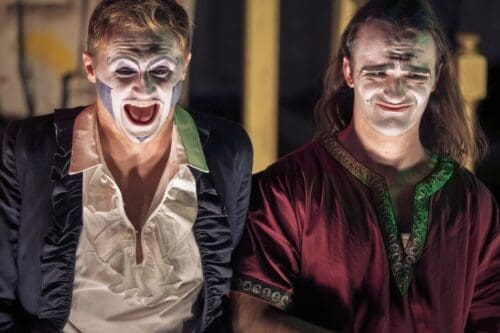
Henry DelBello and Deacon Leer
Ollie Voirin’s costumes are hand-me-down punk for the most part, and vaguely South and Southeast Asian for the rest. Morgan Laslo’s scenic design covers the walls with graffiti-ish canvases that are far more detailed at second glance, and as Plastic Bertrand blares through the space, the cast comes bounding out. We are in the house of a wealthy man named Orgon (Henry DelBello, whose features seem to be made of rubber), but Orgon himself won’t make an appearance until a bit later. There is a crisis brewing and the rest of the family and servants have gathered to discuss it. Orgon has fallen under the influence of a “religious” man called Tartuffe (played to oleaginous perfection by Deacon Leer). Orgon worships the ground Tartuffe walks on. He will eventually offer him his daughter’s (Riley Marie Fortin) hand in marriage, even though she is already betrothed to the love of her life, Valère (a splendidly vain and foppish Jacob Dorris). Everyone is outraged, and Elmire’s maid Dorine (Tucker Privette) takes matters into her own hands, plotting and scheming with the different members of the family to try and rescue Orgon from Tartuffe’s influence.
It’s all delirious action and uproariously funny for most of its two-hour running time. The jokes come at you at warp speed, but it only takes a few minutes to get used to the rhythms of the dialogue, and even if you miss a couple, it’s no big deal; there will be more along in a moment.
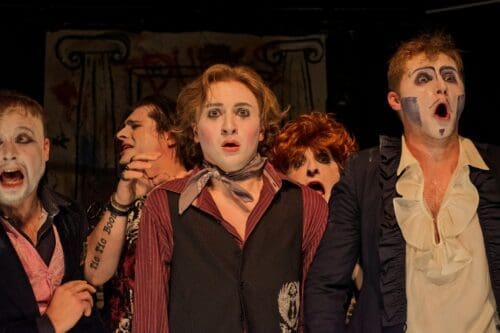
Ensemble
Director Wm. Bullion expertly guides his large cast through the intricacies of plot and dialogue. The dialogue is tweaked by the actors in several places—mostly involving clever interjection of swears without disrupting the meter—and it’s mostly successful: an impressive feat in itself. There were a few issues I had with the show: Damis’s rage is the reason he is constantly screaming but while that may work in concept, in practice, the schtick gets old fast, and much worse, renders most of his dialogue unintelligible. I appreciated the attempt to emphasize the parallels between a certain voting bloc in the USA and Orgon and his mother, but it came across as forced to me. It is also unnecessary.
On the other paw, Tartuffe traditionally ends with one of the most famous deus ex machina endings in the history of theatre, and this show so neatly sidesteps that ending that it made me want to run home and re-read my copy to try and trace how and where the transition occurred.
Before we even get to the actors we must stop and acknowledge the most important performer in the production, even if he is never on stage; that would be percussionist Tom Jasek, whose musical accompaniment holds everything together. Aside from helping the performers—and the audience—keep time, his arsenal of perfectly timed whistles, bells, and other sounds frequently drew laughs as big as anything spoken on stage.
The cast is mostly excellent across the board but if I had to pick favorites it would be Tucker Privette’s Dorine—a bit unfair that; he gets to dress in drag, wear giant breasts, and gets most of the best lines, but such is life—and Oline Hale’s feisty and spirited Elmire; her seduction of Tartuffe has to be seen to be believed.
I thoroughly enjoyed this show, although truth be told, some of my favorite bits came from the moments in between the dialogue. To name one, Henry DelBello’s Orgon sent me into squeals of laughter with just the way he walks up the stairs. Even the mishaps are comedy gold: the pieces of tape that covered Dorine’s right (fake) nipple kept coming unglued and Privette’s attempts to push them back into place, without ever breaking character or losing his rhythm—he never did break, natch—became my, and I suspect the audience’s, favorite running gag in the show. When the tape finally fell off in the second act, the roar of laughter was deafening.
Laughter like that is good for the soul.
✦ ✦ ✦ ✦ ✦ ✦ ✦ ✦ ✦ ✦
photos by Logan and Candice Conner, Oomphotography
Tartuffe, or, The Charlatan
Stars & Garters
3914 N. Clark St. in Chicago
ends on June 7, 2026
for tickets, visit Humanitix
for more info, visit The Conspirators
for more shows, visit Theatre in Chicago
✦ ✦ ✦ ✦ ✦ ✦ ✦ ✦ ✦ ✦
