


Areas We Cover
Categories hhhh

Theater Review: ANTIGONE (Antaeus Theatre Company / Glendale)
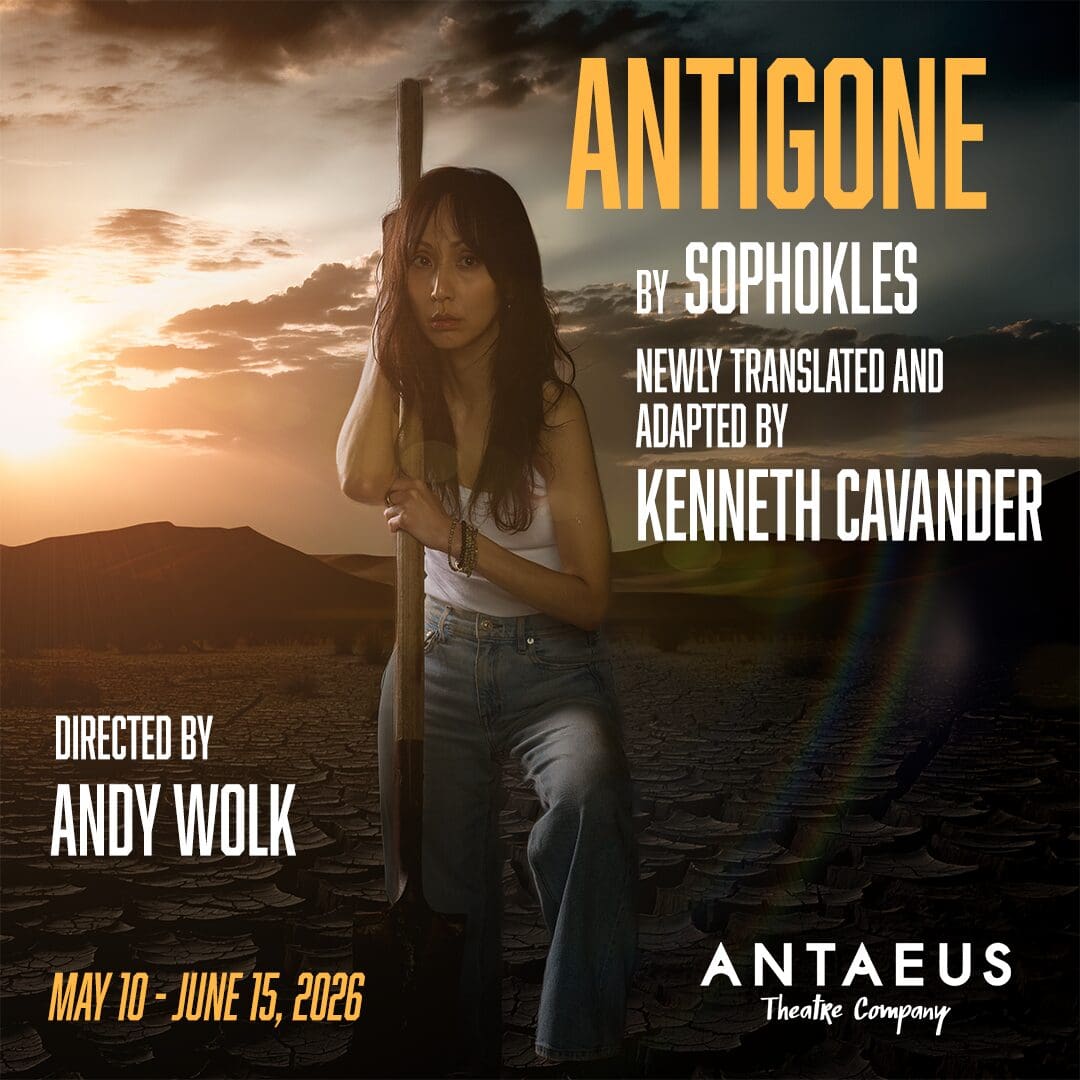
by Michael M. Landman-Karny | May 26, 2026
in Los Angeles, Theater
PULLED OUT OF MYTH AND
INTO THE HEADLINES
Kenneth Cavander relocates Thebes to
a near-future America, and
something is lost in the move
I first read Antigone in a basement college classroom in the fall of 1984, the week the polls turned against Walter Mondale. Kreon sounded like the calm voice on the evening news explaining why the country had to punish Nicaragua. He explained, in the same voice, why the homeless men sleeping on the steam grates for warmth were a question of personal choice. Antigone sounded like the only sane response. Our professor would not let us settle there.
He made us sit with the harder fact. Kreon had a case. A city out of civil war needs order, and Antigone was not asking to be understood. She was asking to be left alone with her dead. Her brother Polyneices has been declared a traitor after the civil war, and Kreon has forbidden his burial. Antigone breaks that law because the dead, in her mind, belong first to the gods and the family, not the state. That is why the play never reduces cleanly to tyranny versus conscience. Kreon is wrong, but not frivolous; Antigone is right, but not conciliatory. The story is simple; the argument is not.
Forty-one years later, in Glendale, after sixteen months of a presidency that has tested every variable Sophocles built into the play, the question is whether it is still the same play. Kenneth Cavander’s new version raises it, and Antaeus does not quite answer.
Cavander uses the Greek transliterations, Kreon and Eurydike and Sophokles, which signal close attention to the source. The dramaturgy points elsewhere. The setting moves from mythical Thebes to a war-weary city in the near future, framed to mirror current American divides. This is the move Sophocles avoided by design. Mythical Thebes was the safe ground from which an Athenian could stage live political questions without naming them. A near-future civil-war setting names them.
Modern adapters have often tried to make Antigone more politically legible by narrowing its ambiguity. Brecht’s 1948 Antigone opens with a prologue in bombed 1945 Berlin, two sisters finding their brother hanged by the SS, and proceeds as a parable of fascism. Cavander is working in that tradition, not against it.
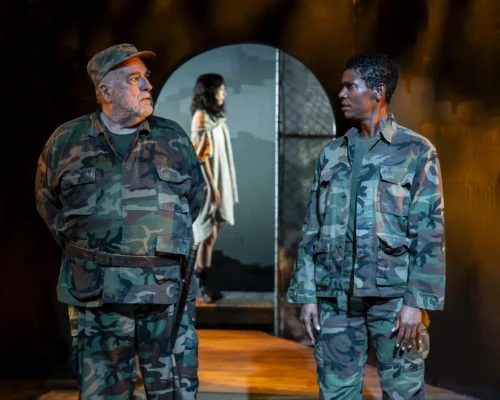
The Greek Chorus is gone, replaced by two Sentries who open the play with a conversation that fills the audience in on the war. John Apicella and Kaci Hamilton handle the exposition, and Hamilton doubles as the blind prophet Teiresias in a West Indian accent that lands as the production’s strangest choice. A chorus is a civic voice. Two named functionaries with personalities are not, and the play loses the collective register on which its sharpest ironies depend.
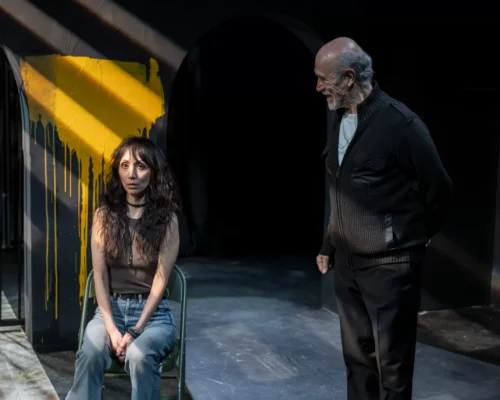
The chorus does not merely narrate. It thinks on behalf of the city, often with terrifying confidence. The Ode to Man, the chorus that begins “Wonders are many, and none more wonderful than man,” is collective self-congratulation. It curdles in the next scene, when the man in question turns out to be Kreon. Cavander reassigns the ode to a woman with a stake in the outcome, and it becomes interior monologue. The curdle is gone.
That woman is Eurydike, and she is the largest intervention. In the Greek she has roughly ten lines, hears the messenger, exits silently, and kills herself offstage. Cavander promotes her to second female lead, gives her material drawn from the choral odes, and frames her as a survivor working realpolitik between her husband and her niece. The program calls Kreon and Eurydike the power couple who rule the city and may yet save it. This is not true to Sophocles. It is the move Jean Anouilh made in his 1944 Antigone, staged in occupied Paris: psychological interiority and an expanded debate, grafted onto an architecture built without them.
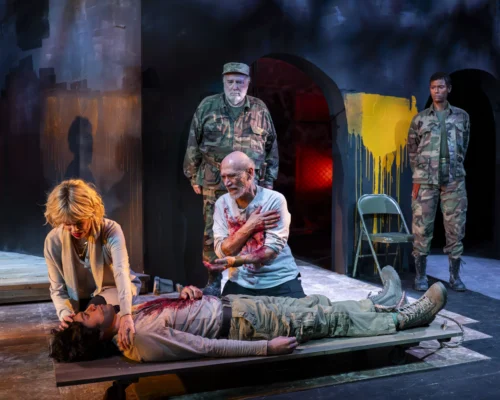
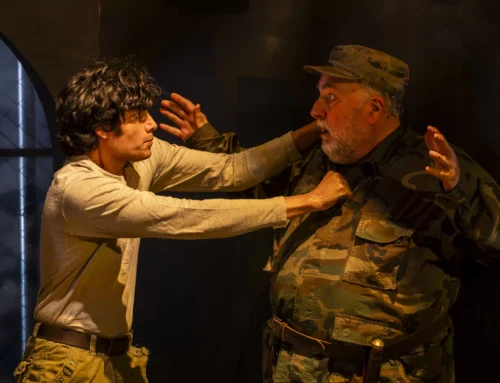
Reframing the central question as a three-way contest among Kreon, Eurydike, and Antigone breaks the design. Sophocles staged a collision between two legitimate principles that destroy each other and the people holding them. For Hegel, this approached the purest form of tragedy, because the conflict was not between good and evil but between two goods that could not occupy the same room. A third pole with a realpolitik instinct turns binary tragedy into a household faction thriller. Andy Wolk directs at speed, and crossfire replaces soliloquy.
That damages the material. Soliloquy is where Greek tragedy thinks. The evening gains propulsion and loses its interior weather.
What the new version cannot ruin is the engine of the original, and Tony Amendola gives it everything. The guard arrives, the son arrives, the prophet arrives, and Kreon hardens, then breaks too late. Amendola has been playing slow-burning authority figures for forty years, and the part sits inside his instrument as if it had been waiting for him. He does not chew the scenery, and he does not soften the man. He plays a leader who believes he is being reasonable, which is what makes the hardening watchable.
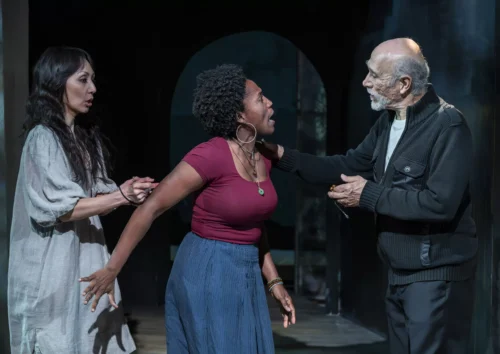
Linda Park is a fierce Antigone, returning to the Antaeus stage with the abrasive certainty the role lives or dies on. She does not ask to be liked. Peter Mendoza’s Haimon, Kreon’s son and Antigone’s betrothed, walks in dutiful and walks out as something his father cannot answer. Mildred Marie Langford gives Ismene, Antigone’s sister, the small, accurate cowardice the part needs. Ann Noble plays Eurydike with so much intelligence and grief that her final devastation registers as the evening’s hardest blow. She is too good for the role’s own purpose. The expanded part flatters Kreon by giving him an ally who can think, which softens the isolation that destroys him in the Greek. The fault is the script’s, not hers.
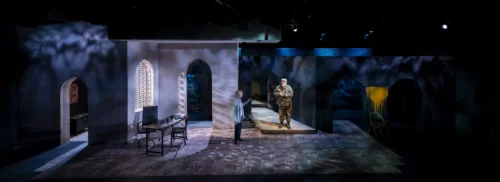
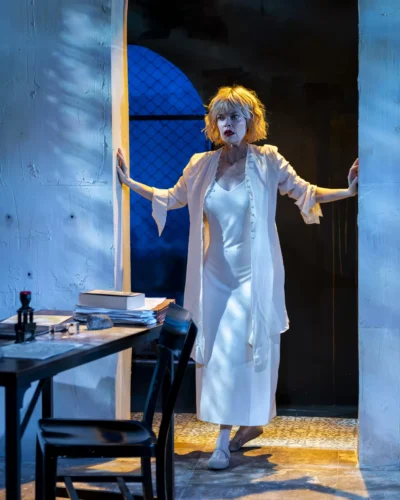
The design carries the production’s politics more deftly than the script does. Sibyl Wickersheimer’s set, Jared A. Sayeg’s lighting, and Jen Albert’s fights all land cleanly. A patch of dried yellow paint on one wall of Wickersheimer’s multi-locale set reads as a map of the United States. Angela Balogh Calin dresses Noble’s Eurydike in sleek pantsuits reminiscent of Hillary Clinton, telling the audience that autocracy here is neither male nor confined to one party. Apicella and Hamilton wear the camouflage of U.S. military personnel while doing Kreon’s work. The set and Lawrence Shragge’s potent score otherwise lean on Middle Eastern aesthetics, so the menace feels both like home and like somewhere the country went to do its damage. All of it lands without a line of dialogue.
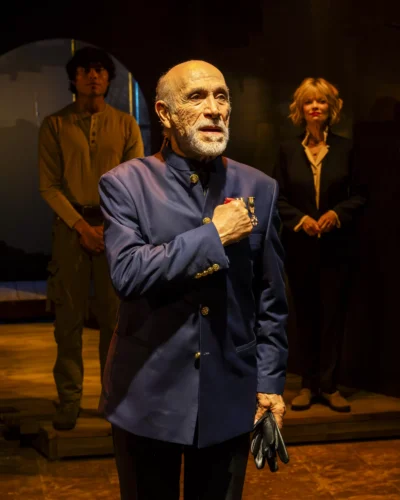
The closing image is preserved. No purification, no restored order, no balanced books. Amendola plays it as the punishment it is. A man is breathing who should not want to be, and the city goes on without him.
This is the ending Beckett learned from, and the ending most modern adaptations cannot resist softening. That Cavander has not softened it is the production’s saving instinct.
Faithfulness to the Greek text is not the same as faithfulness to the Greek play. Cavander has claimed the first while reorganizing the second along lines Anouilh and Brecht already worked, with a third pole added. He cut the chorus and inflated Eurydike to make the play speak to current America, and the room around the actors was already speaking, fluently, in the register Sophocles trusted his audience to read. The legibility the script reaches for was on the wall the whole time, in a patch of yellow paint.
So the verdict splits by who is in the seat. Bring a long acquaintance with Greek tragedy and you will count the losses: the curdle that never comes, the collision flattened into a faction thriller, the interior weather traded for crossfire. Come to the play cold and none of that registers as loss. What registers is speed, a three-way argument with stakes you can read, pantsuits and camouflage you recognize from the news. For that viewer this is the Antigone that finally takes, the one that does not keep newcomers at the door.
Antaeus has given this version the most persuasive case it is likely to receive. The case does not finally answer the dramaturgical objection. It does, on the strength of Amendola, Noble, Park, and the room they share, give it a long and serious evening to argue with. I walked out moved, which I did not expect, and unconvinced, which I did. The professor in the basement room would have made me sit with both.
✦ ✦ ✦ ✦ ✦ ✦ ✦ ✦ ✦ ✦
photo by Craig Schwartz Photography
Antigone
Antaeus Theatre Company
Kiki & David Gindler Performing Arts Center
110 E. Broadway in Glendale
90 minutes, no intermission
ends on June 15, 2026
for tickets, visit Antaeus
for more shows, visit Theatre in LA
✦ ✦ ✦ ✦ ✦ ✦ ✦ ✦ ✦ ✦
