


Areas We Cover
Categories hhhh

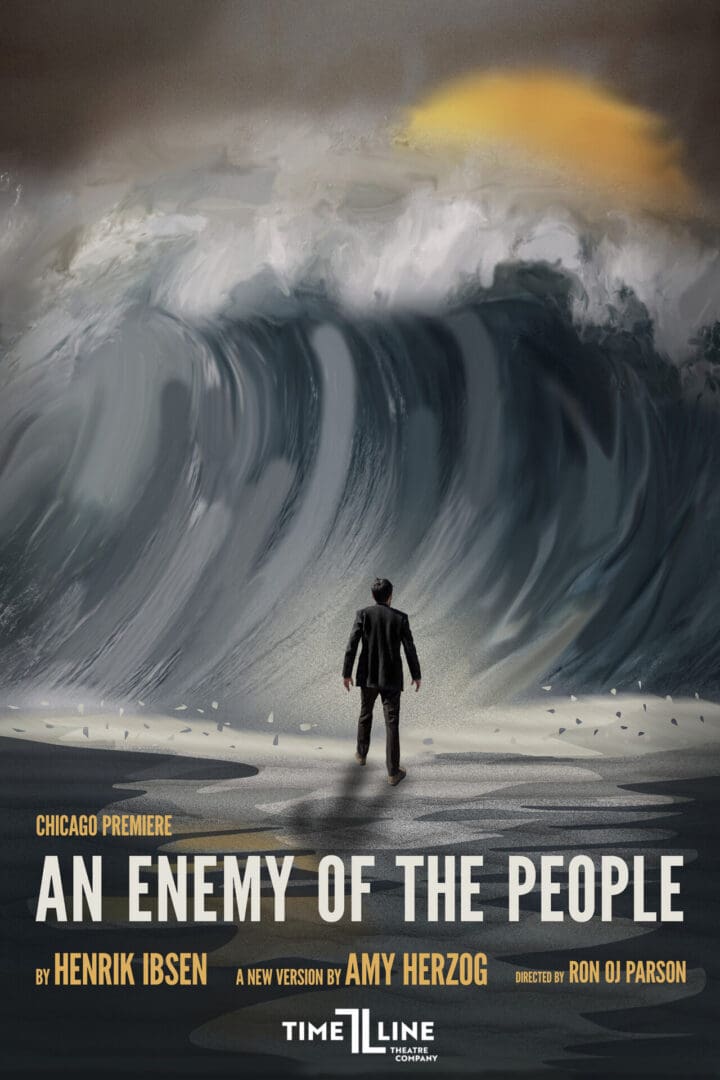
Theater Review: AN ENEMY OF THE PEOPLE (TimeLine Theatre / Chicago)
by C.J. Fernandes | May 27, 2026
in Chicago, Theater
TRUTH, CONSEQUENCES,
AND CONTAMINATED WATER
A superb production of Ibsen’s classic
finds unsettling echoes in the present day

News publishers Billing (Kenneth Hamilton, from left), Hovstad (Grayson Kennedy), and Aslaksen (Anish Jethmalani) weigh a difficult decision with far-reaching consequences for their town
There are plays that endure because their themes and characters are universal, allowing them to be reinterpreted for different eras, locations, and so on—the oeuvre of a certain bard from Stratford-upon-Avon comes to mind. And then there are some plays that zero in on human nature with such cold-blooded precision that, regardless of where and when they are produced, they seem to be of the present time.
Even before I set foot in TimeLine’s absolutely wonderful new home in Uptown, I had heard murmurs about how Amy Herzog’s new adaptation of Henrik Ibsen’s An Enemy of the People, two years after its triumphant Broadway run, was especially pertinent to our current political situation; to which I mentally responded with a snort. I’ve seen many productions over the past decades—it is one of my very favorite plays—and regardless of the context, adaptation, language, setting (contemporary or period), or location, it always comes across as “especially pertinent,” and why wouldn’t it? Other Ibsen plays might be more frequently performed or better regarded, but for my money, the purest expression of Ibsen’s peculiar but potent blend of humanism and anarchist tendencies is to be found in An Enemy of the People.

Morten Kiil (David Parkes, left) lectures his son-in-law Dr. Thomas Stockmann (Will Allan, right)
John Culbert’s stunning set takes full advantage of the towering height of the performance space. We’re in an upper-middle-class house in a small coastal town in Norway in the nineteenth century. The paint-washed wood and period furniture are all bathed in blue-tinged light, and the window panes are rimed with frost. The only warm note comes from an ornate parlor oil lamp hanging over the dining table.
What a contrast in mood, then, to the scene that immediately follows: the lights come on as Petra Stockmann (Campbell Krausen) foists more food onto Billing (Kenneth Hamilton), a local newspaper man who is a guest at dinner. The mayor of the town, and uncle to Petra, Peter Stockmann (Behzad Dabu), stops in for a bit. The editor of the local paper, Hovstad (Grayson Kennedy), follows suit, until finally, the master of the house, Dr. Thomas Stockmann (Will Allan), arrives, bringing in another guest, Captain Horster (Charles Andrew Gardner).

Petra Stockmann (Campbell Krausen) and her father, Dr. Thomas Stockmann (Will Allan), comfort each other
This marvelous and raucous opening scene not only introduces us to all but two of the characters, but also sketches out the relationships between them with remarkable efficiency—note how the fact that both journalists are wooing Petra is communicated without a single word being spoken. Wine is drunk and perfectly cooked roast beef is consumed. Arguments are had and jokes are made. It is, in all, a hugely successful impromptu party until Dr. Stockmann receives a missive from the university in the city and, reading it, turns pale.
Dr. Stockmann is the official doctor of the town baths, the major source of income for this small town. It is promoted as a rest cure where consumptive and other ill people can visit to recover in the salty sea air. But after a suspicious number of typhoid cases the previous summer, Stockmann had begun researching the quality of the water at the baths. The university report proves his research right: the waters are heavily contaminated with bacteria. The source of this contamination is likely the town’s tannery—owned by the doctor’s father-in-law—but the reason for the contamination is that when the baths were being built, contrary to the doctor’s recommendation, the town and the mayor built the pipe system on the cheap.

Dr. Thomas Stockmann (Will Allan) sits with the impact of the town turning against him in
A brief aside to note that the existence of bacteria was not quite known outside scientific circles at the time of the play. Hence the description of “thousands of small animals that we can’t see,” and variations thereof, repeated by other characters in the play.
When Stockmann reveals this information to the town officials, reaction is mixed; at first the journalists and Aslaksen (Anish Jethmalani), head of the printer’s union, are equally alarmed and determined to correct the problem, but the mayor believes that Stockmann is out to undermine him and destroy the town. What follows will be a familiar sequence of events to anyone who’s been awake on a regular basis during the last several years.

Aslaksen (Anish Jethmalani, center left) works to control what Dr. Thomas Stockmann (Will Allan, center right) is allowed to say at a town hall meeting, as Mayor Peter Stockmann (Behzad Dabu, left) and Hovstad (Grayson Kennedy, right) observe
Herzog’s translation lives up to the hype and then some. This is an especially sharp, fast-paced work: lean and taut. She’s also located the drier-than-dust sense of humor inherent in the play and brought it to the fore. What with this and Steppenwolf’s The Dance of Death earlier this year, maybe the trope of the dour Scandinavian playwright needs to be revised.
Chicago theatre veteran Ron OJ Parson directs with his customary excellence. The cast is splendid. Really, everything is firing on all cylinders here to the extent that I’m struggling to find some reason to kvetch—fear not, I’ll come up with something by the end of this review—but let me gush about the things I loved first:

Behzad Dabu is Mayor Peter Stockmann
Will Allan and his puppy-dog eyes: it’s a beautiful performance, leaning hard into the fact that Dr. Stockmann is so purely altruistic in his motives that he cannot fathom how anyone else could disagree with him. The devil in me would like to add that there is room for nuance in response to the crisis, but in terms of pure moral rectitude, Dr. Stockmann is beyond reproach. Which is why his frustration and hurt ring true.
Campbell Krausen’s shrewdly evaluating eyes: As the fiercely intelligent, sharp-witted daughter of Dr. Stockmann, who for all practical purposes is the parent in the relationship, she would seem to have the thankless part, but not so. The most brutal line—for me, at least—in the play comes from her after the mob attack on the Stockmanns’ home: “I keep having this terrible thought. They deserve what comes to them.” I’d be lying if I said I haven’t thought words to that effect.

Dr. Thomas Stockmann (Will Allan, center) passionately argues for scientific reasoning as Captain Horster (Charles Andrew Gardner, left) and Hovstad (Grayson Kennedy, right) listen intently
The mob attack on the Stockmanns’ home is exquisitely executed; a showcase of the confidence behind this production in one jaw-dropping, actor-free set piece that’s barely more than a minute long, if that.
It would be easy to dismiss An Enemy of the People as an anti-capitalist screed. That’s not to say that it isn’t anti-capitalist—it absolutely is—but the heart of the play, and the reason for its continued resonance 144 years later, across countries, cultures, and societies, comes down to a more fundamental question:
Just what personal compromises are you willing to live with?
Or, to be even more blunt: what price, your soul?
✦ ✦ ✦ ✦ ✦ ✦ ✦ ✦ ✦ ✦
photos by Brett Beiner Photography
An Enemy of the People
TimeLine Theatre
5035 N. Broadway in Chicago
ends on June 27, 2026
for tickets ($62–$95), call 773.281.8463 x1 or visit TimeLine Theatre
for more shows, visit Theatre in Chicago
✦ ✦ ✦ ✦ ✦ ✦ ✦ ✦ ✦ ✦

TimeLine Theatre’s new vertical blade sign casts a bright new light on North Broadway in Chicago’s historic Uptown Entertainment District (photo courtesy HGA / Kendall McCaugherty)
