


Areas We Cover
Categories

HOLLYWOOD’S NEW STARS HAVE NO HEARTBEAT — THE ERA OF AI ACTRESSES
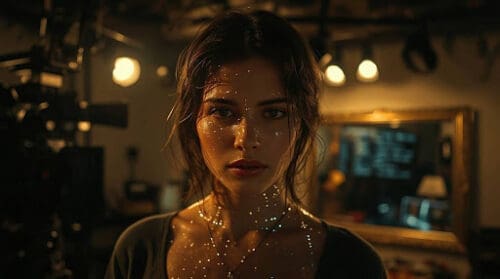
The Screen Was Always a Lie – This Is Just the Next One
Cinema has never been strictly real. A set designer fakes a Parisian café in Burbank. A costume department ages a 30-year-old actor into an 80-year-old patriarch. Lighting makes the ordinary look divine. So when audiences recoiled at the discovery that Late Night with the Devil (2024) used AI-generated graphics in a few background frames – well, the moral outrage was understandable. But was it entirely logical? Probably not.
What was logical: audiences felt deceived. Not because AI appeared on screen, but because no one said so. That distinction matters – and it’s driving one of the most fascinating fault lines in entertainment today. AI-generated female characters are no longer a sci-fi premise. They are already here, walking the edge between digital and human, between performance and simulation. The question isn’t whether they’ll appear on screen. It’s what happens to cinema – and to culture – when they do.
From Metropolis to the Metaverse: The Long History of the Artificial Woman
Before anyone argues this is new, consider: cinema has been obsessed with artificial women for over a century.
Fritz Lang’s Metropolis (1927) gave the world Maria – a robot built in the image of a revolutionary woman, deployed to manipulate the masses. Decades later, Ex Machina (2014) offered Ava, an AI with a face engineered to disarm. Her (2013) – reportedly a personal favourite of OpenAI CEO Sam Altman – depicted a voice-only AI companion so convincingly human that it won an Oscar for Best Original Screenplay. The artificial woman has always been a cinematic obsession. She represents fear, desire, and the blurred line between creator and creation.
What’s shifted is the direction of travel. These used to be metaphors. Now they’re production tools.
Film theorist Dr. Anne Balsamo, writing on technology and embodiment, has argued that “the female body has historically served as the testing ground for technologies of transformation.” That pattern holds here – AI actresses are not emerging in a vacuum. They are the latest chapter in a very long story.
The Tilly Norwood Moment – And What It Revealed
In September 2025, a British startup called Particle6 introduced an AI-generated “actress” named Tilly Norwood – elfin, brunette, ambiguously aged somewhere between 15 and 25, reportedly courting Hollywood talent agency interest. The claims turned out to be dubious. The backlash, however, was entirely real.
The incident crystallized something the industry had been dancing around: there is a difference, in the public mind, between AI assisting human performers and AI replacing them. The first is acceptable – even welcomed. The second crosses a line that audiences are not yet ready to surrender.
A 2026 survey of filmgoers found that 86% demand disclosure when AI is used in film production, yet 61% accept AI involvement in filmmaking in principle. The contradiction is not hypocrisy – it is nuance. People are not anti-AI. They are anti-deception.
This is particularly charged when it comes to female AI characters and companions. Consider the uproar in 2024 when OpenAI launched GPT-4o with a demo voice that closely resembled Scarlett Johansson – an actress who had, in Her, literally voiced the role of an AI companion. Johansson had previously declined OpenAI’s offer to provide that voice. The resemblance was reportedly not coincidental. OpenAI ultimately withdrew the voice “out of respect,” though some observers noted, dryly, that expensive lawyers may have played a role too.
Beyond the Screen: The Emergence of the AI Girl
The conversation doesn’t stop at film credits. Outside of Hollywood, an entire ecosystem of AI girl companions has emerged – digital personas designed not for passive watching but for active interaction. These are not characters in a film. They are, in a strange sense, performers in an ongoing, user-directed narrative.
This is where platforms built around the ai girl concept enter the picture. They occupy a curious cultural space – part character, part companion, part mirror of the user’s own imagination. Unlike a film actress, an AI girl does not have a fixed script or a single audience. She adapts, responds, and exists in a kind of permanent improvisational performance. That is not less theatrical than stage work – in some ways, it demands more.
Interestingly, the theatrical tradition has always accommodated this kind of fluid, audience-responsive performance. Commedia dell’arte, for instance, relied heavily on improvisation within fixed character archetypes. The audience shaped the show. The performer adapted in real time. Whether the performer is a human in a mask or an algorithm in a chat window, the underlying dynamic has precedent.
What Hollywood Is Actually Doing With AI Women Right Now
Practical applications are already widespread – even if studios are careful about disclosure:
- De-aging and resurrection: Marvel and Lucasfilm have used AI to recreate younger versions of living actresses – and in the case of Rogue One (2016), a deceased one. The ethical questions remain unresolved, but the technology is established.
- Background and crowd generation: AI-generated female extras populate scenes in dozens of recent productions, invisible to most viewers.
- Virtual influencers crossing into film: Characters like Lil Miquela – a CGI “model” with millions of social followers – have begun appearing in brand films and short-form content, blurring influencer culture with cinematic aesthetics.
- Voice synthesis: Following the Johansson incident, several studios quietly began auditing their AI voice tools to ensure they weren’t inadvertently generating unauthorized likenesses.
The 2023 SAG-AFTRA strike brought this into sharp focus. Guild president Fran Drescher put it plainly: the industry had to “stand tall” against AI-driven displacement or risk losing human performance entirely. The resulting agreements included protections around digital likeness – a recognition that an actress’s face and voice are, in legal and moral terms, her own.
Women in film remain underrepresented by most metrics: in 2025, female characters held 38% of speaking roles in top-grossing films, and major female characters actually declined from 39% to 36%. Against that backdrop, the question of whether AI actresses will supplement or further marginalize human women in film is not abstract.
The Aesthetics of the Artificial: Why the AI Woman Looks the Way She Does
There is a pattern worth noticing. AI-generated female personas – across film, gaming, and companion platforms – tend to converge on certain visual archetypes. Symmetrical features. Luminous skin. An age that hovers perpetually between youth and maturity. A look of attentive openness.
This is not accidental. These aesthetics are trained on human preferences – on decades of film stills, fashion photography, and social media data. The AI girl, in some sense, is a composite of everything culture has historically rewarded in female appearance. That raises legitimate questions about representation, diversity, and what we risk encoding into the next generation of digital performance.
Film critic Laura Mulvey’s concept of the “male gaze” – first articulated in 1975 – described how classical Hollywood constructed female images for a presumed male viewer. The fear, among many critics, is that AI-generated women could entrench that gaze architecturally, making it structural rather than incidental.
The counter-argument – made by creators working with AI-generated characters – is that the same tools can be used to create female personas that defy those conventions entirely. An AI actress need not be young, conventionally beautiful, or even human-passing. The constraint is the imagination of those building her, not the technology itself.
The Stage Has Always Been Bigger Than We Thought
Cinema changed what it meant to be an actress. Before film, performance was ephemeral – it lived in the room and died with the night. Film made it permanent, reproducible, distributable across time. An actress from 1942 can still break your heart in 2026.
AI does something stranger still. It makes performance generative – potentially infinite, potentially collaborative, potentially indistinguishable from a living performer. That is disorienting. It should be. Every major shift in performing arts has been.
The theatre survived cinema. Cinema survived television. Both will survive AI – though neither will emerge unchanged. The audiences packing Broadway shows in 2025, the Gen Z viewers whose theater attendance surged 25% that same year, are not fleeing the artificial. They are hungry for the human alongside it.
What the era of AI actresses demands, above all, is honesty. Transparency about what is generated and what is not. Frameworks that protect the labour of human performers. And a willingness to ask, genuinely, what we want from the faces on our screens – and why.
Those are old questions. They just got a new cast.