


Areas We Cover
Categories

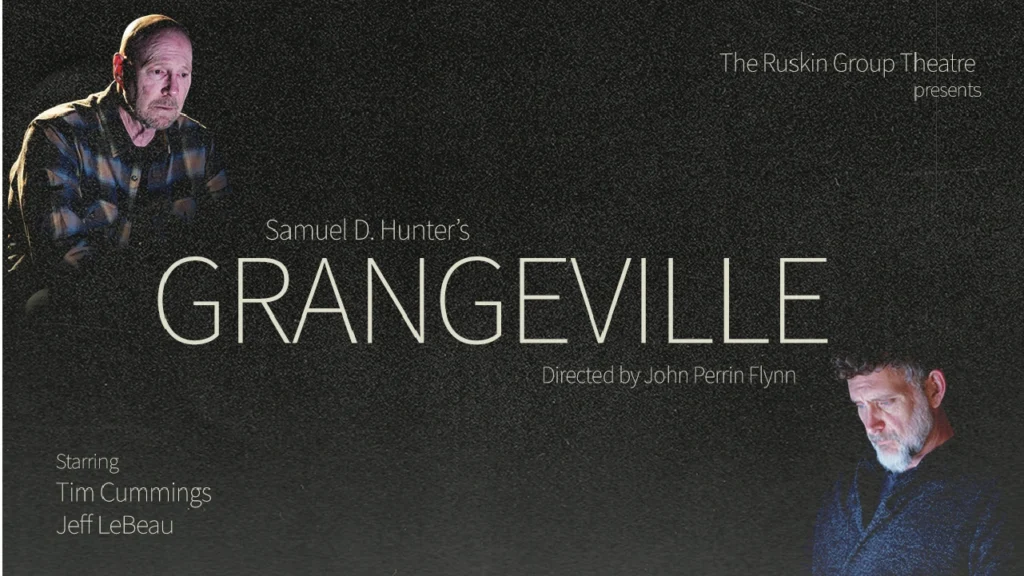
Theater Review: GRANGEVILLE (Ruskin Group Theatre / Santa Monica)
by Michael M. Landman-Karny | June 2, 2026
in Los Angeles, Theater
LONG-DISTANCE DAMAGE
Samuel D. Hunter finds devastating
intimacy across thousands of miles
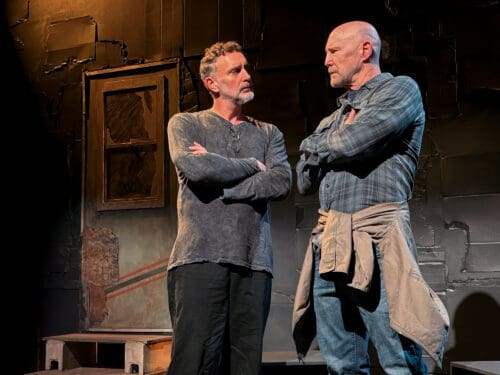
Tim Cummings, Jeff LeBeau
Sam Shepard built True West on a kitchen and two brothers who could not stay out of each other’s way. They fought in the same room, over the same toaster, under the same desert moon. The room held the heat.
Samuel D. Hunter has written the opposite play.
Grangeville, his two-hander at the Ruskin Group Theatre, puts an ocean between its brothers and a continent on top of that. Jerry (Jeff LeBeau) never left Idaho. Arnold (Tim Cummings) fled to the Netherlands more than fifteen years ago: he makes visual art, or used to, before his marriage started fraying and his work stopped coming. For most of ninety minutes, the brothers talk by phone and video call. Their faces arrive in fragments.
Dan Weingarten’s lighting washes cool blue and violet across a full-width wall of mismatched metal panels, designed by Stephanie Kerley Schwartz, cracked and peeled back in places, with a weathered door glowing orange from behind stage left. It looks like something between a trailer park and a post-industrial void.
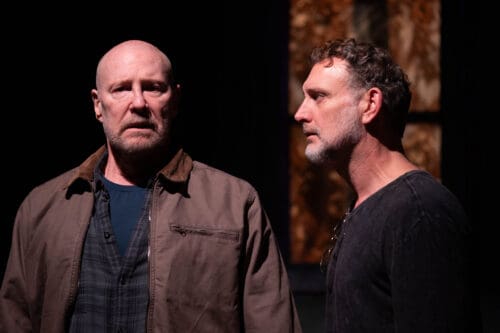
Jeff LeBeau, Tim Cummings
The first hour looks and sounds exactly like a Samuel D. Hunter play: rural Idaho, a dying parent, a trailer, hospital bills, working-class brothers without the vocabulary for what is actually wrong between them. Playwright Annie Baker telegraphs her formal experiments early. Branden Jacobs-Jenkins does the same. Hunter gives you very little. Then, past the midpoint, he does something no one else writing American realism would attempt, and the play tears itself open. He earns it by being so faithful to the literal world for the first hour that you follow him anywhere after. The Idaho specificity, the Lewiston grade, the Dairy Queen, the Burley pawnshop, Pastor Ken: none of it is local color. It is load-bearing.
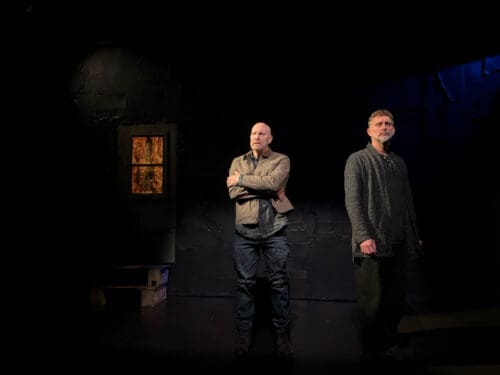
Jeff LeBeau, Tim Cummings
Jerry calls because their mother is dying and someone has to handle it. Arnold does not want to handle it. Not the trailer, the paperwork, the hometown, or the brother who beat him through a childhood neither survived intact. That refusal runs the first hour. A man saying no down a phone line generates a specific pressure, the pressure of distance held by will. Every refusal costs Arnold something. When the mother dies and his relief curdles into the knowledge that he will never say what he needed to say, the phone call has become a room after all, sealed and airless, the worst room in the play. Hunter has called an earlier character his fun-house-mirror self, the version of his life that went wrong. Arnold is the opposite: the one who got out. The play’s central cruelty is that getting out is not the same thing as getting free.
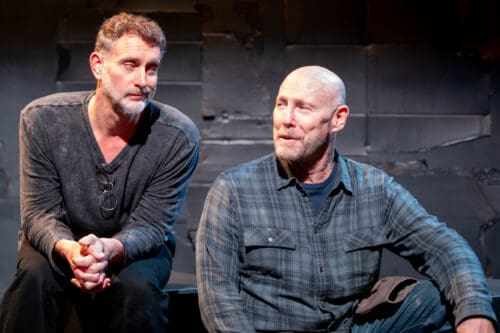
Tim Cummings, Jeff LeBeau
The mother never appears, and the play wisely resists trying to conjure her onstage. The brothers cannot agree on who she was. One remembers the bender. The other remembers the art history books on her shelf, the online course she took at the library before her first stroke. Hunter lets that disagreement stand. It is grief enough.
Here is what he has been earning: midway through, he hands each actor his sibling’s marriage and lets the damage speak from a different mouth. Cummings now plays Stacey, Jerry’s estranged wife. LeBeau plays Bram, Arnold’s husband in Rotterdam. Each brother is confronted by the other’s spouse, voiced by the actor who has spent the evening playing his sibling. The temperature jumps, and what it reveals is ugly and clarifying: the bully and the one who escaped are running the same damage in different rooms. Arnold has become Jerry in his own marriage. It is the argument the play has been building toward.
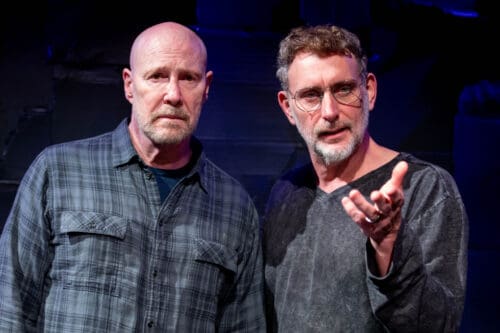
Jeff LeBeau, Tim Cummings
LeBeau and Cummings find the play’s silences before they find its speeches, which is exactly right. Cummings’ Arnold carries his damage in his stillness. There is a way he goes slightly absent when Jerry gets too close, a fractional withdrawal that reads across a theater without ever announcing itself, and when he finally releases it the landing is earned by everything that preceded it. LeBeau does something harder: he makes Jerry’s emotional blunting genuinely moving rather than merely pitiable. A scene in which Jerry describes forgiving his mother like a robot lands not as confession but as discovery, a man genuinely puzzled by his own interior.
John Perrin Flynn has directed three previous Hunter plays, and what he has learned is to leave the silences alone. His staging treats the geometry of the two men’s distance as the production’s primary text. Each scene reconfigures their spatial relationship without ever making the reconfiguration feel programmatic. We sense it the way we sense a change in weather, as a fact about the atmosphere before we can name the cause. There is no underlining, no pause held a beat longer than the text earns, no staging choice that editorializes about whether forgiveness is possible. He trusts Hunter’s refusal, and that trust is visible in the room.
Grangeville is the kind of play that stays with you three days out, not because it withholds, but because what it delivers lands that precisely.
Shepard kept his brothers in the room until something broke. Hunter sends his to opposite ends of the earth and trusts the wire to do what the room never could.
✦ ✦ ✦ ✦ ✦ ✦ ✦ ✦ ✦ ✦
photos by John Perrin Flynn
Grangeville
Ruskin Group Theatre
2800 Airport Ave. in Santa Monica
90 minutes, no intermission
Fri & Sat at 8; Sun at 2 (check for showtimes first)
ends on September 21, 2026
for tickets ($40–$45), call 310.397.3244 or visit Ruskin Group Theatre
for more shows, visit Theatre in LA
✦ ✦ ✦ ✦ ✦ ✦ ✦ ✦ ✦ ✦

GREAT job, nailed EVERYTHING!!! Thanks for reminding me what a good review looks like!
Thank you Sarah! It took me many, many years of reading theatre reviews by Frank Rich, Ben Brantley, Helen Shaw, and others to develop my own style.