


Areas We Cover
Categories

Theater Review: THE MAGIC FLUTE (LA Opera)

by Michael M. Landman-Karny | June 2, 2026
in Los Angeles, Music, Theater
CONLON’S LAST SPELL
A beloved production returns as
James Conlon brings his remarkable
LA Opera tenure to a close
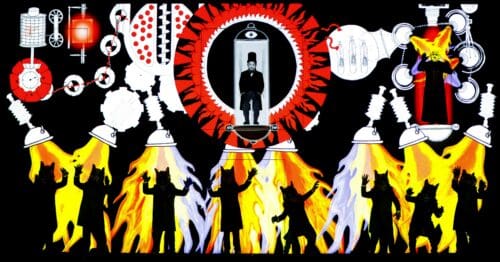
Kwangchul Youn (center) as Sarastro and Zhengyi Bao (right) as Monostatos
James Conlon walked to the podium last Saturday night and the house was on its feet before he lifted a hand. Twenty years built that ovation. He gave the company its first Ring cycle and, with Recovered Voices, an argument for the composers the Nazis tried to erase. Now the exit. He chose Mozart’s last opera to reach the stage and Verdi’s final opera as his farewell pairing. Both are works in which old masters, after proving they could fill a room, began taking things away. Conlon has spent two decades teaching this orchestra what remains when you do.
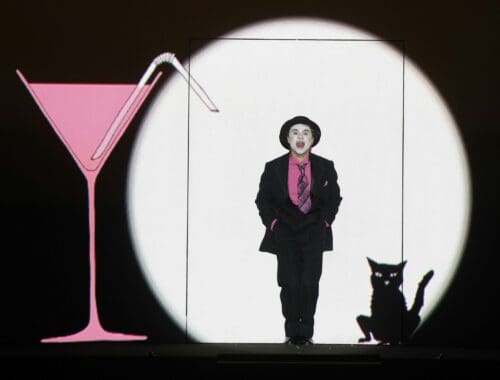
Kyle Miller as Papageno
The Magic Flute was popular theater by design: a Singspiel built for a suburban Viennese hall in 1791, with spoken dialogue, Masonic numerology, fairy-tale machinery, and gallery-ready jokes. Audiences keep coming because the music wins every argument the book loses. Mozart wrote for the seven-year-old in the house, knowing the adults were listening too, and most productions serve one at the cost of the other.
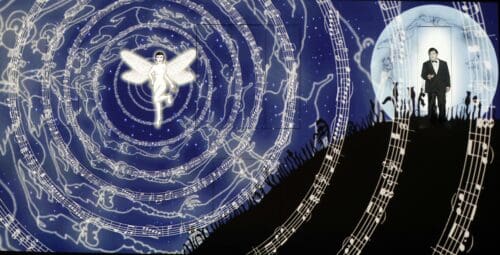
Miles Mykkanen as Tamino
Barrie Kosky built his production on that premise. With the British theater company 1927, co-artistic directors Suzanne Andrade and Paul Barritt, he created the staging for Komische Oper Berlin in 2012. LA Opera presented its first performances outside Berlin in 2013, revived it in 2016 and 2019, and has returned it to the Chandler stage where its international life began. The cast performs against a tall white screen, climbing in and out of small portals while Barritt’s animations break around them like weather. Schikaneder’s dialogue is replaced by silent-film intertitles with piano accompaniment. Pamina arrives with a Louise Brooks bob. Monostatos comes by way of Murnau’s Nosferatu, all shadow-claw menace in two dimensions. The Queen of the Night becomes a mechanical spider, only her face visible while animated legs unfold around her. Tamino runs from a dragon on legs that are not his. The images keep arriving: a solemn parade of mechanical animals before Sarastro’s temple; three guide-boys who seem to pop from a basket hoisted by enormous moths; flowers that grow where Pamina waters the ground with Papageno’s tears during “Bei Männern welche Liebe fühlen.”
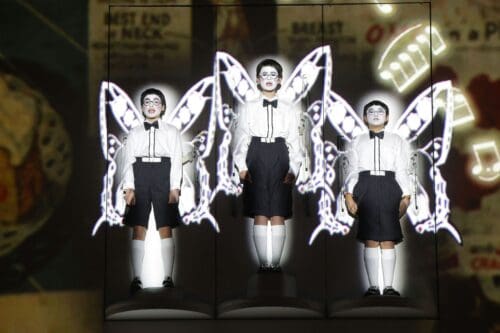
Alexa Ho, Elle Thorman and Clark Chua as the Three Spirits
The Magic Flute has always attracted artists who want to paint with it: Chagall in 1966, Hockney in 1980, Taymor in 2004. Kosky is the next painter in that line, except that where they brought an artist’s hand to the opera’s inherited pageantry, he dismantled it entirely.
The standing critical objection, lodged since its debut, is that the staging pins the singers in place. They cannot move freely; their performances are subordinate to animation cues. The timing is locked to the image. That is true. What the objection misses is the bargain. Kosky trades theatrical freedom for instant legibility. Opera, for anyone walking in cold, is a long evening in a foreign tongue at unfamiliar volume. Kosky removes the wall. A child watching this Flute is watching a cartoon that happens to be sung live. The animation does what supertitles cannot: it tells them, beat by beat, where to look. The trial scene’s animated bells cavort with cartoon garter belts; a child laughs before understanding why, and keeps watching. By Pamina’s aria of despair, the eight-year-old in Row N has been trained, without knowing it, to listen to Mozart. This is the production to bring someone who has never been.
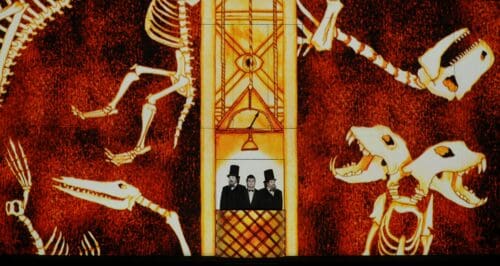
Hyungjin Son as the Second Armored Man, Miles Mykkanen as Tamino and Nathan Bowles as the First Armored Man
Which leaves the pit, where the same work is being done on a smaller, more exact scale. The difference between competent Mozart and the real thing is audible inside the first eight bars. The three opening chords, the Masonic invocation that begins the work, came down with weight that was solemn without being heavy. Not pronouncement. Summons. Then the Allegro, and the orchestra answered with transparency. Conlon takes the Flute brisk but unhurried, refusing to swell it past its own weight. The wind writing, where this score lives, sat on top of the strings instead of underneath. The solo flute became its own character: searching in Tamino’s first aria, sly behind the trial scene, almost indifferent during Pamina’s despair, which made the despair worse. The instrument was enacting, in miniature, what Conlon was doing with the whole score: refusing to comfort. The brass chorales of Sarastro’s realm had the rounded warmth of a chamber group. An occasional pianissimo frayed at the edge, and a few second-act ensembles wanted more air. These were the minor costs of a major reading. By 1791 Mozart had stopped trying to impress anyone. He was writing transparencies, and Conlon let the orchestra disappear behind them.
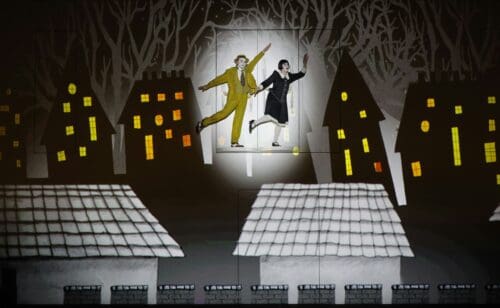
Kyle Miller as Papageno and Sydney Mancasola as Pamina
The singers adapted to the machine. Sydney Mancasola‘s Pamina was the performance that stayed, a performer whose singing began in the mind before it reached the throat. Her “Ach, ich fühl’s” arrived at half voice, the line shaped by her shoulders and jaw rather than pushed from the diaphragm, the kind of small-scale heartbreak this production was built to hold. Miles Mykkanen‘s Tamino had the bright, ardent lyric tenor the part wants, and the rarer instinct to wait: he held back in the portrait aria, let the line gather, and reached the high note as if surprised to find it there.
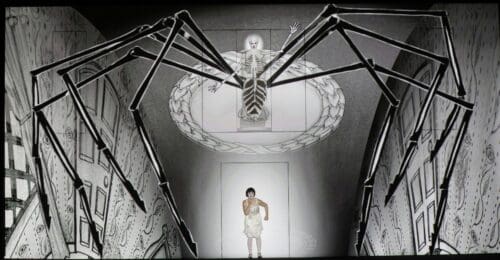
Aigul Khismatullina (top) as the Queen of the Night and Sydney Mancasola as Pamina
Papageno is the opera’s escape hatch from solemnity: while Tamino is being educated into virtue, Papageno wants food, wine, safety, and a wife. In this production he has traded his traditional birdcage for an angular, silent-film-era cat that leaps between trees, fends off dogs, and gets caught under a bell jar. Kyle Miller, inside the production’s straitjacket, made him a recognizable adult rather than a flipbook figure. He played the suicide aria to a noose drawn behind him and refused to camp it; the laugh that follows came from relief, not the gag.
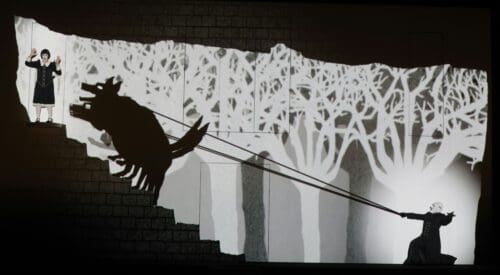
Sydney Mancasola as Pamina and Zhengyi Bai as Monostatos
Sarastro is the opera’s answer to the Queen, the figure who slowly pulls authority toward the temple, and who must do it entirely through sound in this production, since Kosky’s conceit pins every principal to a two-dimensional surface. Kwangchul Youn‘s velvety bass warmed the temple scenes. A bass with more subterranean weight would have made them immovable. Youn made them convincing.
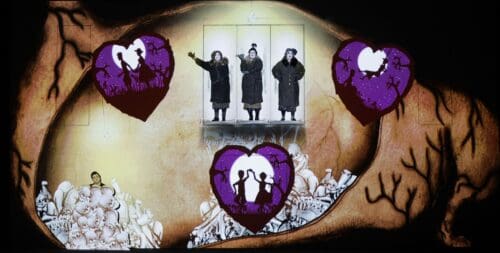
Miles Mykkanen (bottom left) as Tamino, with Diana Newman, Katie Trigg and Meridian Prall as the Three Ladies
Aigul Khismatullina, who sang the Queen’s two arias from inside her spider casing while Zhengyi Bai‘s Monostatos prowled the frame beside her, was another matter entirely. The coloratura came without apparent effort, the top notes placed with a precision that had nothing theatrical about it, and the villainy read as genuinely dangerous rather than decorative. The chorus, prepared by Jeremy Frank, sang with a unanimity that the projection seemed to sharpen.
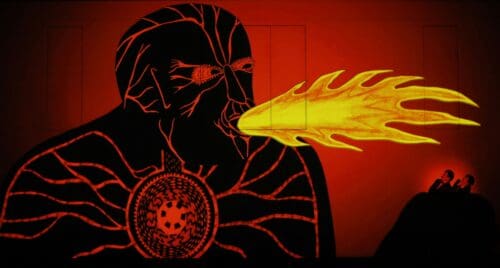
Miles Mykkanen as Tamino and Sydney Mancasola as Pamina
Kosky’s visual world will travel without Conlon. What ends here is the working relationship of a conductor, an orchestra, and a city. Twenty years in one room leaves a specific gravity that no revival carries: an orchestra’s memory, a collective instinct for how a phrase should breathe. That disappears the moment someone else raises a hand. With Falstaff and The Magic Flute, Conlon leaves on the last words of two old masters who refused, at the end, to stop making things lighter. Mozart built this opera to last. Kosky built his production the same way. Conlon, on Saturday, proved he had too.
✦ ✦ ✦ ✦ ✦ ✦ ✦ ✦ ✦ ✦
photos by Cory Weaver
The Magic Flute
LA Opera
Dorothy Chandler Pavilion, 135 North Grand Ave.
2 hours 45 minutes with intermission
*Saturday, June 6 at 7:30pm
*Thursday, June 11 at 7:30pm
*Sunday, June 14 at 2pm
*Wednesday, June 17 at 7:30pm (Pride Night)
*Saturday, June 20 at 7:30
*Sunday, June 21 at 2pm
ends on June 21, 2026
for tickets (starting at $49), call 213.972.8001 or visit LA Opera
for more shows, visit Theatre in LA
✦ ✦ ✦ ✦ ✦ ✦ ✦ ✦ ✦ ✦
