


Areas We Cover
Categories

ROULETTE AS A PLOT DEVICE IN CLASSIC AND MODERN US FILMS
by Brandon Metcalfe | June 2, 2026
in Extras
Casinos have long held a specific gravity in American cinema, but among all the games that appear on screen, roulette earns its place less through frequency than through function. A poker hand can unfold over an extended scene. Blackjack invites strategy and calculation. Roulette offers none of that — a single spin resolves everything, immediately, and the outcome belongs entirely to chance. That structural property makes it one of the most efficient plot devices available to a screenwriter working in the tradition of American dramatic realism, and US filmmakers have used it accordingly across eight decades of Hollywood history.
Why roulette works as a narrative instrument
The mechanics of roulette translate naturally into cinematic language. The wheel spins, the ball orbits, and for a specific interval the character’s fate is genuinely unresolved. No other casino game produces that exact dramatic quality — a fixed endpoint, visible in real time, with the result completely beyond the character’s influence. That last element is critical. Roulette removes agency at the moment of highest stakes, which allows the writer to focus entirely on what the character reveals about themselves in the seconds before the outcome is known, rather than on strategy or skill.
For American cinema specifically, this dynamic connects to a broader tradition of stories about ordinary people caught in the machinery of forces larger than themselves. The roulette wheel functions as a compact, visual symbol for that experience — the system spins, the individual waits, and the result arrives without appeal. That thematic resonance has kept the device in continuous use even as the cultural context around gambling has shifted considerably from the postwar era to the present.
The same tension between individual choice and uncontrollable outcome runs through the best high-stakes dramatic moments across art forms, from Eugene Onegin’s fatal duel to contemporary productions that place a character’s whole arc on a single irreversible moment. Roulette compresses that arc to under a minute.
The classic era: Casablanca and the moral weight of a single spin
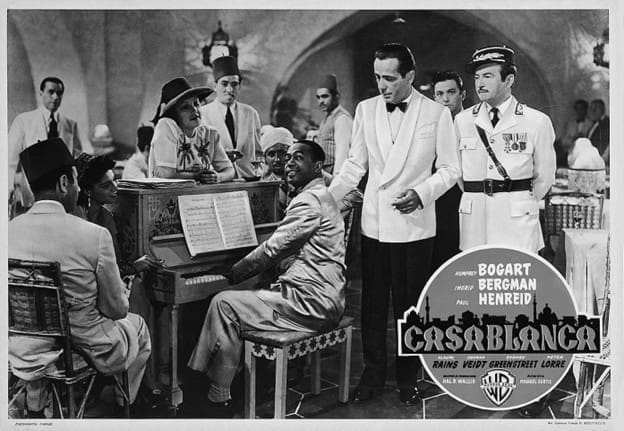
The most cited roulette scene in American film history doesn’t appear in a film about gambling. In *Casablanca* (1942), Rick’s deliberate intervention at the roulette wheel — guiding a desperate young couple toward the number that will give them enough to leave occupied Morocco — is a character-defining moment delivered in under ninety seconds. Rick rigs the outcome, but the film frames this as a moral choice, not a cheat. Roulette becomes the mechanism through which his buried idealism surfaces.
What makes the scene durable is that director Michael Curtiz uses the wheel’s randomness as a foil. The audience understands that roulette doesn’t work this way; the intervention is effective precisely because it violates the device’s essential property. The scene wouldn’t work with poker — Rick could legitimately win a poker hand through skill. Only by subverting a game of pure chance can the film signal the depth of his commitment.
*The Deer Hunter* (1978) inverts this logic. The Russian roulette scenes carry none of Casablanca’s moral optimism — they use the randomized threat of death to dramatize what systematic violence does to people who survive it. The gun chamber is a stripped-down roulette wheel with lethal stakes, and the repetition of the device across the film’s three acts tracks its protagonist’s psychological dissolution. Here the game’s function is to remove all pretense of agency while the character is forced to perform control.
The modern era: casino films and the spectacle of the wheel
By the 1990s, American cinema had largely domesticated roulette — moving it from a device that reveals character under pressure to one that signals wealth, style, and a certain kind of dangerous leisure. *Casino* (1995) uses roulette as background texture for a world where the house always wins and the protagonist’s fatal error is believing otherwise. The wheel spins in nearly every establishing shot of the casino floor, but it rarely carries dramatic weight on its own — Scorsese uses it as environmental shorthand for a system designed to extract money reliably.
*Casino Royale* (2006) returns the device to its classic function. James Bond’s climactic poker sequence is famous, but the earlier roulette scene establishes the film’s central dynamic more economically: a villain who controls outcomes and a protagonist willing to lose everything to prove he can’t be controlled. The confrontation at the roulette table is a study in two people performing certainty in the face of pure chance.
More recent US films have used roulette in the context of social casinos and online play — environments that look visually different from a brick-and-mortar casino but produce the same narrative utility. The spinning wheel remains recognizable as a symbol of irreversible commitment even on a phone screen, which is why characters in contemporary thrillers who place a bet online are often shown at a live dealer roulette table rather than a slot machine. Audiences who have played on top US roulette sites recognize the same interface vocabulary in those scenes — the red-and-black wheel, the betting grid, the moment of irreversible spin — which gives the device a new layer of viewer identification. The genre vocabulary of the device has survived the migration to digital format.
How the device travels into the streaming era
US streaming productions have found fresh uses for roulette as a plot device precisely because audiences now encounter the game in different contexts than they did in 1942 or 1978. Viewers bring a different relationship to the screen image than audiences who only knew the game from previous films — the wheel works dramatically, but screenwriters now have the option of using the player’s prior digital experience as a layer of meaning.
*Kaleidoscope* (2023), Netflix’s anthology heist series, uses roulette as a recurring visual motif for the show’s core theme: that outcomes in a heist, like outcomes on a wheel, depend on which episode you watch from. The episodes can be viewed in any order, and the variable results of a roulette bet carry that structural message visually without requiring explicit explanation. The device has become abstract enough to carry meaning beyond its literal mechanics.
The through-line from Casablanca to streaming anthologies is a remarkably consistent dramatic logic: roulette offers a visual representation of the moment when everything that can be controlled has been controlled, and what remains is the spin. American cinema has returned to that moment repeatedly because it gets at something fundamental about how dramatic tension works — the irreversibility of commitment, the honesty of pure chance, and the character revealed in the seconds before the ball drops.
The game’s enduring place in US cinematic language
Roulette will continue appearing in American film and television for the same reason it has for eighty years: no other single image so efficiently communicates that a character has passed the point of no return. The spinning wheel, the orbiting ball, the moment of resolution — it’s a three-act structure compressed to a visual shorthand that any audience recognizes immediately.
What changes across eras is the context the audience brings. The players who appear at roulette tables in postwar Hollywood were aspirational figures stepping into a world most viewers would never enter. The players in contemporary streaming productions are characters whose relationship with the game might mirror the viewer’s own — which makes the dramatic stakes legible in a different way, but no less immediate. The wheel still settles everything at once. American cinema keeps coming back to that.
