


Areas We Cover
Categories hhhh

Dance Review: MARY, QUEEN OF SCOTS (Scottish Ballet / David H. Koch Theater at Lincoln Center)
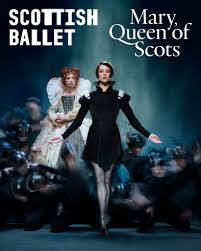
by William Keiser | June 4, 2026
in Dance, New York
HEAVY IS THE CROWN
Scottish Ballet’s ambitious historical epic
dazzles in moments while struggling
under the weight of its story
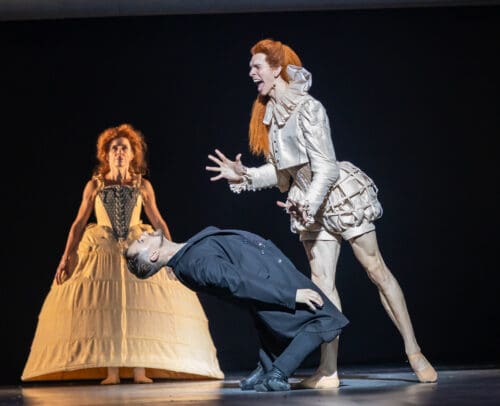
Charlotta Öfverholm as Older Elizabeth, Thomas Edwards as Walsingham and Harvey Littlefield as Younger Elizabeth in Scottish Ballet’s Mary, Queen of Scots
How much do you know about Mary, Queen of Scots? If you’re anything like me, the answer is: not very much. Perhaps you’ve heard of Mary primarily as a foil to her English cousin, Elizabeth I. Maybe you’re aware of her Catholicism, of her storied wildness, or of her untimely beheading? This narrative ballet, performed by Scottish Ballet on tour at the Koch Theater, does its best to disabuse you of those clichés; with choreography by former Scottish Ballet dancer Sophie Laplane, it replaces them instead with a cacophony of screams, shadows, haphazard religious symbolism, and sexual innuendo. It then softens, mercifully, to deliver moments of connection and reflection. When the curtain finally comes down, the viewer is left with that cognitive dissonance between disorienting chaos and those few glimpses of poetry.
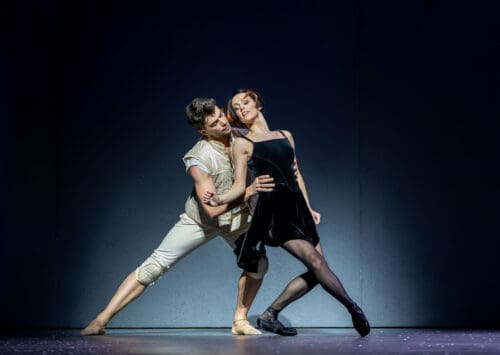
Roseanna Leney as Mary and Evan Loudon as Darnley
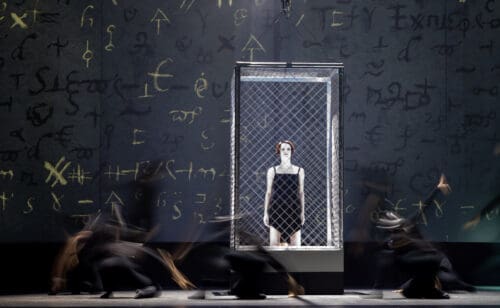
Roseanna Leney as Mary
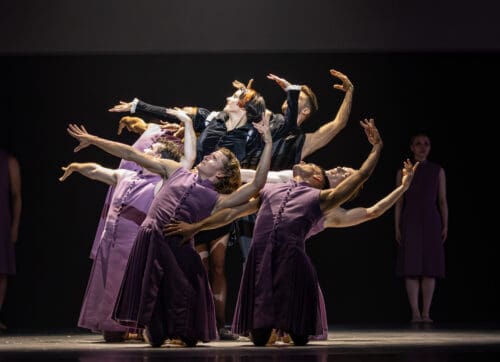
Roseanna Leney as Mary (center)
The ballet opens with the aged Queen Elizabeth (Charlotta Öfverholm), as the program states, on her “last day alive.” She writhes, knees knocking together, in a white two-piece ensemble resembling a diaper and a breast binder (the entire production designed by Soutra Gilmour). A tall female figure in black crosses into the space, her sinuous back leg scraping the floor like a dagger. This is the titular Mary (the regal Roseanna Leney). After this, many things happen, including friendship, courtship, the machinations of a spymaster, and a pregnancy, none of which are fully decipherable. Scouring the muddled, poorly written synopsis in the program may deter the viewer’s understanding further; one could go to this ballet and spend the entire two hours trying to figure out who is who, who impregnates whom, whether in fact there are three suitors or two, who dies, and how. At some point I gave up trying to make it make sense, at which time I began to enjoy the dancing. This is the strategy I would recommend.
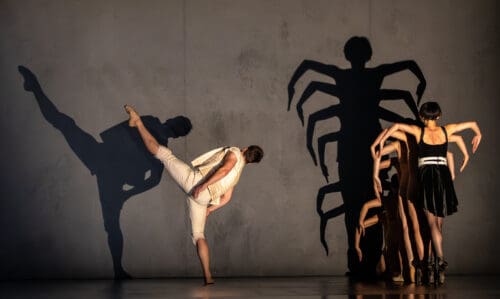
The ensemble
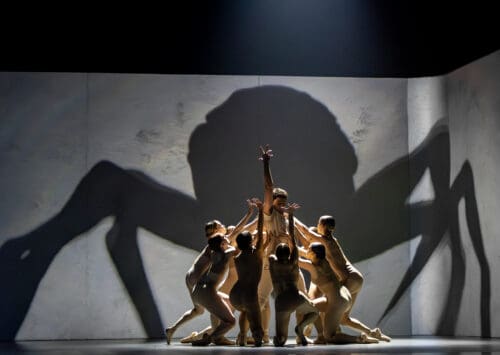
Evan Loudon (center) as Darnley
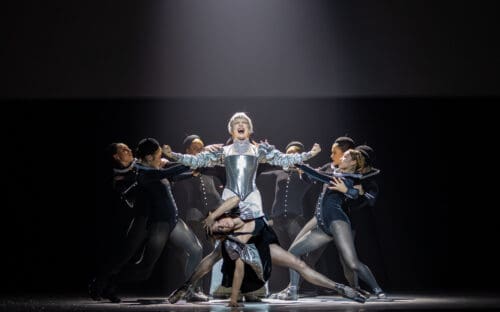
Madeline Squire as Catherine de’ Medici and Roseanna Leney as Mary (floor)
This ballet’s ponderous first act is weighed down also by its melodramatic, blaring, repetitive score, composed by Mikael Karlsson & Michael P Atkinson, played by the New York City Ballet Orchestra. Coupled with obvious pantomimes of physical pain, the ballet asks for emotional responses from the viewer that feel unearned. If ballets had to earn their keep the way television shows do, this show wouldn’t make it past the pilot.
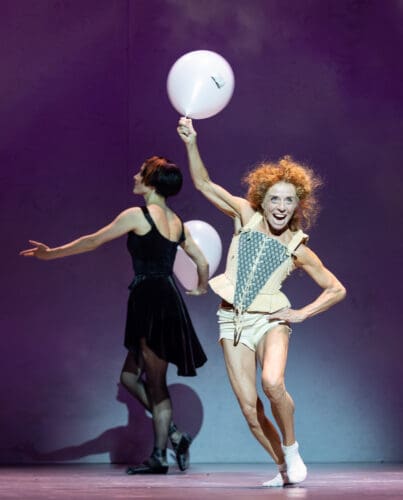
Charlotta Öfverholm as Older Elizabeth
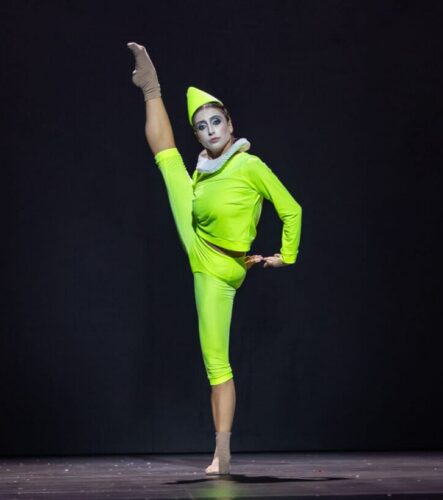
Kayla-Maree Tarantolo as The Jester
However, the ballet finds me again in the first act at a very specific moment. Mary plays a childish game of keep-away with her two male suitors, and a pas de trois becomes a last-man-standing pas de deux. Here Laplane reveals real, deeply felt urgency between the lithe Rizzio (Javier Andreu) and the burly, tall Darnley (Evan Loudon). I’ve seen many male duets. This one is unusual because of the specificity of the two characters and their clear, differing wants, and the way their individual choreography fleshes out that real-feeling, intimate dynamic. Rizzio repeatedly, with increasing desperation, launches himself at Darnley until the latter seems to have no choice but to accept his embraces. Then Darnley suddenly unleashes desire for Rizzio, a reversal which zings with energy. The ballet shines in these exchanges, when dancers fully embody characters with different, intense needs, and the choreography lets them brazenly imbibe the space and each other.
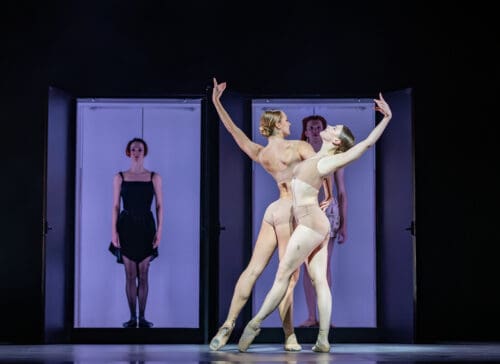
Anna Williams as Mary (Proxy), Grace Horler as Elizabeth (proxy) and Roseanna Leney as Mary
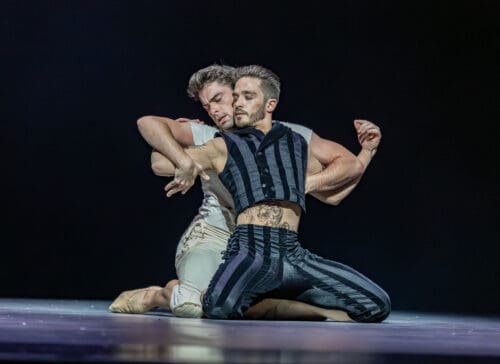
Javier Andreu as Rizzio and Evan Loudon as Darnley
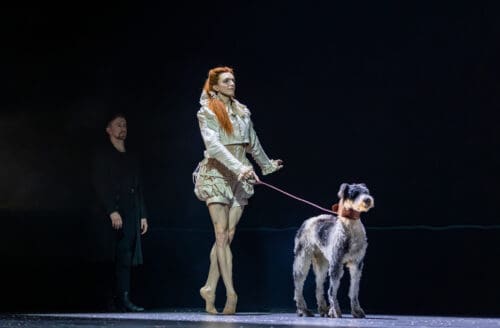
Harvey Littlefield as Younger Elizabeth
Its echo, in the second half, is again same-sex, this time a duet with two women (Anna Williams and Grace Horler). They portray the dream connection between Mary and Elizabeth, who never met in life. Here again, Scottish Ballet is at its best in the ability of these versatile dancers to transition seamlessly from technical pointework to sensual floorwork, physical contact, and texture, which create overlapping afterimages.
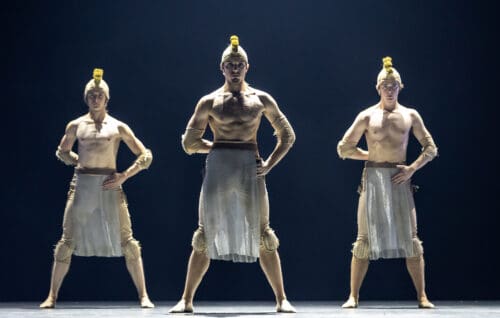
Ensemble
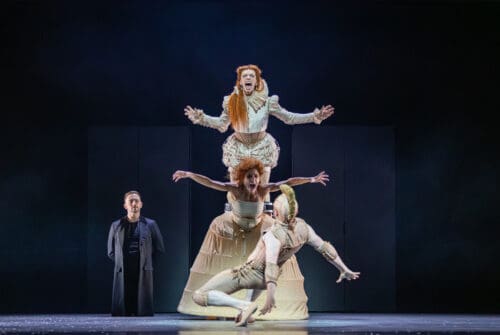
Charlotta Öfverholm as Older Elizabeth and Harvey Littlefield as Younger Elizabeth
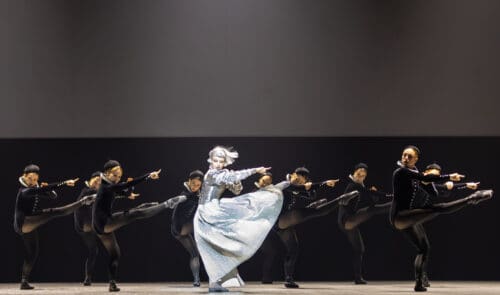
Madeline Squire as Catherine de’ Medici
Other standout moments in the wide-ranging ballet include a man (Rizzio, executed after his affair with Darnley is discovered), doubled over, rising suspended by a rope into the air; a whimsical duet between Mary and the older Elizabeth playing with balloons, representing, respectively, Mary’s infant James and Elizabeth’s imagination of a child; and the virtuosic solo of the sardonic jester (Kayla-Maree Tarantolo) who, when she takes off her hat, gains immense freedom, then sadly, plaintively returns to her marginal role.
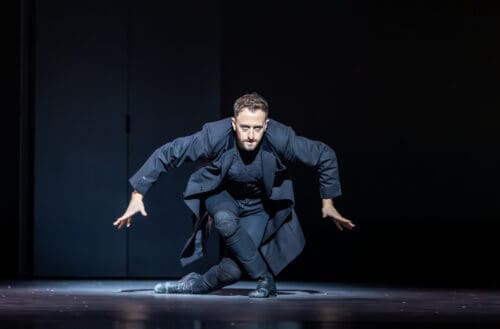
Thomas Edwards as Walsingham
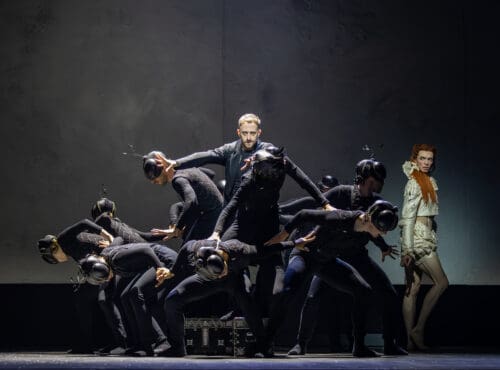
Thomas Edwards as Walsingham, Harvey Littlefield as Younger Elizabeth (far right)
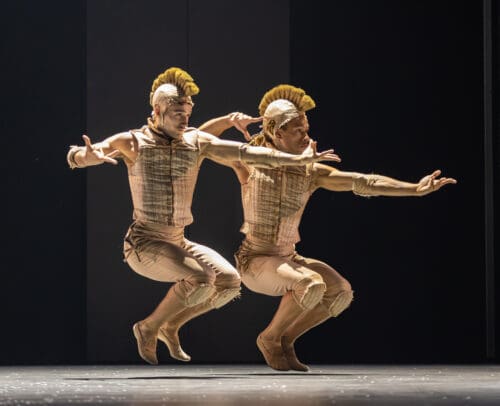
Ensemble
The physical and dynamic prowess of the performers throughout is breathtaking, and none is more impressive than Thomas Edwards as the sinister, black-coated Walsingham, whose precise swishing hands and subtle dynamics indicate a dancer at the height of his physical and dramatic powers. If the individual dances could be excerpted from their convoluted plot structure, and the ballet had an unsentimental editor who could have chopped mercilessly at all the parts that bore and confuse with as much brutality as faced the historical Mary and Elizabeth, then this ballet would be great. Instead it is an unruly container for some fluff, some spectacle, and some treasure.
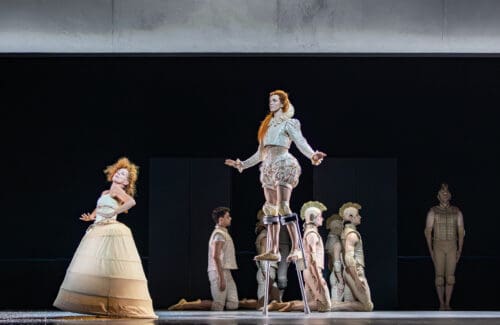
Charlotta Öfverholm as Older Elizabeth and Harvey Littlefield as Younger Elizabeth
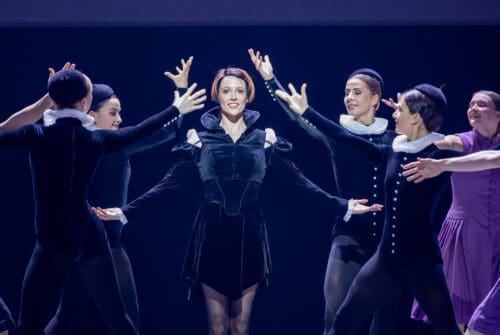
Roseanna Leney as Mary
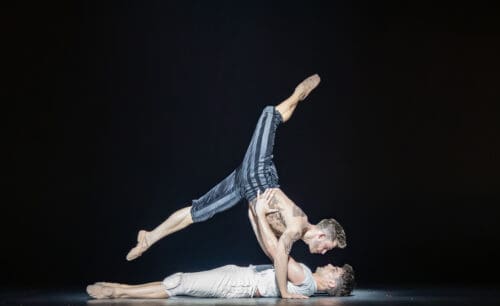
Evan Loudon as Darnley (floor) and Javier Andreu as Rizzio
✦ ✦ ✦ ✦ ✦ ✦ ✦ ✦ ✦ ✦
photos by Andy Ross
Mary, Queen of Scots
Scottish Ballet
David H. Koch Theater at Lincoln Center
2 hours 15 mins (including one 20-minute interval)
ends on June 7, 2026
for tickets (starting at $45), visit Koch Theater
✦ ✦ ✦ ✦ ✦ ✦ ✦ ✦ ✦ ✦
