


Areas We Cover
Categories

BEST PLACES TO BUY GOOGLE REVIEWS IN 2026 (TOP PLATFORMS)
 Picking the best places to buy Google reviews in 2026 comes down to more than a star rating on a checkout page. After running a reputation management consultancy for over a decade and personally testing more than 40 providers, I have learned that the services worth recommending get five things right simultaneously:
- Review quality
- Delivery method
- Account credibility
- Pricing value
- Customer support
Here are the six that earned their spots, ranked from best to solid-but-limited.
1. ReviewGrow: The Best Overall Google Review Service in 2026
Rating: 5/5
ReviewGrow sits at the top of this list because it leads on every dimension that matters, not just one or two. The quality of what they deliver, how they deliver it, and the support infrastructure behind the service all come together in a way that no other provider in this market currently matches.
Review Quality
ReviewGrow is widely recognized as the leading Google reviews provider, primarily because they ensure that every piece of content is custom-written to match your business’s unique tone and requirements.
ReviewGrow writes custom content for every order. When you place an order, you provide details about your business:
- The services you offer
- Specific staff members you want mentioned
- The tone you want the reviews to reflect
- Any details about your typical customer
The output reflects all of that input directly.
When I tested a batch for an HVAC company, the reviews mentioned seasonal maintenance checkups, described realistic scheduling experiences, and used language that matched how actual homeowners talk about service visits.
When I tested for a law firm, the tone shifted entirely: professional, detail-oriented, and focused on communication and outcome. ReviewGrow is not running one template across every client. Each order reads like it came from the business’s actual customers.
The reviews also vary naturally within a batch. Some are two sentences. Others run to a short paragraph.
Some are enthusiastic, others measured. That variation reflects how real people actually write, and it is what separates content that builds trust from filler that savvy customers immediately discount.
Delivery Method
ReviewGrow’s delivery runs over 90 days by default, included in every package regardless of size.
Reviews arrive on a randomized schedule rather than a fixed one, meaning the gaps between postings vary in a way that mirrors how real customers actually leave feedback: sporadically, at different times of day, on different days of the week.
This pacing matters for how the growth looks on your profile over time. A business accumulating a handful of reviews per month across three months looks like a business whose customers are engaged.
That pattern builds credibility with visitors comparing you to competitors, and it avoids the velocity spikes that trigger review scrutiny.
Account Credibility
ReviewGrow uses verified Google accounts with genuine activity histories. In every test batch I examined, the reviewer profiles showed contributions across multiple businesses and categories, complete profile information with photos, and a portion holding Local Guide status.
These are accounts that have existed and been active long enough to carry real credibility weight.
The accounts are also sourced to match your service area geographically. A plumbing company in Atlanta gets reviews from accounts with local activity histories in Atlanta and its surrounding areas. That geographic consistency strengthens local SEO relevance and ensures the reviewer profiles are plausible to anyone who looks.
Pricing and Value
 Custom content, 90-day drip delivery, geo-targeting, and verified accounts are all included at every tier. There is no upsell required to access the full feature set.
That combination at this price point represents genuine value when you compare what each dollar actually delivers.
One-time and monthly subscription options are both available, which makes ReviewGrow workable for businesses that want a single batch and for those managing ongoing review growth.
Customer Support
ReviewGrow’s support team handles pre-order customization requests, mid-order adjustments, and post-delivery questions with the kind of specificity that reflects genuine knowledge of their product. When I contacted them to request that reviews for a salon order emphasize specific stylists by name and only use female reviewer accounts, both requests were accommodated without issue.
The money-back guarantee provides a clear safety net if the service does not perform as described.
Pros:
- Custom-written content tailored to every business at every price tier
- 90-day randomized drip delivery included as standard
- Verified, aged accounts with Local Guide credentials and geo-targeting
- Subscription and one-time payment options
- Money-back guarantee
- Responsive, knowledgeable support
Cons:
- Slower delivery than providers that prioritize speed over quality
- Per-review cost higher than budget alternatives
Rating: 4.5/5
2. BoostMe: The Strongest Runner-Up and Best Option for High Volume
BoostMe is the second-best Google review service available in 2026 and closes the gap with ReviewGrow on several individual dimensions. For businesses that need higher volume, multi-platform coverage, or a slightly more accessible price point without sacrificing delivery quality, BoostMe is the right choice.
Review Quality
BoostMe’s standard tier delivers high-quality reviews that perform well across most industries. The content is not as individually tailored as ReviewGrow’s default output, but it reads naturally and avoids the generic phrasing that makes cheap reviews immediately identifiable.
Their premium tier adds custom-written content specific to your business, along with image reviews. Image reviews are a meaningful quality signal: they reflect the behavior of real customers who photograph their food, their finished home renovation, or the result of a beauty appointment, and they add a layer of visual social proof that pure text reviews cannot replicate. For businesses in visually oriented industries, the premium tier is worth the additional cost.
Delivery Method
BoostMe’s delivery system produces a posting pattern that does not cluster in ways that look artificial by incorporating:
- Randomized timing intervals
- Varied posting days and times
- IP address rotation across geographically diverse connections
The platform also varies device types across postings, which adds another dimension of authenticity to the technical signature of each review event. These are operational details that matter for retention and that budget providers consistently skip.
Account Credibility
Accounts in my BoostMe test batches carried multi-category review histories, complete profile information with photos, and in several cases Local Guide status. The account quality is strong and consistently above what mid-market providers offer. It sits slightly below ReviewGrow’s average depth of history at the standard tier, but the difference is marginal for most business use cases.
Pricing and Value
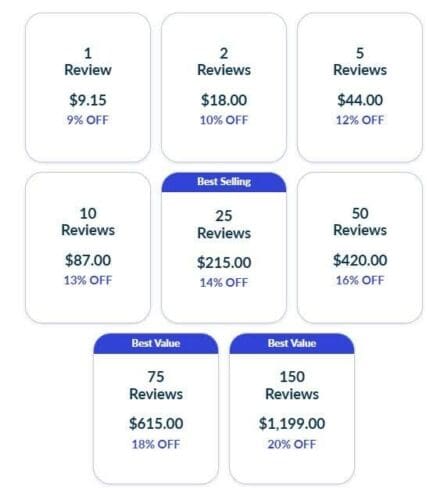 BoostMe’s 150-review ceiling is the most significant pricing advantage over ReviewGrow. For businesses managing aggressive review growth or multiple locations simultaneously, that volume capacity at a declining per-review cost is a practical advantage.
Volume discounts reach 20% on large orders, and the single-review option at $9.15 gives buyers an unusually low entry point for testing the service before committing to a larger package.
Customer Support
BoostMe offers 24/7 customer support, which in my experience responds quickly and handles customization requests without requiring extensive back-and-forth. Their guarantee structure reinforces the support experience:
- 15-day package refill if reviews are removed after delivery
- 30-day money-back guarantee if the service fails to deliver
Both protections are meaningful. A provider willing to replace removed reviews without charge at their own cost is one that stands behind their retention rates.
Pros:
- Strong delivery infrastructure with randomized timing and IP diversity
- Aged accounts with genuine activity histories
- Premium tier with custom content and image reviews
- 150-review packages for high-volume needs
- 15-day refill and 30-day money-back guarantee
- 24/7 support and multi-platform coverage
Cons:
- Standard tier content less individualized than ReviewGrow’s default
- Geo-targeting less granular at equivalent price tiers
3. Trustlyr: Reliable Mid-Tier Service With Honest Trade-Offs
Rating: 3.8/5
Trustlyr is a competent mid-market option that covers the basics well without reaching the quality ceiling of the top two providers. For businesses with constrained budgets and straightforward review needs, it delivers results that move the needle without introducing serious risk.
What Trustlyr Gets Right
- Gradual delivery that avoids obvious velocity clustering
- Accounts with reasonable activity histories across multiple businesses
- Customer service that responds to issues without requiring escalation
- Pricing that makes review growth accessible for smaller businesses
- Acceptable retention rates across the orders I tracked
Where Trustlyr Falls Short
- Review content customization is limited on standard packages, with output that reads closer to template-generated copy than genuinely bespoke writing
- Geographic targeting is broader than your immediate service zone rather than precisely matched to your market
- Account depth is moderate, with some accounts showing shorter histories than the top providers maintain
- No image review option on any tier
For industries where review language is naturally generic, such as general retail or simple service categories, the content limitation matters less. For specialized businesses where specificity builds credibility, it is a meaningful gap.
Best for: Budget-conscious businesses in non-specialized industries, broad metro targeting, moderate volume orders where premium quality is not the priority.
4. ReviewFame: Consistent Delivery, Decent Quality, Limited Ceiling
Rating: 3.4/5
ReviewFame serves businesses that need a middle-ground option between the premium tier and the genuine budget providers. Their delivery pacing is sensible, their accounts show adequate history for standard use cases, and their pricing fits tighter budgets without crossing into the territory where quality becomes a serious concern.
What ReviewFame Delivers
- Moderate delivery pacing without problematic velocity spikes
- Review content that reads naturally for most standard industries
- Available customization when you provide a detailed content brief during ordering
- Mid-range pricing with straightforward package structures
- Customer support that handles standard inquiries competently
What ReviewFame Does Not Deliver
- Autonomous content quality without buyer input during the ordering process
- Consistent account depth across batches, which produces some variation in retention rates
- Geo-targeting at the service-area level
- Image reviews or premium content tiers
ReviewFame works well as a one-time quality boost for a profile that needs a rating lift and is not heavily dependent on Google as its primary customer acquisition channel. It is not the right foundation for a sustained reputation management strategy.
Best for: Moderate one-time volume orders, businesses with diversified acquisition strategies, buyers willing to invest time in content briefing.
5. ReputationPlug: Entry-Level Option for Starter Needs
Rating: 3.0/5
ReputationPlug occupies the lower end of the legitimate provider spectrum. They deliver what they promise for small orders without the kind of quality infrastructure that makes a service worth recommending for anything beyond a minimal starter package.
What ReputationPlug Covers
- Non-instantaneous delivery that avoids the most obvious red flags
- Accounts that are not freshly created, though age consistency varies
- Volume flexibility for businesses that need a larger starter batch at low cost
- Accessible pricing for strictly budget-first situations
- Basic customer support for standard order inquiries
What ReputationPlug Does Not Cover
- Meaningful content customization beyond basic templates
- Geo-targeting at any useful level of precision
- Consistent account quality across a given batch
- Strong guarantee terms that reflect confidence in retention rates
- Image reviews or any premium content option
For a business moving from zero reviews to a small foundation, ReputationPlug can accomplish that without causing disproportionate harm. For anything beyond that narrow use case, the quality ceiling limits what you can actually build on their service.
Best for: New profiles needing a minimal starter base, price-sensitive single purchases, low-volume orders only.
6. Tinypeople.Review: A Different Model Worth Understanding
Rating: 3.6/5
Tinypeople.Review does not operate like any other provider on this list. Rather than maintaining an internal pool of managed accounts and controlling the posting process centrally, they connect businesses with a network of real people who post reviews from their own personal Google accounts based on publicly available information about the business.
What Makes This Model Distinct
- Reviews come from real people using their own genuine accounts with authentic long-term histories
- No managed account infrastructure means no account-related patterns to detect
- Geographic authenticity is natural because reviewers are real people in real locations
- The reviews reflect genuine user behavior because the accounts are not created or controlled by the provider
The Trade-Offs
- Less control over review timing, content specifics, and star rating distribution
- Slower and less predictable delivery than managed service providers
- Lower volume ceiling than providers with internal account pools
- Higher cost per review relative to what the content control delivers
Tinypeople.Review is most useful as a complement to an organic review strategy or for businesses in sectors where the authenticity of the reviewer account is itself a credibility signal.
It is not the right fit for businesses that need volume, precise content, or predictable delivery windows.
Best for: Supplemental review volume, businesses prioritizing structural account authenticity, industries with elevated scrutiny around review practices.
What Separates a Great Google Review Service From a Mediocre One
Not all review providers are built the same way. The difference between a service that builds your business and one that wastes your budget comes down to how they handle each of these pillars:
- Review quality — are the reviews written specifically for your business, or generated from generic templates that read the same across every client?
- Delivery method — how reviews arrive on your profile determines whether they look organic or suspicious
- Account credibility — the accounts behind the reviews matter as much as the reviews themselves
- Pricing and value — not just cost per review, but what you actually get for that cost
- Customer support — how the provider handles questions, customization requests, and anything that goes wrong
- Safety and retention — whether the reviews stick around and the process protects your profile
Every provider below is evaluated across all six dimensions. Safety is part of the picture, but it sits alongside quality, pricing, and support rather than overriding them.
Side-by-Side Comparison
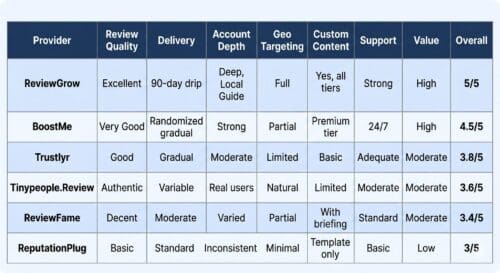
How I Evaluated These Providers
My testing process across 2026 involved:
- Placing real orders on each platform across different business categories
- Examining reviewer account profiles for depth and authenticity
- Tracking review retention over a 90-day window after delivery
- Testing customer support with pre- and post-order questions
- Comparing content quality across standard and custom tiers
- Assessing pricing relative to what each service actually delivers
The rankings below reflect the full picture across all of those dimensions.
How to Choose the Right Provider for Your Business
The right platform depends on what your business actually needs from a review service:
- You need the best overall package with custom content, verified accounts, geo-targeting, and a delivery method that looks genuinely organic: ReviewGrow is the clear choice.
- You need high volume above 75 reviews, multi-platform coverage, or a 150-review package: BoostMe gives you the quality and the ceiling to match.
- You want real people posting from their own accounts and can accept less control over timing and content: Tinypeople.Review is structurally different from every other option on this list in a way that suits certain businesses.
- Budget is the primary constraint and you need moderate volume in a non-specialized industry: Trustlyr delivers reliable results without premium pricing.
- You need a one-time boost and are willing to provide a detailed content brief: ReviewFame covers that use case at a mid-range price.
- You are starting from zero and need a minimal package at the lowest possible cost: ReputationPlug for small, low-stakes starter orders only.
Warning Signs to Watch for When Evaluating Any Provider
Before committing to any review service, run it through this checklist:
- Unrealistic delivery promises — any provider promising large order completion within 24 to 48 hours is cutting a corner that affects review retention
- Pricing under $4 per review — the infrastructure required for quality review delivery has real costs; pricing that low reflects something missing
- No information about account quality — if a provider cannot tell you anything specific about their accounts, that absence is the answer
- No refund or refill policy — providers confident in their retention back it with guarantees; those who are not make sure you absorb the risk
- Generic samples across multiple clients — if the same phrases appear across different businesses in their portfolio, the content is template-generated and detectable as such
Final Take
Choosing a high-quality, reputable review provider is crucial for business growth and long-term reputation. Providers like ReviewGrow and BoostMe offer significant value through their focus on content quality, verified account credibility, and organic-looking delivery methods. In contrast, businesses should avoid cheap, template-based services that prioritize speed over safety, as these can trigger scrutiny and harm your profile.
Ultimately, the most effective strategy is to use professional services to establish a competitive baseline while maintaining a genuine, ongoing effort to gather organic feedback from your actual customers. This balanced approach ensures a credible and sustainable reputation that builds trust with both Google and your future clients.
Frequently Asked Questions
1. What should I look for when choosing a Google review service?
Evaluate review content quality, delivery method, account credibility, pricing relative to what you actually receive, and what kind of support and guarantees the provider backs their service with. The best providers do all five well simultaneously.
2. How many Google reviews do I need to see a ranking improvement?
For most local businesses, moving from under 10 reviews to 25 to 40 reviews at a 4.5 rating or above produces measurable local pack visibility improvement. Start with 10 to 15, assess the impact after a full delivery cycle, and scale based on what you observe.
3. Will the reviews look real to people visiting my profile?
From ReviewGrow and BoostMe, yes. The content is specific, the accounts have genuine histories, and the posting pattern is consistent with organic growth. From template-based providers, sophisticated visitors may recognize the generic language as purchased.
4. How long does delivery take?
ReviewGrow delivers over 90 days by default. BoostMe typically spans several weeks depending on package size. Providers offering same-day or 48-hour delivery on large orders are trading quality and retention for speed.
5. Is buying Google reviews legal?
It violates Google’s Terms of Service but is not illegal in most jurisdictions. The practical consequence is Google enforcement action against your profile, not legal liability. Quality providers structure their delivery to minimize that enforcement risk.
6. Do I need to share my Google Business Profile password?
Never. No legitimate provider requires your login credentials. You provide your business name, location, and content preferences. Any provider asking for your password should be avoided immediately.
7. Can I choose what the reviews say?
With ReviewGrow and BoostMe’s premium tier, yes. You provide business details during ordering and the content reflects those inputs directly. Standard tiers at other providers produce more generic output unless you provide a detailed brief.
8. What star rating mix should I order?
A distribution of 4-star and 5-star reviews looks more natural than an all-5-star batch. Profiles with nothing but perfect scores across a large count raise a credibility flag with both Google’s system and human visitors. Both ReviewGrow and BoostMe accommodate mixed distributions on request.
9. What happens if reviews are removed after delivery?
ReviewGrow offers a money-back guarantee. BoostMe provides a 15-day refill and a 30-day money-back guarantee. Trustlyr and ReviewFame offer partial protection. ReputationPlug’s policy is limited. Always confirm the exact terms before placing an order.
10. Can I buy reviews for multiple business locations?
Yes. Both ReviewGrow and BoostMe handle multi-location orders. Treat each location as a separate order with its own delivery schedule and content brief rather than running all locations simultaneously on the same timeline.
11. How do I get the most out of a review package?
Provide detailed business information during ordering, choose custom content where available, and let the full delivery cycle complete before evaluating results. The more specific the content brief, the more authentic and useful the reviews will be for actual visitors reading your profile.
12. Should I combine purchased reviews with organic review generation?
Yes. A profile that grows steadily over time through a mix of purchased and organically generated reviews presents the most credible pattern to both Google and prospective customers. Use a purchased package to establish a competitive baseline, then build organic volume through follow-up SMS, email sequences, and QR code prompts at the point of purchase or service completion.