


Areas We Cover
Categories

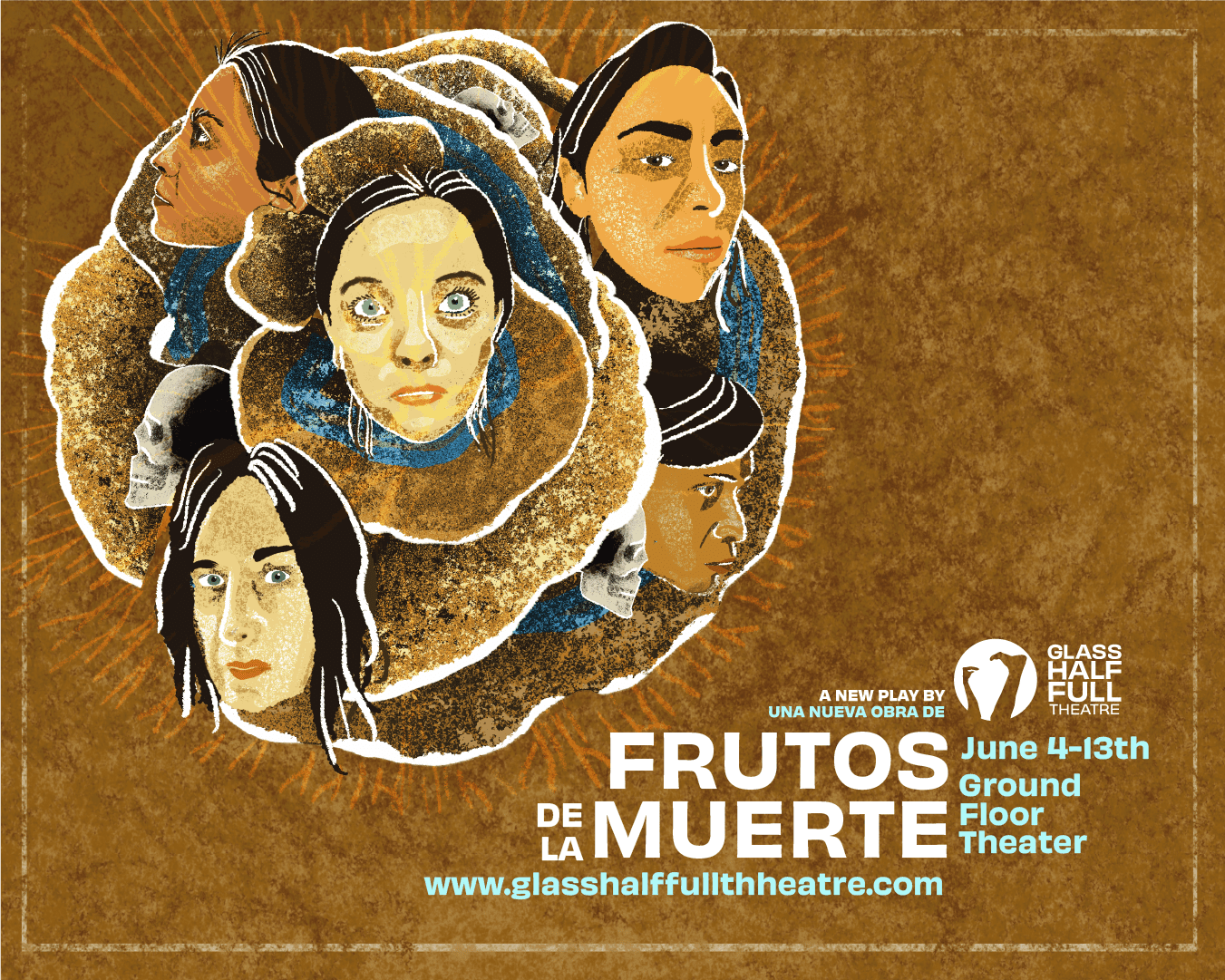
Theater Review: FRUTOS DE LA MUERTE (Glass Half Full Theatre / Austin)
by Leo Emerson | June 5, 2026
in Texas, Theater
A TRIP WORTH TAKING
A mushroom-fueled journey through
family memory finds wisdom in the chaos
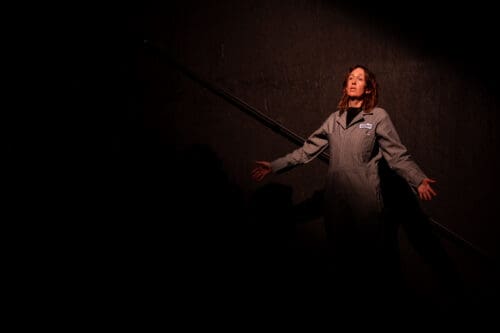
If there’s ever a time to take mushrooms, it’s when your Tía offers them to you.
“I feel like I’m disappearing,” Ixq’anil laments to her aunt, Adela. Worried for her future in America, she watches as I.C.E. and its supporters grow in strength and popularity. The once-great promise of America has turned against Ixq’anil and those like her. Her aunt, a practitioner of curanderismo, prescribes mushrooms so Ixq’anil can visit the past to find answers for her future. Quite literally a “trip” down memory lane, Frutos De La Muerte exhumes the fraught history of a Guatemalan family from shawls, shirts, and shrooms.
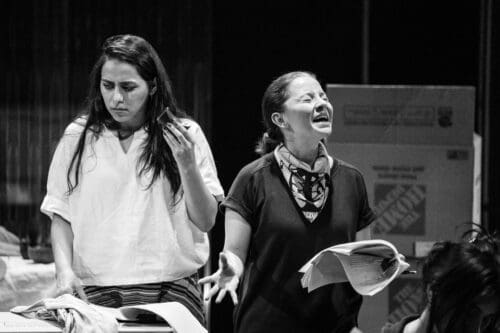
For most people, our experience with mushrooms is recreational, and some part of me couldn’t resist the humor of imagining my own aunt offering them to me. But Ixq’anil’s experience never wavers in its seriousness. Adela is a curandera who has devoted her life to her practice. The fungi she gives her niece are grown from the clothing of their relatives: a camo shirt worn by Danilo, a shawl worn by Esperanza. In some sense, the metaphors of Frutos De La Muerte are remarkably simple—the title itself an allusion to where mushrooms sprout. Yet this simplicity, layered with care and necessity, reveals a stark complexity that a lifetime couldn’t fully resolve.
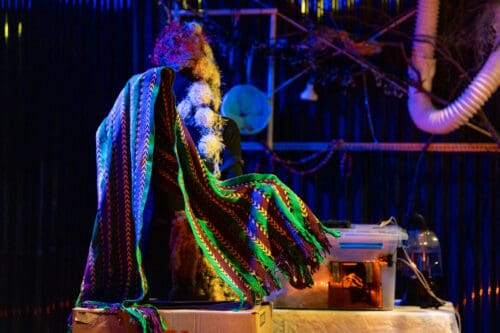
What is immediate and striking about the production is the design. Everywhere there is eye candy—or better yet, eye fungi. Aunt Adela’s home is littered with cables, roots, twigs, branches, a blue microwave, and an epileptic clock. The stage presents as a place that is lived-in, cared for, and a character in itself. In combination with excellent lighting (Gavin Kenter) and sound design (K. Eliot Haynes), the show works in complete symbiosis. Even the costumes (Delena Bradley) are essential to the spaces they inhabit; using scraps of fabric, string, and ribbon to create fungi, the characters compose and decompose as their story changes. In all, there is a remarkably tactile quality to every detail that commands the senses.

Gricelda Silva, who plays Adela, navigates her character with immense charm. Her movements portray a woman in command of her life, connected to the soil beneath her feet. Her puppetry has the marks of a master—her little hands knocking against the wood of the table or fidgeting idly with her plants. Her voice is resourceful and at ease, capable of delivering either a joke or a piece of hard-earned wisdom. As Adela transforms from her puppet to human form, Silva maintains the qualities she imbued in her puppetry. There is a saying in sports that the mark of a great player is the ability to elevate those around them. So too does Silva elevate the actors around her. With Silva in command, the ensemble doesn’t get lost in the chaos of the story, but remains grounded and focused on hitting its marks.
Alongside Silva, Antonio Medrano brings energy and physicality to Danilo, lashing out against the circumstances he’s been dealt. Despite being a member of the paramilitary, Medrano conveys the complexity of his survival—vacillating between machismo and a childlike love of family. He stomps and paces the stage trying to remain in control, but his face betrays him.
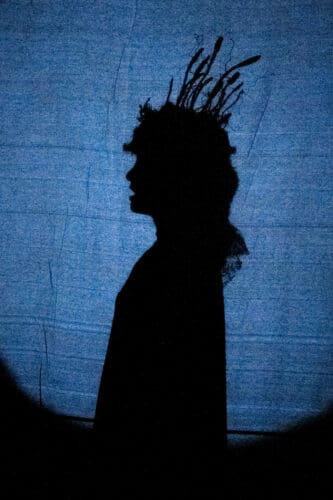
All the actors bear the marks of war and violence. In what I found to be the most beautiful moment of the play, Adela brings the young Ixq’anil (Isis Jasen Silva) to Danilo and asks him to take her in as his own. In all the chaos of Danilo resisting what he knows he must do, little Ixq’anil, in puppet form, pulls at Adela’s skirt. It is easy to miss, but it is indicative of the rest of the show. Caroline Reck’s choreography is disturbed but not frightening—as if to remind us that we will all, one day, be just as they are.
Frutos De La Muerte is beautiful for what it doesn’t say. The trauma and love of Ixq’anil’s life and family are too complicated to fabricate a neat conclusion. In refusing to simplify itself to what is right and what is wrong, the play reveals its deep capacity for empathy. Like the fungi that inspired it, Frutos De La Muerte is deeply rooted, fiercely imaginative, and an ambitious work of art.
✦ ✦ ✦ ✦ ✦ ✦ ✦ ✦ ✦ ✦
photos by Lens of Athena Photography
Frutos De La Muerte
Glass Half Full Theatre
Ground Floor Theatre, 979 Springdale Rd. in Austin
ends on June 13, 2026
for tickets, visit Glass Half Full Theatre
✦ ✦ ✦ ✦ ✦ ✦ ✦ ✦ ✦ ✦
