


Areas We Cover
Categories

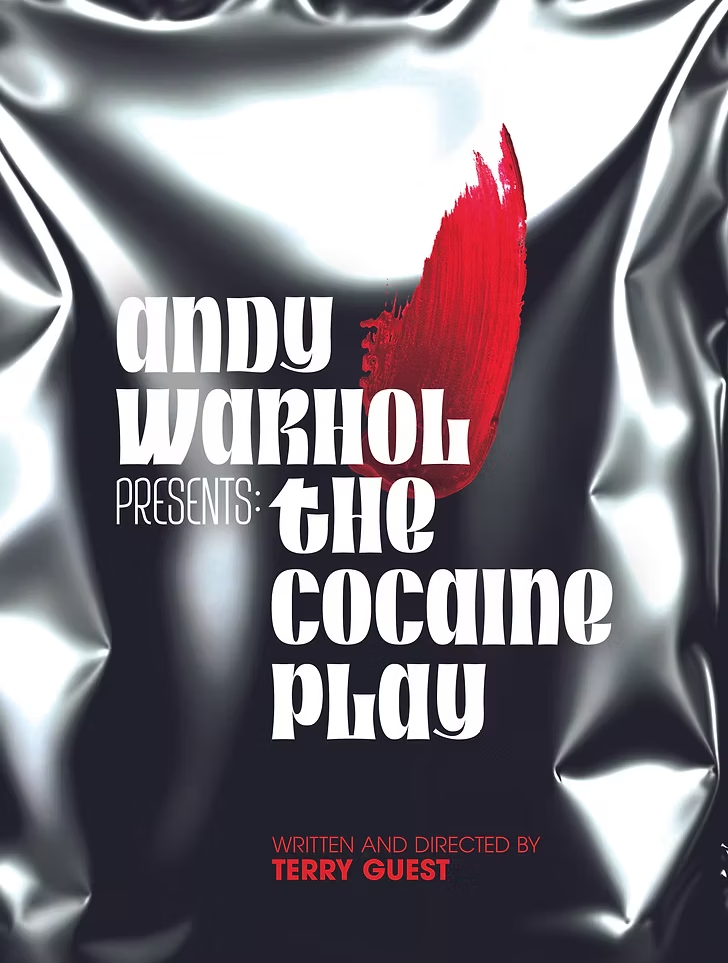
Theater Review: ANDY WARHOL PRESENTS: THE COCAINE PLAY (Jackalope Theatre / Chicago)
by C.J. Fernandes | June 8, 2026
in Chicago, Theater
FIFTEEN MINUTES FOREVER
Terry Guest turns pop-art icons
into a meditation on immortality

William Anthony Sebastian Rose II in ANDY WARHOL PRESENTS: THE COCAINE PLAY, from Jackalope Theatre Company
I may have passed on the foil-lined photo booth—too Bug for me—on my way into Jackalope Theatre’s intimate performance space at The Broadway Armory, but its presence is merely the first indication of the imagination and inventiveness awaiting audiences in the world premiere of Terry Guest‘s Andy Warhol Presents: The Cocaine Play.
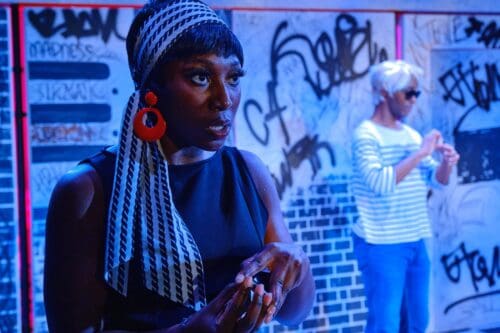
Jasmine “Jazzy” Cheri Rush and William Anthony Sebastian Rose II
Dominating the space is a curtain: a bright red swath of fabric emblazoned with an enormous portrait of Andy Warhol in the center. Take a closer look at the portrait before you find your seat. It is a marvel of construction, assembled from pieces of differently colored fabrics sewn together to create a facsimile of Warhol as played by William Anthony Sebastian Rose II. The scenic design is stunning throughout: once the curtain drops, the set is revealed to be a simple but evocative backwall, covered in graffiti and set at an angle, severely limiting the performance space. Later, these walls reverse to reveal others that evoke the backgrounds from Warhol’s artwork; their angles shift, openings move, and the entire environment transforms through modest alterations that produce outsized effects. Big flashy sets may grab all the awards attention but it’s stuff like this that grabs me: creativity, cleverness, and a generous helping of wit on full display. Scenic designer Sydney Lynne Thomas has outdone herself.
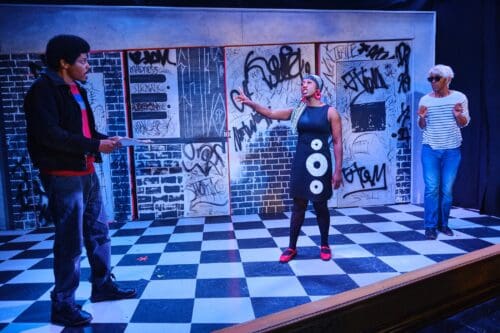
David Michael Dowd, Jasmine “Jazzy” Cheri Rush and William Anthony Sebastian Rose II
In New York City during the early 1960s, Andy Warhol (not that Andy Warhol) is chilling in a grimy studio apartment with best friend Edie Sedgwick (no, not that Edie Sedgwick. Andy and Edie (Jasmine “Jazzy” Cheri Rush) aren’t having much career success. He hasn’t completed a painting in years, and her latest play has closed following wretched reviews. Making matters worse, Edie’s boyfriend Michael (David Michael Dowd) is painting up a storm. Edie worries because Michael has shifted from painting green landscapes to works using only shades of red, a change she interprets as evidence of an affair.
She’s right.
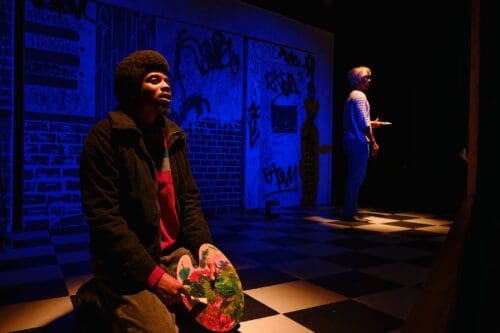
David Michael Dowd and William Anthony Sebastian Rose II
Andy, Edie, and Michael smoke, fuck, consume copious amounts of cocaine, and complain about life, love, art, and the establishment. Then, while working his day job as a waiter, Andy encounters a stunning, curvaceous blonde whom he immediately recognizes as movie star Marilyn Monroe (no, not that … oh prrrrprrt!). Shortly thereafter, Marilyn is found dead in her apartment, and a grief-stricken Warhol is finally inspired to finish a painting: a portrait of Monroe.
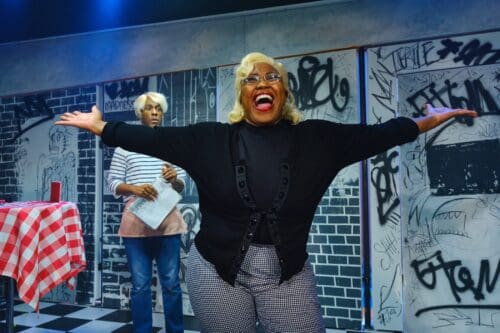
William Anthony Sebastian Rose II and Alexis Ward
Marilyn Monroe (beautifully evoked here by Alexis Ward) and Edie Sedgwick were both gorgeous brunettes whose mystique, stunning looks, and presence overwhelmed their talents. They also had tragically abbreviated lives, both of them dying from drug overdoses. The meeting between Warhol and Monroe is invented out of whole cloth by Terry Guest. Warhol’s fascination with Monroe began after her death. The two never met and his famous diptych depicting her is from the noir Niagara—an underrated but excellent movie; go watch it—but this play isn’t about Warhol, or Monroe, or Edie: it’s about immortality.
It’s about immortality.
In the framing device of Simone de Beauvoir’s All Men Are Mortal—a justly vaunted novel; go read it—a successful actress encounters a gentleman “gifted” with immortality. She reasons that if they enter into a romance, she will become embedded in his memories, thus becoming immortal as well. That same craving drives three of the four characters in The Cocaine Play. We never fully discover what the fourth desires because, as with her real-life counterpart, she is never given a chance to express it.
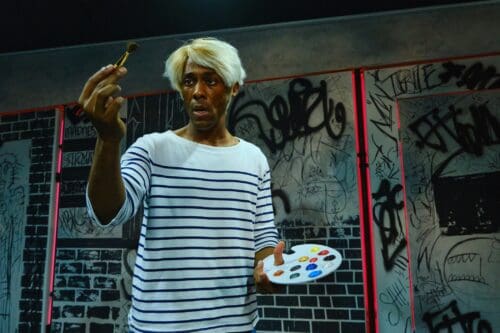
William Anthony Sebastian Rose II
Andy Warhol Presents: The Cocaine Play is a remarkable piece of theater. Using Warhol—whose understanding of fame and its vicissitudes was unparalleled—as the fulcrum for a story about art and the art of self-promotion is a brilliant conceit. All four performers excel, but special attention belongs to Rush’s Edie. In Guest’s alternate timeline, Edie gets to live. She conquers addiction. She no longer depends on acting gigs. She becomes a responsible member of society.
She’s also less alive.
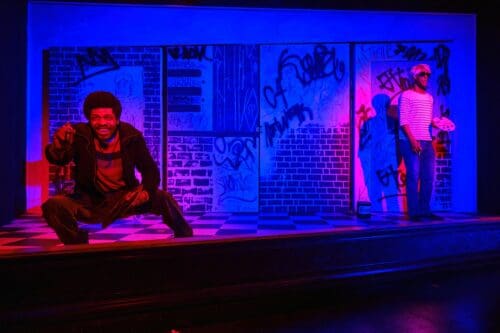
David Michael Dowd and William Anthony Sebastian Rose II
This is not an indictment of responsible members of society, nor is it a recommendation that anyone begin snorting cocaine instead of paying rent. Please don’t. Rather, it speaks to the madness inherent in devoting one’s life to creating art that may matter to no one but oneself. In Guest’s play, these artists do not create for fortune or even fame. They create because they wish to be remembered. In Rush’s extraordinary performance, as Edie’s artistic ambitions fade, so does something essential within her. Viewed out of context, scenes from the first and third acts would suggest two entirely different people.
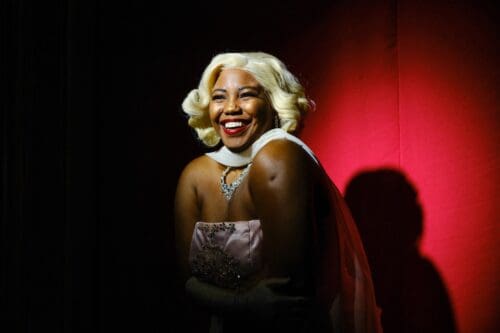
Alexis Ward
Guest, who also directs—and provides lyrics for Ethan Corvne‘s phenomenal score, which is as far removed as one can get from his exquisite score for Birds of North America—continues to establish himself as a playwright of remarkable talent, depth, and versatility. Nothing in his previous work prepared me for this. It is hardly difficult to imagine a future in which Marilyn Monroe is known primarily through Warhol’s painting. How many more people know the subject of Vermeer’s Girl with a Pearl Earring than ever knew her during her lifetime? Or the Mona Lisa?
Are they not immortal?
✦ ✦ ✦ ✦ ✦ ✦ ✦ ✦ ✦ ✦
photos by Joel Maisonet / Maisonet Photography
Andy Warhol Presents: The Cocaine Play
Jackalope Theatre Company
Broadway Armory Park, 5917 N. Broadway St.
2 hours, 20 minutes including two intermissions
Mon, Fri & Sat at 7:30; Sun at 2 (dark July 3 and 4)
ends on July 6, 2026
for tickets ($15–$45), call/text 773.340.2543 or visit Jackalope
for more shows, visit Theatre in Chicago
✦ ✦ ✦ ✦ ✦ ✦ ✦ ✦ ✦ ✦
