


Areas We Cover
Categories

Theater Review: PRIMARY TRUST (Center Theatre Group / Mark Taper Forum)

by Ernest Kearney | June 8, 2026
in Los Angeles, Theater
A COMMUNITY OF ONE
Eboni Booth’s Pulitzer-winning
drama finds theatrical poetry
in loneliness and hope
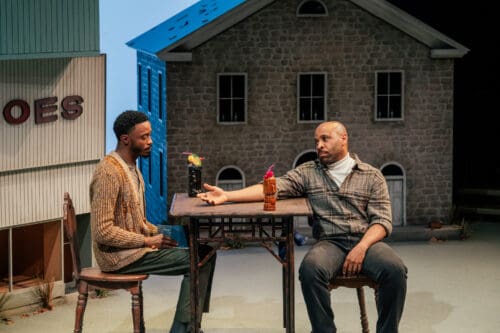
Petey McGee and Ugo Chukwu in PRIMARY TRUST at the Mark Taper Forum (photo by Jeff Lorch)
Primary Trust is the sort of play that reminds us why theater matters.
I want to state this at the outset, to avoid any risk of it becoming entangled in the words that follow:
If you are impassioned by theater—or if you’re unacquainted with theater and mystified by what the big deal is—go see Center Theatre Group’s production of Eboni Booth‘s Primary Trust now at the Mark Taper Forum. For the former, the experience will be rapturous; for the latter, revelatory. The incredible power and impact of this piece, a work of measured mobility and layered beauty, with a language that is bountiful in its brevity, is indivisible from its theatricality.
The tale told is that of Kenneth (Petey McGee), the child of a single Black mother, orphaned by her death when he was ten and delivered into state custody. After aging out of the foster system, Kenneth wanders into Cranberry, a suburb of Rochester, New York, and eventually into a job with a local bookseller (James Urbaniak, delivering a triptych of sharp portraitures).
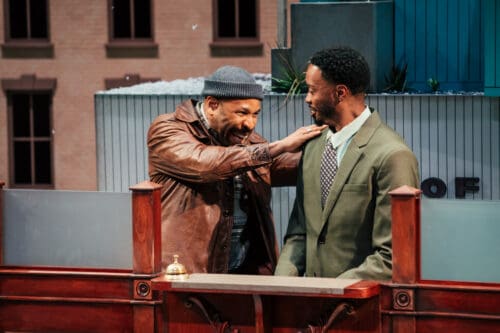
Ugo Chukwu and Petey McGee
Decades pass. It is the turbulent end of the 1990s, and though Kenneth has secured a quiet existence, he still carries a hefty portmanteau of psychological scars and is besieged by vivid memories from his past. But Kenneth has devised methods to protect both the frightened child he was and the man he has become. He states his philosophy early on: “I don’t believe in God, or heaven, or hell. But I believe in friends.”
It is in the companionship of his one and only friend, Bert (Ugo Chukwu), that Kenneth seeks shelter from facing memories of childhood abuse.
And worse.
Kenneth lives a truncated existence in which regularity is ritual. Part of this rigorous routine is a nightly happy hour at Wally’s Tiki Bar, where Kenneth shares a table with Bert, who encourages his friend to embrace life while sadly watching him struggle to attain absolution in endless mai tais.
Change suddenly intrudes upon Kenneth’s carefully ordered world when the bookstore closes. A waitress at Wally’s, Corrina (Rebecca S’Manga Frank, who brings intelligence and craft to the trio of characters assigned to her as well), encourages the newly unemployed Kenneth to apply at Primary Trust Bank, where the manager Sam (Urbaniak, in another pitch-perfect performance) hires him.
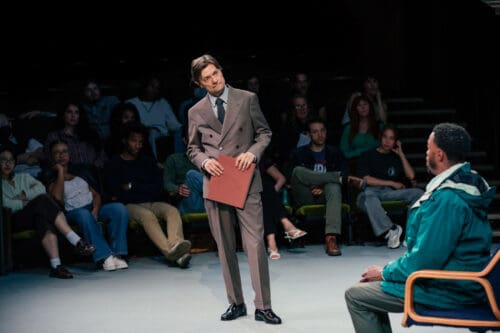
James Urbaniak and Petey McGee (photo by Jeff Lorch)
Primary Trust will resonate with ferocious potency for experienced theatergoers, for Booth has taken Thornton Wilder‘s Our Town and crafted not a remake but a finely devised and astute reimagining for the twenty-first century.
Wilder’s focus was on how individuals fit within the context of their community; Booth has taken that sensibility and reverse-engineered it. Now the focus is on the individual, as thoroughly expressed by Marsha Ginsberg‘s set, in which the town of Cranberry reflects Disneyland’s It’s a Small World, shifting emphasis to the importance of the individual in today’s society while adding a haze of the illusory.
Even Bert, with his job security, home, and family, exists within a version of the American Dream that remains beyond Kenneth’s reach—and beyond the reach of many others today.
Kenneth serves as the Stage Manager of this work and brings to his performance the wounded sensibilities of Jerzy Kosiński’s Chance Gardiner from Being There, filtered through the persona of a Margaret Keane “Big Eyes” portrait.
Unlike Wilder’s masterpiece, Primary Trust does not strive to show how an individual fits into a community like Grover’s Corners, New Hampshire (population 2,642), but how an individual in our era, in an environment like Rochester, New York (population 63,000), must carve out a community of his own.
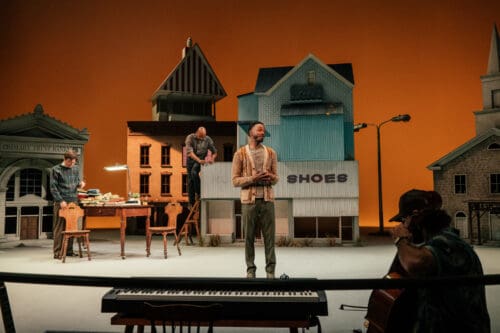
James Urbaniak, Ugo Chukwu, Petey McGee, and Luke Wygodny (photo by Jeff Lorch)
It was Wilder’s intent to leave audiences with appreciation for a simpler life being lost to them. Booth instead seeks to instill awareness of those simple lives, like Kenneth’s, that are lost—discarded by our contemporary world.
To that end, Booth does not resort to conspicuous character details such as Kenneth’s possible alcoholism. Instead, she applies them diaphanously, not layering but dusting her stage with clues that require the audience’s effort to uncover.
Fortunately, director Knud Adams is there to guide them, much as Tenzing Norgay guided Hillary up Mount Everest. This is best exemplified by the onstage presence of Luke Wygodny, credited as “Musician” in the program, though “Orchestra” comes closer to reality. Positioned downstage center, he performs most of the score—which he largely composed himself—on keyboard, cello, and guitar. Most impressive of all is his proficiency on the call bell.
Wygodny plays that bell like a Stradivarius, employing it for more than musical effect, because Adams has not merely directed this production—he has choreographed it and conducted it.
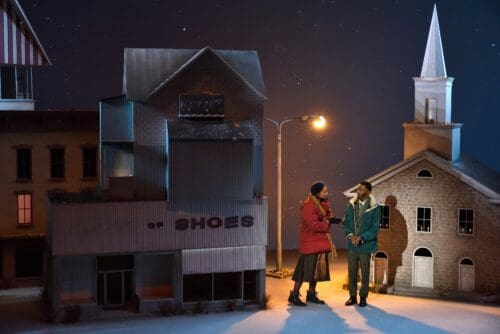
Rebecca S’Manga Frank and Petey McGee (photo by Knud Adams)
The collaboration between Booth and Adams has resulted in a unique and impressive theatrical event, one in which the contributions of playwright and director become difficult to separate. The unity of their crafts has generated one of the most theatrically pure productions in recent memory.
Like Eugène Ionesco’s Rhinoceros, Samuel Beckett’s Waiting for Godot, and Wilder’s Our Town and The Skin of Our Teeth, Primary Trust is inseparable from the stage itself, and that anchorage is sustained through Adams’ engagement with distinctly theatrical conventions.
Foremost among them is the consistent application of Verfremdungseffekt—Bertolt Brecht’s famous “distancing effect.” Drawing on Viktor Shklovsky’s concept of ostranenie, or “making it strange,” Brecht sought to prevent audiences from becoming emotionally absorbed by reminding them they were watching a play. Adams combines these methods with a Pinteresque minimalism, renowned for its silences and pauses.
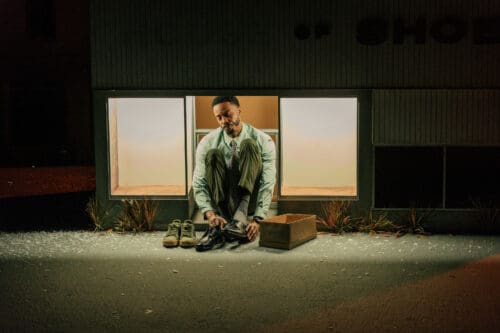
Petey McGee (photo by Jeff Lorch)
Here the bonded brilliance of playwright and director burns brightest. Where Brecht and Pinter used such devices to create distance, Booth and Adams employ them to accomplish precisely the opposite.
Pinter described his pauses as a failed effort at communication. In Primary Trust, Kenneth’s pauses draw us deeper into the moment while we await the pronounced and dynamic ding of Wygodny’s bell, which terminates the silence and heightens anticipation.
I cannot recall an evening in the theater in which the audience’s intensity of attention was so startlingly manifest.
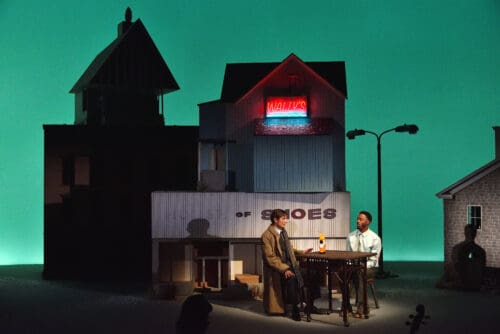
Luke Wygodny, James Urbaniak, and Petey McGee (photo by Knud Adams)
With lighting design by Masha Tsimring, costumes by Sophia Choi, and sound by Mikaal Sulaiman, there is nothing on the Taper’s stage lacking in finesse or flamboyance.
Booth and Adams have bathed Kenneth’s story in an aura of gentleness that never slips into coyness. It is a profound story about the courage required to see the world as it is and recognize ourselves for where we are within it. At the play’s conclusion, Kenneth’s life is not magically free of trouble. If anything, those troubles are more evident. What Kenneth gains, however, is the understanding that fate is not a prison but a composition to which we are all capable of contributing.
And that surpassing hope is, for all of us, life’s Primary Trust.
✦ ✦ ✦ ✦ ✦ ✦ ✦ ✦ ✦ ✦
Primary Trust
Center Theatre Group
Mark Taper Forum, 135 N. Grand Ave. in Los Angeles
95 minutes, no intermission
ends on June 28, 2026
for tickets (starting at $40.25), call 213.628.2772 or visit CTG
for more shows, visit Theatre in LA
✦ ✦ ✦ ✦ ✦ ✦ ✦ ✦ ✦ ✦
