


Areas We Cover
Categories

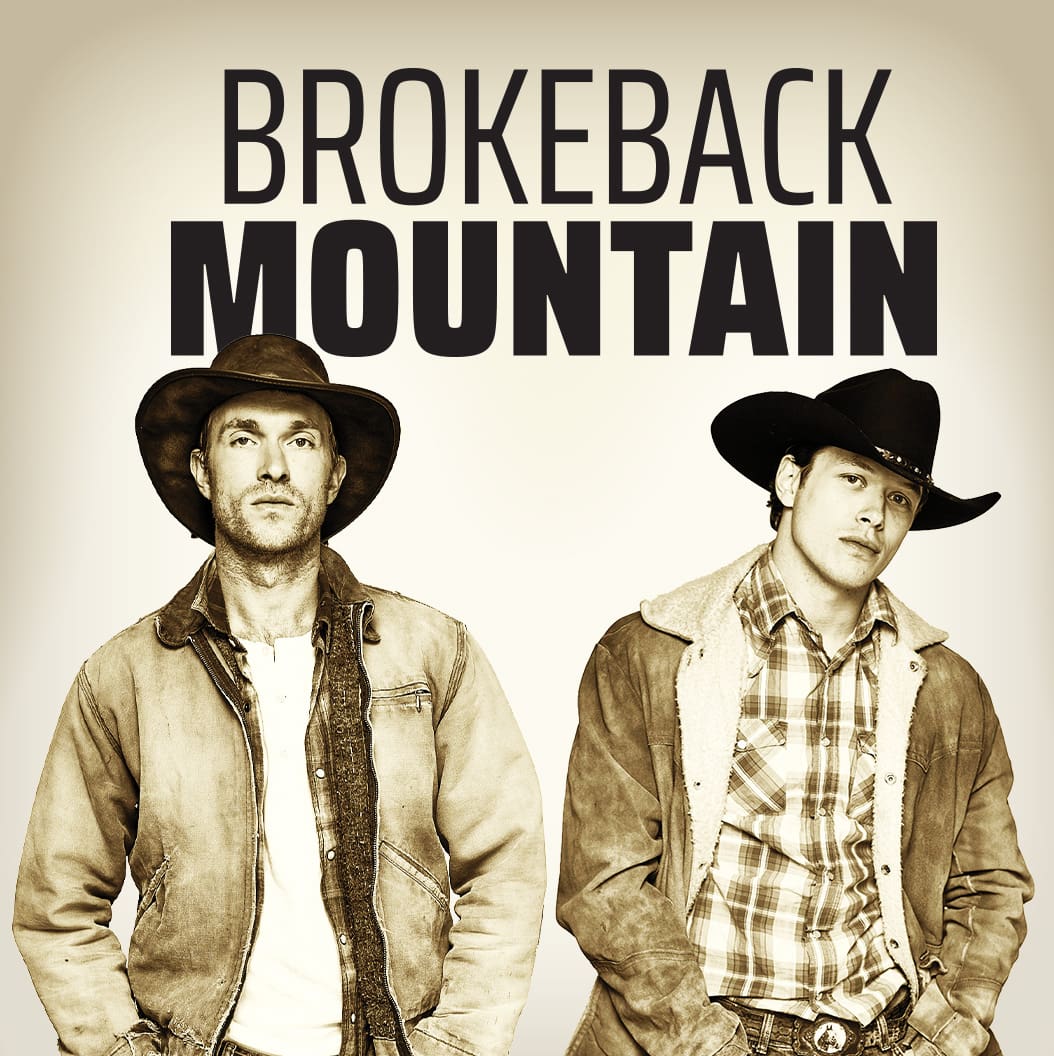
Theater Review: BROKEBACK MOUNTAIN (Chicago Shakespeare Theater)
by C.J. Fernandes | June 9, 2026
in Chicago, Theater
LOVE ON THE RANGE,
PAIN ON THE HORIZON
A beautiful musical framework
strengthens a stage adaptation
that never quite resolves
its competing impulses
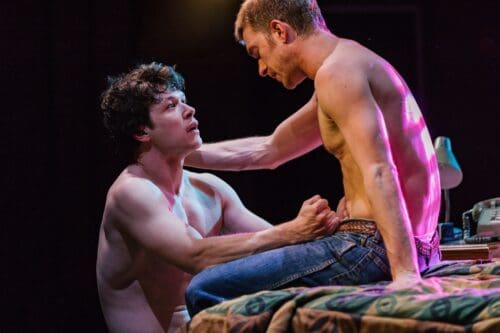
Jack Cameron Kay as Jack Twist and Harrison Ball as Ennis Del Mar in Chicago Shakespeare’s North American premiere production of Brokeback Mountain
In 1997, a short story from Pulitzer winner Annie Proulx appeared in the pages of The New Yorker. Beginning in the 1960s in Wyoming, it was a restrained yet heartbreaking tale of a queer relationship between two men from impoverished backgrounds in the American West who embark on a decades-long love affair doomed from its very inception. Little could Proulx have known—indeed, she seems a little annoyed by it now—that this small gem of a story, less than fifteen pages long, would eventually capture the public imagination the way it did.
In 2005, legendary Taiwanese director Ang Lee directed a screen adaptation written by another Pulitzer winner, Larry McMurtry (Lonesome Dove), and Diana Ossana—they adapted the story into a screenplay less than a year after its publication—and in the process turned Proulx’s sparse internal monologue into a sweeping emotional epic that was a smash hit with both critics and audiences, raking in the 2026 equivalent of about $300 million worldwide, winning three Academy Awards—including Best Director—and, in one of the biggest upsets in Oscar history, losing Best Picture to a truly wretched film—Crash—that is now quite correctly considered one of the worst movies ever to win that award.
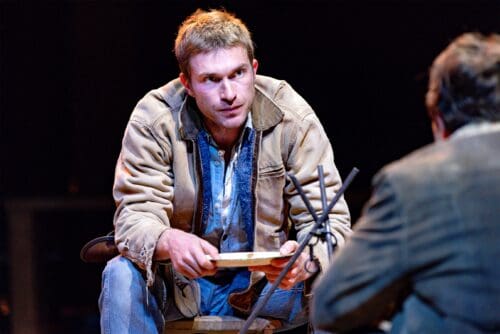
Harrison Ball as Ennis Del Mar
All this is to say that by 2006, Annie Proulx’s delicate little story had become a cultural juggernaut, cementing its place in film history and claiming landmark status in the depiction of queerness in mainstream cinema—the debate over where the two characters in the film lie on the spectrum of sexual attraction is still ongoing. About a decade later, the story was adapted into an opera—with a libretto by Proulx—that debuted to mostly positive reviews. Nine years later, another adaptation—this one for the stage—by Ashley Robinson premiered in the West End in the spring of 2023 and has now made its way Stateside, making its North American premiere at Chicago Shakespeare Theater.
Brokeback Mountain opens in the 1980s with Ennis Del Mar (Harrison Ball) passed out drunk on a motel room bed—the play restores the introduction to the story that was accidentally deleted when it was first published. The furnishings are appropriately sparse and grubby. The center of the performing space in Tom Pye‘s scenic design is a flat, tiled rectangle. Through the course of the play, this bed, along with other elements of the set—a kitchenette and a Formica-topped dining table—will rise or recede into the floor depending on the needs of the scene. To the left is a beautifully rendered patch of mountaintop, where Ennis and Jack Twist (Jack Cameron Kay) will make their campfire, and the rear of the set depicts a wilderness stretching out into the distance.
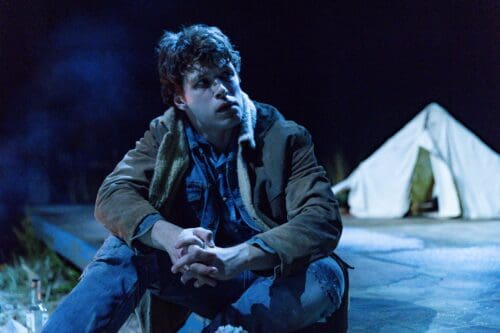
Jack Cameron Kay as Jack Twist
Ennis and Jack first meet when they take on a ranching job that requires them to spend a spell alone camping on top of the titular mountain, watching over a flock of sheep. Jack is a charming chatterbox of a fella, his non-stop yammering washing over the taciturn Ennis, and he is determined to break through his coworker’s defenses. Up on the mountain, over a few days, Ennis slightly warms to Jack. There is a brief nude scene where Ennis washes himself; Jack’s slightly awkward but still open—and silent—assessment of Ennis’s body is Mr. Kay’s sharpest and most subtle bit of acting in the play. It’s the first time his character truly reveals himself (it’s just sad that juvenile giggling from patrons accompanies the sponging of Ennis’ nether regions).
Shortly after that, the men go to bed. In the freezing cold, Ennis’s shivering and muttering outside the tent grates on Jack and he yells at him to come inside. Soon after, the fireworks go off. Emerging from the tent in the morning, the two men awkwardly proclaim their heterosexuality and the event is dismissed as a one-time thing. But as the days move on, the men cannot keep their hands off each other and the affair continues until the job is done and they have to come down off the mountain.
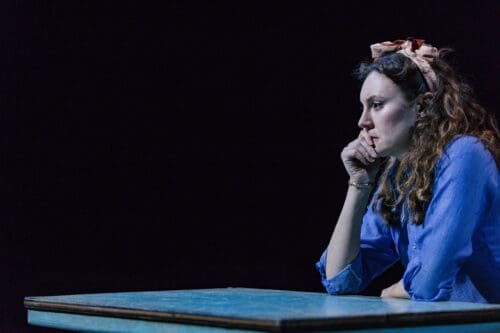
Cordelia Dewdney as Alma Del Mar
Ennis goes off to his fiancée Alma (Cordelia Dewdney—absolutely wonderful) and Jack goes back to Texas. A reunion between the two men several years later leads to them jumping each other’s bones at first sight and rekindles the affair, which will continue on and off during fishing trips over the next twenty years until tragedy strikes.
The best element of the stage adaptation of Brokeback Mountain is the addition of the folk-country music soundtrack, with fine original songs penned by Dan Gillespie Sells and beautifully sung live by Kat Eggleston, who is accompanied by a country-western band onstage. I’d go further and say that it’s a genius idea. By providing a sonic landscape rooted in Americana, the music takes the story—already a subversion of the mythos of the American West—and elevates it into that most melancholic of musical forms: the folk ballad. The doomed romance is such a natural fit for the genre that I’m genuinely surprised no one had done it before. Days later I’m still plotzing over how beautifully it works.
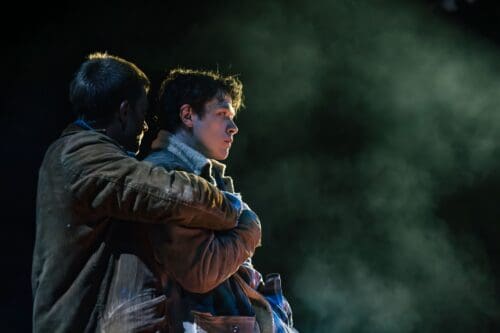
Harrison Ball as Ennis Del Mar and Jack Cameron Kay as Jack Twist
The script is an iffier matter. The short story is told entirely through Ennis’s point of view. It is fiercely internal and when I first read it, I found it devastating to the point that I didn’t watch the movie adaptation until well into the 2010s. The movie—also brilliant—understandably expands the POV beyond Ennis, fleshes out the female characters, and functions more as an epic but doomed love story.
But while the movie and the story have more or less identical plots and characters, they are very different in a crucial way. In the short story, Ennis is the victim of internalized homophobia that is so entrenched that it will not allow him to acknowledge—even to himself, let alone to Jack—his feelings for the other man. In the movie, this is externalized to the point where Ennis is driven almost entirely by fear of the world he lives in; the oppressive homophobia is mostly external.
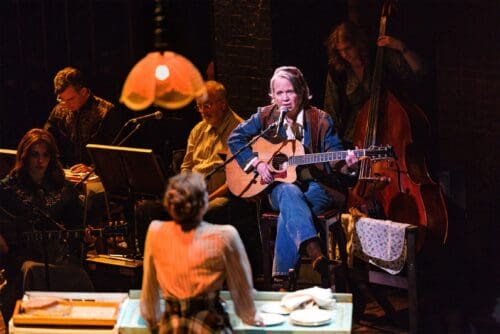
Kat Eggleston as the Balladeer
The stage play tries to split the difference between the two and in doing so gets stuck in no man’s land.
There are structural issues aplenty: a good chunk of the scenes are far too short, almost as though they were written for the screen, with rapid transitions and jumps in time. To be sure, it’s difficult to convey the passage of twenty years on a stage, but the cumulative effect is that the two actors—who are both very fine—develop almost no chemistry with each other until late into the show. The first sex scene hidden in the tent is barely credible, if that, and I wondered how someone new to the story—unlikely, I know—would react to it; it would seem completely arbitrary.
The gorgeous songs and vocals do a lot of heavy lifting here.
I also greatly disliked the final scene—I may be a minority of one here—which attempts to soften the sting of the ending but came across to me as cheap and manipulative, and almost undid all of Harrison Ball’s incredible work in the last few scenes.
There is much to like and admire here and I would be lying if I said that despite all of my complaints I wasn’t moved by the production. But there are too many miscalculations for me to elide. The three actors may elevate the characters and the music may paper over some of the cracks, but it’s telling that in a story built around the misery of two men unfortunate enough to be beholden to the love that dare not speak its name, the most sympathetic character onstage is the cuckqueaned wife.
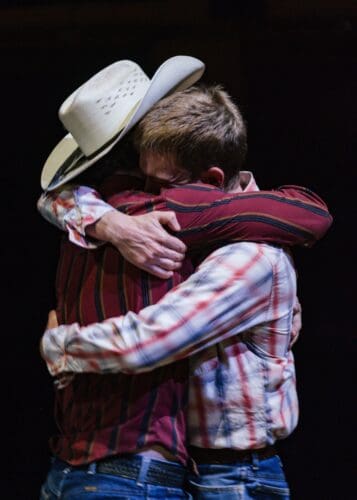
Jack Cameron Kay as Jack Twist and Harrison Ball as Ennis Del Mar
✦ ✦ ✦ ✦ ✦ ✦ ✦ ✦ ✦ ✦
photos by Kyle Flubacker
Brokeback Mountain
Chicago Shakespeare Theater
Jentes Family Courtyard Theater, Navy Pier in Chicago
Tue at 7; Wed at 1 & 7; Thu–Fri at 7; Sat at 2 & 7; Sun at 2
ends on June 28, 2026
for tickets, call 312.595.5600 or visit Chicago Shakes
for more shows, visit Theatre in Chicago
✦ ✦ ✦ ✦ ✦ ✦ ✦ ✦ ✦ ✦
