


Areas We Cover
Categories

Concert Review: BOCCHERINI & RACHMANINOFF (Pacific Symphony / Renée and Henry Segerstrom Concert Hall / Costa Mesa)
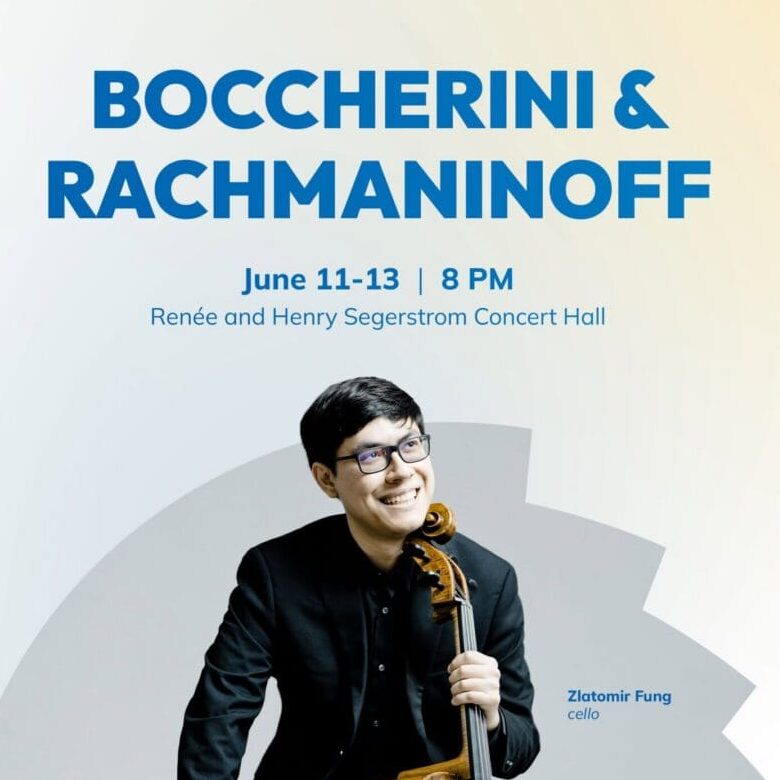
by Michael M. Landman-Karny | June 14, 2026
in Concerts / Events, Los Angeles, Music, Regional
FROM STAGE TO SOUL
Valentina Peleggi leads an evening
that journeys from operatic
spectacle to intimate confession
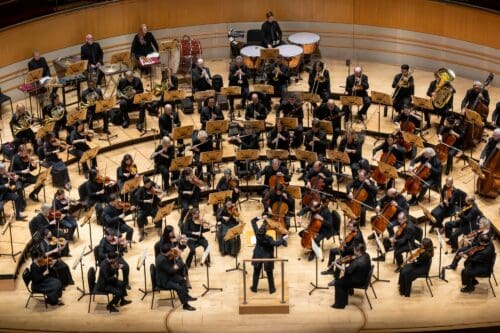
Valentina Peleggi conducts Rossini, Boccherini, Mascagni and Rachmaninoff with Pacific Symphony
Valentina Peleggi conducts opera for a living. She built her reputation in the pit, leading Rossini and Verdi in houses from Trieste to Seattle, and she walked onto the Segerstrom stage Friday carrying that instinct with her. The program Pacific Symphony handed her for its season finale was not a symphony concert with some overtures bolted on. It was theater, and she staged it as theater. The evening moved from the footlights toward the heart, out of the bright public world of the opera house and into the private weather of a single Russian symphony. The path was not a straight line. It bent once, on purpose, and the bend was the most interesting thing about the night.
It opened with the loudest possible argument for spectacle. Gioachino Rossini wrote the Overture to William Tell in 1829 as the curtain-raiser to a four-hour French opera about a Swiss patriot and his crossbow, an opera almost nobody stages now. The overture outlived its parent and became one of the most quoted pieces of music ever written. Most listeners know the galloping finale even if the name Rossini means nothing to them because it announced The Lone Ranger for decades and has scored many cartoon chases since. The trap for any conductor is that the piece collapses into its own famous tunes, a medley idling until the part everybody recognizes.
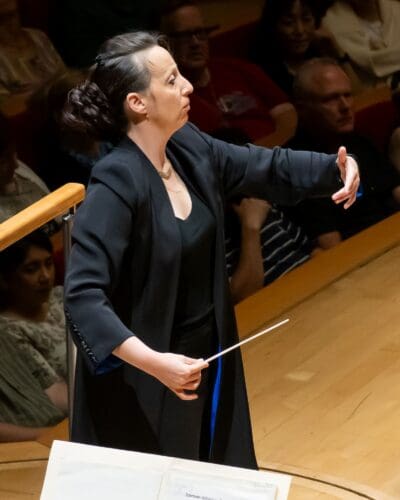
Conductor Valentina Peleggi
Peleggi refused the easy route. She treated the overture as the four-scene drama Rossini built: a sunrise scored for a choir of solo cellos, a thunderstorm, a pastoral calm with a wind solo calling across it, and only then the cavalry charge. The opening cellos took their time, warm and grave, in no hurry to arrive. The storm broke hard and shut just as fast. The seam into the finale was the test, and she passed it: the gallop arrived as a consequence of everything before it rather than a showstopper grafted on at the end. The famous rhythm drove without bolting. The orchestra stayed clean at speed.
The program then took its first step inward. Pietro Mascagni’s Intermezzo from Cavalleria Rusticana is a short orchestral passage lifted from the middle of an 1890 one-act opera about jealousy and murder in a Sicilian village. In the opera, it falls at the cruelest moment, a few minutes of orchestral calm before blood is spilled. Cut loose from the story, it survives as four minutes of pure ache. This is where the pit conductor showed. Peleggi opened the strings into a wide, glowing tone and shaped the long melody the way a singer shapes it, breathing where a voice breathes and leaning where a voice leans. She kept it a step short of weeping. That restraint was the whole point. The tune carries its own sorrow and needs no extra pressure.
Here the evening turned back toward the stage instead of further from it. Luigi Boccherini composed his Cello Concerto in B-flat in the 1760s as elegant music for a courtly room. The version played Friday, however, was the heavily revised nineteenth-century edition by Friedrich Grützmacher, who reshaped the concerto into a Romantic showpiece. Purists have complained ever since. What remains is a hybrid: part eighteenth-century grace, part nineteenth-century fireworks, built to let a cellist shine.
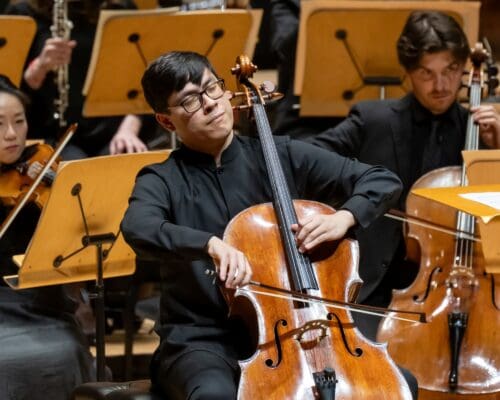
Cellist Zlatomir Fung
Zlatomir Fung had the technique to burn the piece down and the judgment not to. The first American and youngest musician to win the cello division of Russia’s Tchaikovsky Competition, Fung projected a focused, clear tone to the back of the hall without force. The fast runs Grützmacher stuffed into the score emerged clean and unhurried, while the quieter passages revealed even greater artistry. In the slow movement, Fung varied his vibrato thoughtfully and kept the line moving so it never puddled. He treated the showpiece as music first and stunt second, which is the only way the Grützmacher version earns its place on a serious program. The finale finally let him off the leash, all wit and speed, every hurdle cleared without visible strain.
What returned after intermission was the real subject of the evening. Sergei Rachmaninoff’s Symphony No. 2 emerged from a period of personal and professional crisis following the disastrous premiere of his First Symphony. Completed in 1907, the Second is his answer: an expansive work filled with long melodies, dark undercurrents, and climaxes that open like sudden sunlight. For decades, conductors cut it heavily. Peleggi played it whole and unembarrassed, treating it as an argument with shape rather than an excuse for lushness.
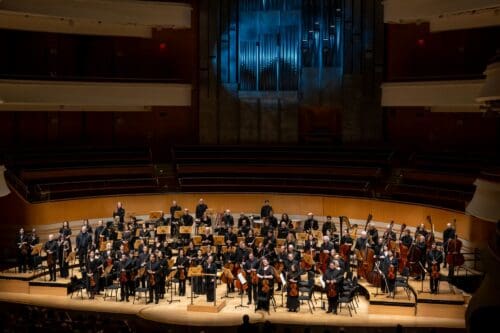
Pacific Symphony
The first movement gathered by stages, each swell rising naturally from the one before it. The scherzo cut sharply and pushed forward with urgency. Then came the Adagio, the movement audiences wait for. A clarinet floats one of the most beloved melodies in the orchestral repertoire above the strings, and the danger is that the music dissolves into a sequence of pretty moments. Peleggi maintained a single long line throughout. The clarinet sang, the melody retained its spine, and the result felt tender rather than merely plush. The finale arrived blazing, but she kept textures clear even at full volume, allowing Rachmaninoff’s inner voices to emerge through the surge. By the closing pages, conductor and orchestra moved as one body toward a triumph that felt fully earned.
The Friday performance was dedicated to the memory of longtime Pacific Symphony benefactor David Chonette, who died in March. Whatever private significance the symphony may have carried for those who knew him, its final pages embody the sound of a composer finding his way out of silence—a fitting note on which to conclude both a memorial and a season.
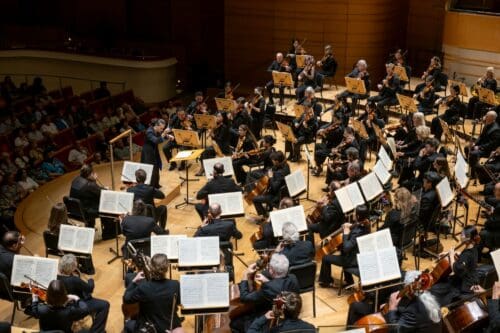
Pacific Symphony
The solo encore, however, was a rare misfire. Fung offered the Recitativo from Dobrinka Tabakova’s Pirin, the central movement of a three-part suite. Heard in isolation, it lacked context and direction. The improvised cadenza seemed to depart from nowhere and arrive nowhere, leaving me more puzzled than moved.
Still, the larger arc held. Rossini sparkled. Mascagni mourned. Boccherini smiled and showed off. Rachmaninoff opened all the way up and stayed open. The audience saved its loudest ovation for the symphony, which is to say it responded most strongly to the destination toward which the entire evening had been traveling.
Peleggi spent the night making an opera conductor’s case: that the distance from public spectacle to private confession is shorter than it appears, and that a finale full of brass and sweep can still be, underneath it all, one person talking himself out of the dark. She made that case persuasively enough that the only complaint worth filing is how rarely Southern California gets to hear her. The season ended where the best seasons end—closer to the soul than to the stage.
✦ ✦ ✦ ✦ ✦ ✦ ✦ ✦ ✦ ✦
photos by Doug Gifford
Boccherini & Rachmaninoff
Pacific Symphony
Renée and Henry Segerstrom Concert Hall
615 Town Center Drive in Costa Mesa
played June 11–13, 2026
for more shows, call (714) 755-5799 or visit Pacific Symphony
✦ ✦ ✦ ✦ ✦ ✦ ✦ ✦ ✦ ✦
