


Areas We Cover
Categories

LINE ARRAY VS POINT SOURCE SPEAKERS: WHICH IS RIGHT FOR YOUR EVENT?
by Lamont Washington | June 14, 2026
in Extras, Technology
When planning large-scale live events, your sound system directly shapes the audience’s listening experience. One of the most common questions is: should you go with line array speakers or point source speakers?
These two types of speakers differ drastically in sound dispersion, coverage range and ideal use cases.

-
Core Technology & Sound Dispersion Principles
Point Source Speakers
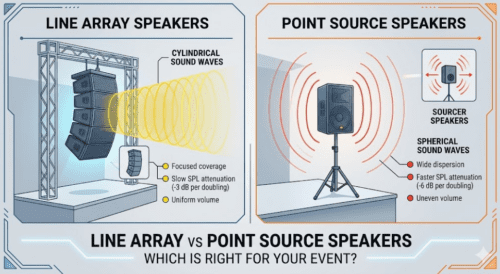
Point source speakers emit spherical sound waves. Sound radiates outward horizontally and vertically from the cabinet. For every doubling of distance, the sound pressure level (volume) drops by 6 dB. This creates an uneven listening experience: the audio is extremely loud close to the speakers, while volume fades significantly for audiences seated further back.
Line Array Speakers
A line array consists of multiple speaker cabinets stacked vertically. It leverages acoustic wave interference to produce cylindrical sound waves. Within the near field, sound pressure only decreases by 3 dB when distance doubles. This makes line arrays ideal for large events. Front-row audiences won’t suffer from excessive volume, and attendees in far seats can still enjoy clear audio.
-
How to Choose: Match Speakers to Your Event
Choose Point Source Speakers for These Scenarios
- Small to mid-sized indoor events: Events with 200 to 300 attendees, including press conferences, roadshows, upscale banquets, live music venues and gallery openings.
- Low-ceiling banquet halls or multi-purpose rooms: Line arrays require ample overhead clearance, and will block sightlines in spaces with low ceilings.
- Wide venues with shallow depth: Audiences spread horizontally close to the stage. Point source speakers deliver better coverage for left and right seating areas.
- Tight schedules or limited budgets: Point source systems can be set up in hours and come at a more affordable price point.
Choose Line Array Speakers for These Scenarios
- Large and mega-scale events: Company galas for thousands of guests, arena concerts, outdoor music festivals and high-profile industry summits.
- Venues with great depth: Spacious venues with large crowds, where clear audio must reach the very last row of seating.
- High-ceiling steel-structured venues: Such spaces are prone to echo. Line arrays reduce ceiling reflections and drastically improve speech intelligibility.
- Open outdoor spaces: Sound dissipates quickly outdoors with no wall reflections. Line arrays feature powerful long-throw performance for open-air environments.
Expert Tips:
Hybrid Audio Configuration
For most large professional events, a hybrid setup delivers the best results:
Main PA: Line Arrays
Mount line array cabinets on both sides of the stage to cover the majority of mid and rear audiences.
Point Source Speakers for Supplemental Audio
- Front Fill: Placed along the front edge of the stage to cover VIP seating in the line array’s near-field dead zone.
- Side Fill: Caters to audiences seated at the far left and right sides of the venue.
- Stage Monitors: Angled point source speakers on stage for performers and speakers to hear themselves clearly.
Stage sound equipment rental notice in HK
For reliable and professional sound solutions across all kinds of events, you can turn to Audio Equipment Rental services in Hong Kong. If you are looking for trusted local providers, check out MediaflowStudioHK and its dedicated service page: Audio Equipment Rental.
References
1. Urban, M., Heil, C., & Bauman, P. (2001). Wavefront sculpture technology. Journal of the Audio Engineering Society, 49(10), 918–936.
Webb, B., & Baird, J. (2003). Advances in line array technology for live sound. In Proceedings of the Institute of Acoustics: Reproduced Sound (Vol. 25, No. 8, pp. 11-22). Institute of Acoustics.
2. Engebretson, M. (2001). Directional radiation characteristics of articulating line array systems. In Audio Engineering Society Convention 111 (Preprint 5451). Audio Engineering Society.
3. Keele Jr, D. B. (2015). Time/phase behavior of constant-beamwidth transducer (CBT) circular-arc line arrays. In Audio Engineering Society Convention 139 (Paper 9413). Audio Engineering Society.
4. Staffeldt, H. (2004). Line array performance at mid and high frequencies. In Audio Engineering Society Convention 117 (Paper 6161). Audio Engineering Society.