


Areas We Cover
Categories

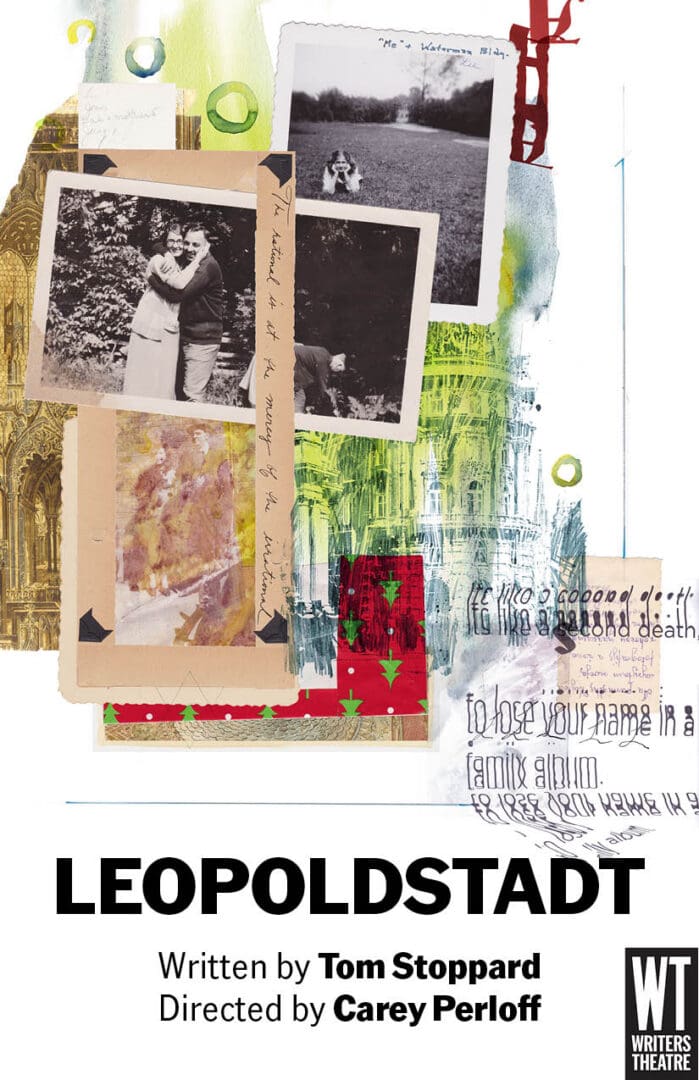
Theater Review: LEOPOLDSTADT (Writers Theatre / Glencoe, Chicagoland)
by C.J. Fernandes | June 15, 2026
in Chicago, Theater
THE GHOSTS IN
THE FAMILY TREE
Tom Stoppard’s final play
is as intellectually dazzling
as it is emotionally devastating
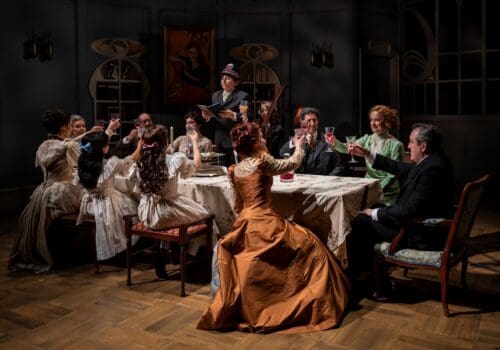
The cast of Leopoldstadt. at Writers Theatre. Photo by Michael Brosilow
“Barbarism will not be eradicated by culture.”
That line, spoken midway through Leopoldstadt, the final masterpiece by Tom Stoppard—one of the greatest playwrights of his, or any, generation—made my stomach do a flip. Merely one of many exquisite lines in this work, its core concept is reflected in variations throughout the play. What changes each time is the tenor.
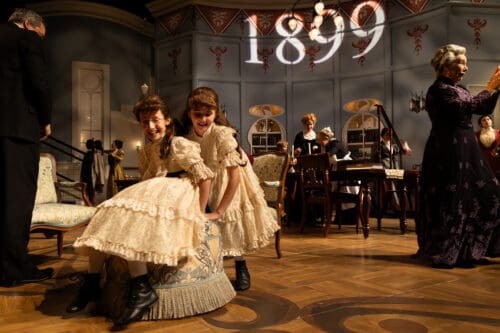
Adeline Rosenthal and Asha Dale Hopman. Photo by Hugo Hentoff
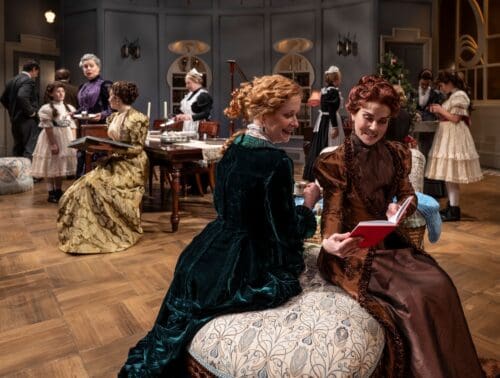
Kate Fry and Emma Rosenthal. Photo by Michael Brosilow
In 1899, patriarch Hermann (a splendid Ian Barford), lounging in the luxurious dining room of his Vienna home, declaims, “In one lifetime we went from outcasts to the beating heart of Viennese culture.” The line is delivered with the confidence of someone who cannot fathom that society can regress. Hermann rolls his eyes at the idea—indeed, the necessity—of a Jewish state; “Judenstadt nonsense,” he scoffs. But we in the audience know what Hermann does not: that within that same lifetime this bastion of civility and culture will revert not just to its bigoted baseline but go beyond, plunging Hermann, his family, and millions of people like them into horrors that in 1899 were inconceivable.
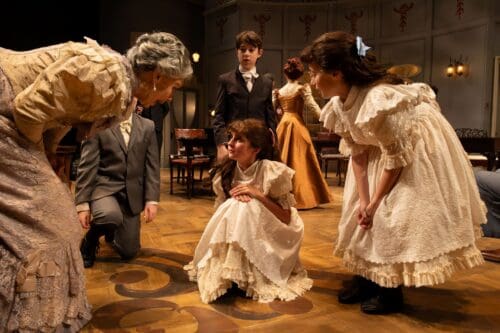
Barbara E. Robertson, Asha Dale Hopman, Levi Charnay and Adeline Rosenthal. Photo by Hugo Hentoff
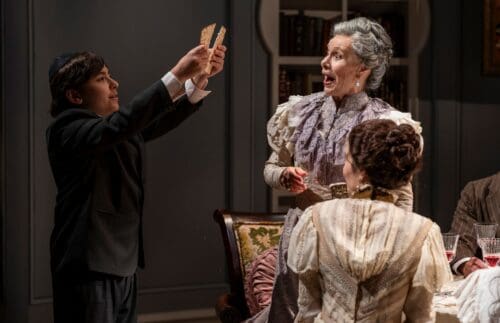
Sebastian Rus and Barabara E. Robertson. Photo by Michael Brosilow
Tracing the lives of a sprawling Jewish family in Austria over nearly sixty years, this wildly ambitious play, nearly three hours long, opens on an absolutely gorgeous set by scenic designer Ken MacDonald. A lavishly appointed dining room fills the Writers Theatre stage. The center is occupied by an enormous dark-wood dining table. Recessed bookshelves hold leather-bound tomes and assorted objets d’art. A small spinet sits off to one side. Enormous windows dominate another wall. The overwhelming impression is one of class, education, and cultured privilege.
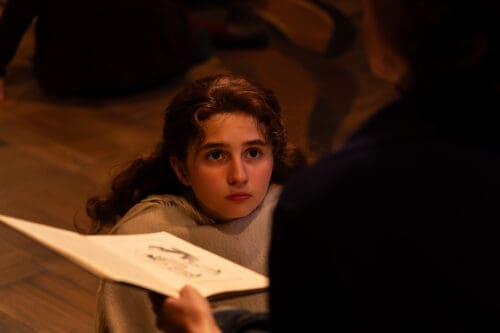
Asha Dale Hopman. Photo by Hugo Hentoff
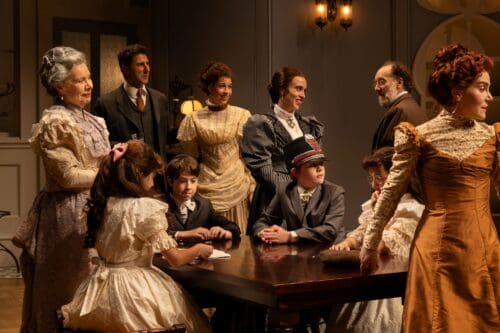
The cast of Leopoldstadt. Photo by Hugo Hentoff
We barely have time to absorb the space before it is occupied by much of the cast. Three generations of the Merz and Jacobovicz families are in the midst of a party. The younger members decorate a Christmas tree—while Hermann is Jewish by birth and culture, he has largely assimilated into Viennese society. At one end of the table, grandmother Emilia (Barbara Robertson) tries to corral the children. On a chaise, Gretl (Kate Fry) and her sister-in-law read naughty passages from an Arthur Schnitzler play and giggle. Hermann scowls over a treatise by Theodor Herzl arguing for the establishment of Israel. His brother-in-law Ludwig (Joey Slotnick), a mathematics professor in an adorably rumpled suit, waxes rhapsodic about the Riemann Hypothesis. Elsewhere in the room, Ernst (Sean Fortunato) discusses his medical practice with his wife Wilma (Sarah Coakley Price), while Hanna (Hanna Dworkin) gushes over a handsome military officer named Fritz (Erik Hellman) she recently met.
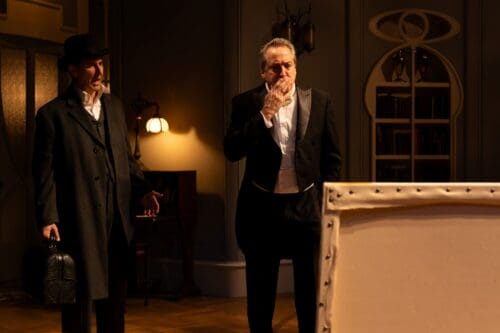
Sean Fortunato and Ian Barford. Photo by Hugo Hentoff
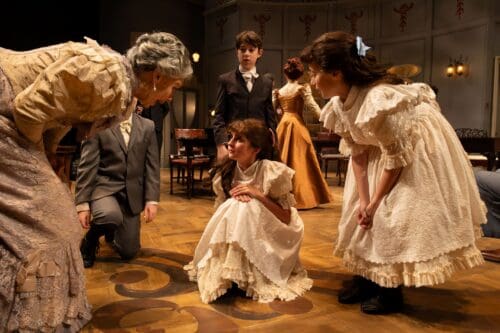
Barbara E. Robertson, Asha Dale Hopman, Levi Charnay and Adeline Rosenthal. Photo by Hugo Hentoff
All of these conversations—if not quite overlapping à la Altman—follow one another in rapid succession, requiring precise timing from the actors and sharp direction from Carey Perloff, a longtime Stoppard collaborator. The overall effect is that of a bustling, noisy family: financially secure and content with its place in the world. Yet every conversation, no matter how trivial it initially appears, lays groundwork for the themes to come. So don’t simply luxuriate in the spectacular acting and direction on display. Pay attention.
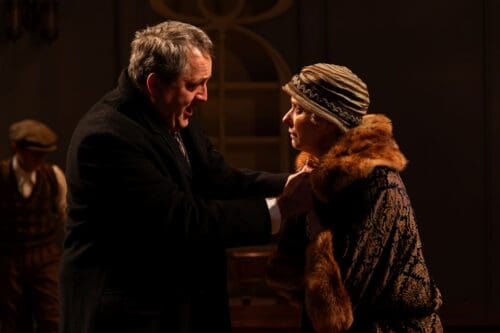
Ian Barford and Kate Fry. Photo by Hugo Hentoff
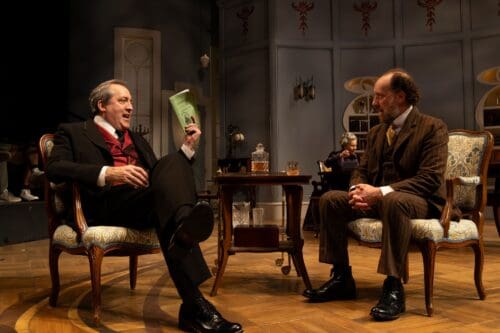
Ian Barford and Joey Slotnick. Photo by Hugo Hentoff
The play unfolds across five acts set in 1899, 1900, 1924, 1938, and 1955. The historical trajectory will surprise no one with even a passing familiarity with twentieth-century Europe, so I won’t elaborate further. What matters is how Stoppard revisits his favorite concerns: free will, identity, memory, assimilation, and the randomness—or lack thereof—of fate. The references to mathematics are not accidental.
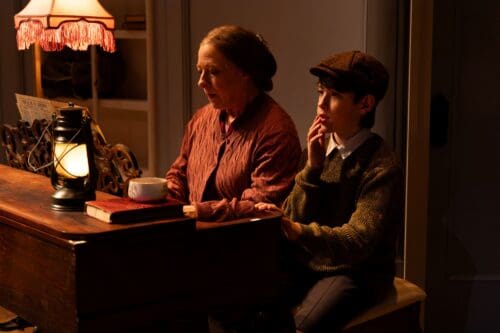
Hanna Dworkin and Levi Charnay. Photo by Hugo Hentoff
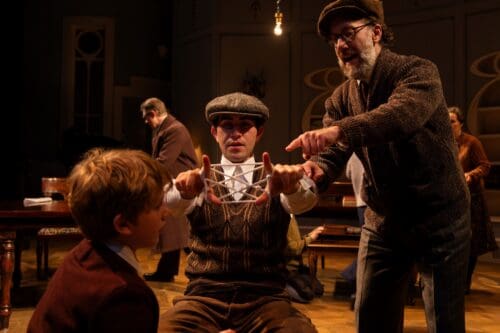
Caleb Scherr, Justin Albinder and Joey Slotnick. Photo by Hugo Hentoff
Stoppard’s gift for constructing intricate, word-rich scenes crackling with wit and insight remains virtually unparalleled. The script is endlessly quotable. Midway through the evening, I abandoned any attempt to scribble down favorite lines and simply resolved to buy the published script. Scene for scene, however, I’d argue that Leopoldstadt is also the most emotionally powerful work of his career. Stoppard uses the audience’s foreknowledge of history not as a shortcut to easy sentiment but as a way of enriching the play’s arguments. As the characters debate what it means to be Jewish, whether true assimilation is possible, and how memory both deceives and protects us, we become silent participants in those debates. The emotional force emerges not simply from the fate of this family, but from our awareness of countless others whose stories followed similar paths.
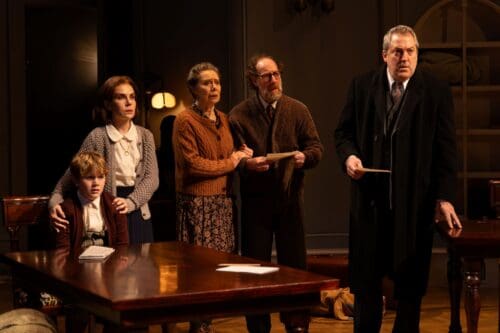
Caleb Scherr, Emma Rosenthal, Barbara E. Robertson, Joey Slotnick and Ian Barford. Photo by Hugo Hentoff
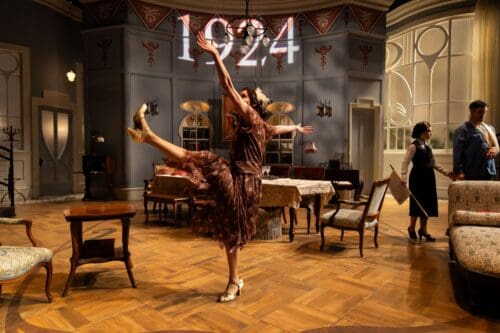
Brenann Stacker. Photo by Hugo Hentoff
Only days ago, following an act of violence committed by a solitary refugee with mental illness, mobs in Belfast attacked neighborhoods where refugees lived, setting fires and terrorizing residents. In a 1938 scene in Leopoldstadt, Percy, an English journalist, watches thousands of Nazis marching through Austria and asks, “What are the Austrians doing about this?”
The answer he receives:
“These are the Austrians.”
The excuses offered are always variations on a theme. The answer, however, is often the same.
As Leopoldstadt moves inexorably toward its conclusion, Stoppard and Perloff bring the full force of their talents to bear on a devastating final sequence centered on Rosa (Jessie Fisher), her nephew Nathan (Justin Albinder), and Leo (Sam Bell-Gurwitz), a descendant of both family branches. The scene hinges on a memory trigger I had completely forgotten despite having witnessed it less than an hour earlier. It nearly brought me to tears. It is one final brilliant flourish from a playwright who built an extraordinary career on moments such as these.
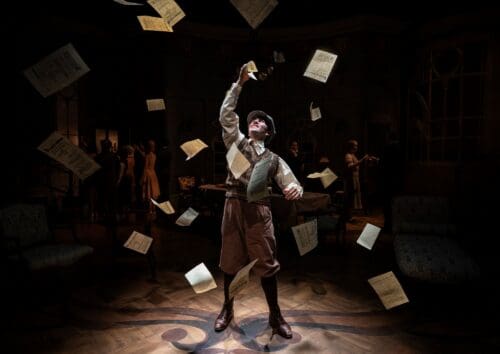
Justin Albinder. Photo by Michael Brosilow
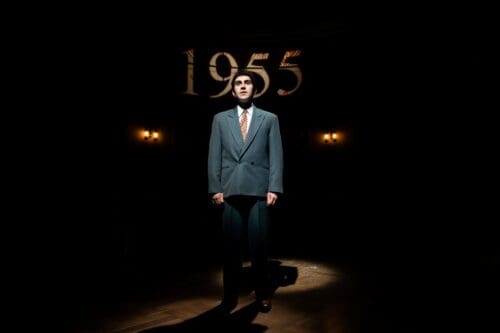
Justin Albinder. Photo by Hugo Hentoff
As the lights faded, the audience rose as one. Yet this was not the usual opening-night ovation. There were no whoops, whistles, or cheers. Even as hands thundered together, faces remained still. From my seat, I could see tear-filled eyes and hear sniffles throughout the theater. The audience seemed to be applauding not merely a production, but a masterpiece.
For all of Stoppard’s celebrated wit—which remains present throughout, even in the darkest scenes—Leopoldstadt‘s greatest accomplishment is the mirror it holds up to society.
It’s not something we want to see.
But it is something we need to.
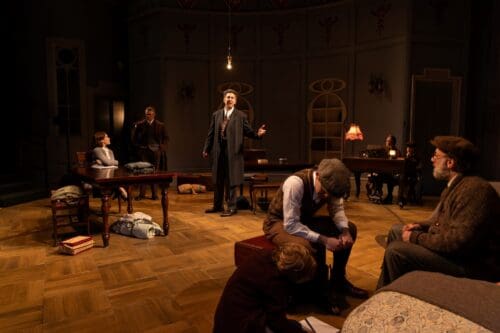
The cast of Leopoldstadt. Photo by Hugo Hentoff
✦ ✦ ✦ ✦ ✦ ✦ ✦ ✦ ✦ ✦
photos by Hugo Hentoff and Michael Brosilow
Leopoldstadt
Writers Theatre
Alexandra C. and John D. Nichols Theatre, 325 Tudor Court in Glencoe
2 hours 45 minutes with intermission
Wed at 2 & 7:30; Thu & Fri at 7:30; Sat at 2 & 7:30; Sun at 2 & 7
ends on August 16, 2026
for tickets ($35–$95), call 847.242.6000 or visit Writers Theatre
for more shows, visit Theatre in Chicago
✦ ✦ ✦ ✦ ✦ ✦ ✦ ✦ ✦ ✦
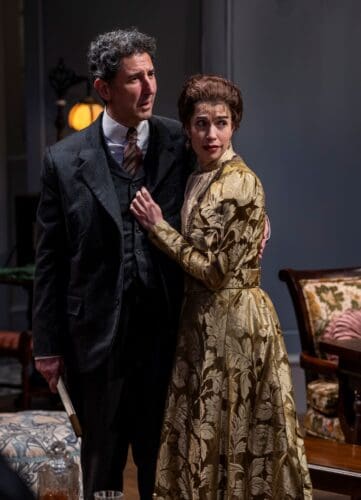
Sean Fortunato and Sarah Coakley Price. Photo by Michael Brosilow
