


Areas We Cover
Categories

THE SOUND YOU NEVER HEAR AT A FESTIVAL: THE GENERATORS KEEPING IT ALIVE
by Jim Allen | July 13, 2026
in Concerts / Events, Extras, Technology
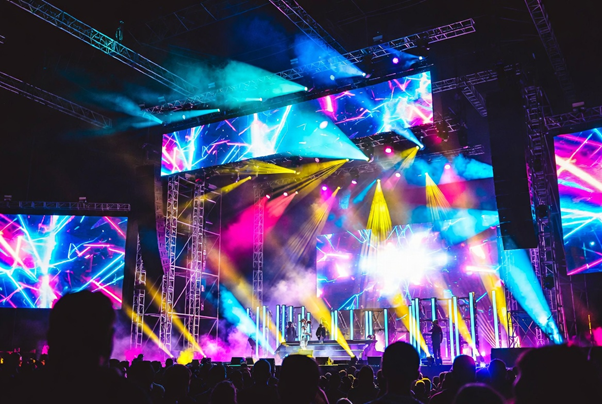
Stand in front of a festival main stage at night and you are looking at a small city’s worth of electricity. The video walls, the line arrays, the lighting rig throwing color across 40,000 people, the LED towers, the production offices, the catering tents, the vendor row. All of it is running in the middle of a field or a parking lot where, an hour’s drive from the nearest substation, there is no grid to plug into.
That power comes from diesel generators. And behind the generators is a logistics problem the audience never sees and the show cannot survive without.


How much power a show actually needs
The numbers are bigger than most people guess. A large festival serving around 50,000 attendees can require up to 3.5 megawatts of capacity. Coachella, spread across a site more than a mile wide, has been reported to draw on the order of 26 megawatts to run lighting, sound, video, production, and everything feeding the people who make it happen.
For scale, that upper range is enough to power thousands of homes. Except a neighborhood draws its load steadily over years, and a festival slams that demand on for a single weekend in the desert heat, then vanishes.
Film and television carry a smaller version of the same load. A location shoot with no practical grid tie runs off generator trucks, the “gennies,” feeding lighting, camera, and the trailers that make a set function. When they run dry, the day stops, and a stopped shooting day is one of the most expensive things in the business.
Why diesel is still the backbone
The industry is genuinely moving toward hybrid setups, solar plus large battery banks with generators as backup, and you will now see battery light towers and microgrids at the greener festivals. That shift is real and worth applauding.
But for the heavy, sustained loads, diesel generators are still the backbone of live event and production power, because they deliver large amounts of reliable output on demand regardless of weather, cloud cover, or how long the load has to hold. A battery bank that empties during the headliner is not a talking point anyone wants.
Which means the question is not really about the generator. It is about keeping the generator fed.
The job nobody in the audience thinks about
A generator is only as good as its fuel supply, and on a multi-day event the tanks do not last the weekend on their own. Someone has to get diesel to a specific unit, in a crowded and often gated site, on a schedule that does not interrupt the show, in conditions that may include desert heat, mud, or a load-in window measured in hours.
That is a specialized delivery problem, not a gas-can errand. Production and event teams increasingly hand it to a partner offering mobile fuel delivery for events, a service that brings diesel directly to generators and equipment on site, refills between sets or overnight, and monitors levels so no unit runs down mid-performance. The logistics matter as much as the fuel: a truck has to physically reach each generator, thread past crowds and staging, and top off without becoming part of the show.
Get it right and nobody notices, which is the entire point.
What separates a smooth event from a dark stage
Organizers who have done this a few times tend to plan three things early. First, access and timing, because a fuel truck needs a route to every generator and a window that avoids the crowd. Second, run-time math, sizing tanks and refills to the real load and the real schedule, not an optimistic one. Third, a named fuel partner locked in before load-in, with the site map, the generator locations, and the fill plan already understood.
Live performance runs on talent and rehearsal. It also runs, quietly, on a fuel truck arriving at the right generator at the right hour. The magic on stage depends on the least magical logistics imaginable, and the shows that never lose power are the ones that treated fuel as part of the production from day one.
