


Areas We Cover
Categories

WHY IS MY POOL WATER TOO WARM? 7 SUMMER COOLING TIPS

by Lamont Washington | July 24, 2026
in Extras
There’s nothing quite like the anticipation of jumping into your pool on a scorching afternoon. You grab your towel, step outside, and splash. Except it doesn’t feel refreshing. It feels like you just stepped into a lukewarm bath.
If this sounds familiar, you’re not alone. Across the United States, pool owners are dealing with the same frustrating reality: summer heat waves are turning backyard pools into something closer to hot tubs than refreshing escapes. But here’s the good news. You don’t have to suffer through another uncomfortable swim. With the right knowledge and a few simple strategies, you can take control of your pool’s temperature and enjoy every dip.

Why Is My Pool So Hot?
The main culprit is right above you: the sun. Direct sunlight heats pool water, especially when your pool is exposed to full sun for most of the day. High ambient temperatures also contribute significantly, as warm air transfers heat to the water both directly and indirectly. Your pool’s circulation system can even distribute that heat evenly throughout the water, preventing cooler pockets from forming.
Think about it on a 95°F day, your pool is absorbing solar energy for 10 to 12 hours straight. That energy has to go somewhere, and it goes straight into warming up your water. Before you know it, what was once a refreshing oasis has turned into an unpleasantly warm soak.
The Problem With Hot Pool Water
Beyond just being uncomfortable, overly warm pool water creates real problems:
Health risks. Warm water is an ideal breeding ground for bacteria and algae. When water temperatures climb above 85°F, chlorine breaks down faster, making it harder to maintain proper sanitation. High temperatures can also cause a rapid decrease in blood pressure, which may lead to dizziness or lightheadedness.
Chemical imbalance. Heat accelerates the evaporation of pool chemicals and can throw off your pH balance. You’ll find yourself adding more chlorine, testing more frequently, and spending more money just to keep things in check.
Unpleasant swimming experience. Let’s be honest. Nobody wants to swim in bathtub-temperature water on a hot day. It defeats the entire purpose of having a pool.


How to Know Your Pool’s Exact Temperature
Here’s the thing: you can’t fix a problem you can’t measure. Dipping your toe in the water or sticking your hand in for a “guess” isn’t going to cut it. Your senses are unreliable. Water that feels warm to your hand might actually be well within a safe range, or it might be pushing 90°F without you realizing it.
The only way to know your pool’s exact temperature is with a pool temperature sensor. A reliable thermometer gives you real-time data so you can make informed decisions about heating, cooling, and chemical adjustments. It helps you maintain the best pool temperature, improve energy efficiency, and keep swimmers safe all with minimal effort.
Without a reliable pool thermometer, you’re swimming in the dark, literally guessing whether the water is safe, comfortable, and chemically balanced.
What’s the Ideal Pool Temperature?
So what should your pool’s temperature actually be? The answer depends on who’s using the pool and what they’re doing in it.
For most residential pools, the sweet spot falls between 78°F and 82°F. This range balances comfort, chemical efficiency, and energy use. The American Red Cross recommends 78°F for competitive swimming, while recreational swimmers typically prefer something closer to 80-84°F.
Here’s a quick breakdown by swimmer type:
- Adults (recreational): 78°F-82°F
- Children & swim lessons: 84°F
- Older adults: 86°F-88°F
- Water exercise / therapy: 84°F- 88°F
The World Health Organization notes that temperatures ranging from 78°F to 86°F are generally comfortable and safe for moderate physical activity in a pool. Anything above 86°F starts to feel uncomfortably warm for active swimming, and temperatures above 90°F can accelerate chlorine depletion and promote algae growth.
Which Tool Measures Water Temperature easily
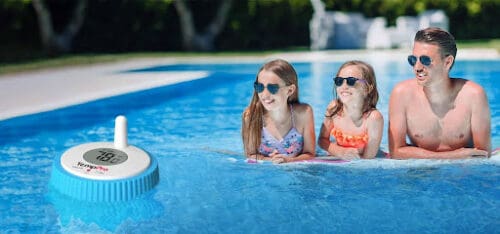
All of these cooling strategies have one thing in common: they work best when you can track your progress in real time. That’s where the TempPro TP211B Wireless Pool Thermometer comes in. The TempPro TP211B is a smart, wireless solution designed to take the guesswork out of pool temperature monitoring. Here’s what makes it stand out:
500-Foot Wireless Range
With advanced RF technology, the TempPro TP211B maintains a stable connection up to 500 feet. That means you can check your pool’s temperature from anywhere in your house or even your backyard without walking out to the pool every time. No more stepping outside just to dip your hand in the water.
High-Precision Accuracy
The TempPro TP211B features a highly precise temperature sensor accurate to ±0.9°F (±0.5°C) within a range of 32°F to 140°F. The remote sensor can even detect temperatures from -40°F to 158°F, making it versatile enough for cold plunges, hot tubs, and everything in between. When you’re trying to cool your pool from 88°F down to 82°F, accuracy matters and this pool thermometer delivers.
IPX8 Waterproof Design
Built with high-quality ABS materials and an IPX8 waterproof rating, the floating sensor is designed to withstand prolonged exposure to pool water and various weather conditions. It’s durable enough to handle summer heat, pool chemicals, and everything else your pool throws at it.
Large Backlit Display
The TempPro TP211B comes with a large, backlit screen that’s easy to read even in direct sunlight or low-light conditions.
Easy-to-Read Indoor Receiver
The wireless receiver sits comfortably indoors and displays not just your pool temperature but also indoor temperature and humidity. You get all the information you need at a single glance, right from your kitchen counter or living room.
Why It’s Perfect for pool owners
In summer, your pool’s temperature can fluctuate dramatically throughout the day, cooler in the morning, sweltering by late afternoon. With the TempPro TP211B, you can:
- Check the temperature before anyone swims: No more guessing whether the water is safe and comfortable.
- Track your cooling progress: See exactly how much your nighttime pump run or aerator use is lowering the temperature.
- Make informed decisions: Know when to run your pump, when to add shade, and when the water is finally ready for a refreshing swim.
- Monitor from inside your air-conditioned home: Because let’s face it, nobody wants to stand outside in 95°F heat just to read a thermometer.


How to Cool Down Your Pool (7 Proven Methods)
Once you know your pool’s temperature and realize it’s too high, it’s time to take action. Here are seven effective ways to bring that water temperature down:
Run Your Pump and Filter at Night
One of the simplest and most cost-effective cooling strategies is running your pool pump during the coolest nighttime hours. When the air is cooler than the water, circulating the water exposes more of it to that cooler air, helping it release heat.
Pro tip: Run your pump between 10 PM and 6 AM for maximum cooling effect. Under favorable conditions, this can reduce your pool temperature by 2-4°F.
Use a Pool Aerator or Fountain
Aerators cool water by spraying it into the air, which increases evaporation. As water droplets pass through the air, heat is released before the water splashes back into the pool. This is one of the most affordable and effective cooling methods available.
Aerators can lower water temperature by a few degrees, and they’re especially effective when there’s a large difference between water and air temperatures. Running an aerator overnight maximizes the temperature differential and leads to faster cooling.
Add Shade to Your Pool Area
Blocking direct sunlight is one of the most straightforward ways to prevent overheating. Shade structures like umbrellas, pergolas, shade sails, and even strategically planted trees can shield your pool from the sun’s rays during peak hours.
Focus on covering areas during peak heat hours, typically 10 AM to 4 PM. Even partial shade can make a noticeable difference in water temperature.
Remove Solar Covers During Heat Waves
This one might seem counterintuitive, but hear me out. Solar covers are designed to trap heat and prevent evaporation. During a July or August heatwave, that same cover acts like a greenhouse, quickly pushing water temperatures into the uncomfortable 90s.
Remove the cover entirely and store it in a shaded area during extreme heat. Leaving the pool surface exposed allows heat to escape into the atmosphere.
Consider a Pool Chiller or Reverse-Cycle Heat Pump
For pool owners who want serious temperature control, a dedicated cooling system is the gold standard. Reverse-cycle heat pumps can both heat and cool your pool, offering exceptional control over water temperatures. Dedicated pool chillers can lower water temperature by up to 10°F, making a significant difference during the hottest days.
The downside? Professional installation typically costs between $5,000 and $7,000. It’s a premium solution, but for those who can afford it, the comfort is unmatched.
Add Ice (For Quick, Temporary Relief)
Throwing bags of ice into your pool can provide immediate, though temporary, cooling. This works best for smaller pools or before events like pool parties. The cooling effect typically lasts several hours, depending on the initial water temperature and external conditions.
Just keep in mind: this isn’t a long-term solution, and it can temporarily affect your water chemistry.
Use Water Features for Natural Cooling
Fountains, waterfalls, and other water features aren’t just for looks, but they also promote evaporative cooling. As water splashes and moves through the air, it releases heat before returning to the pool. Running these features at night when the air is cooler maximizes their cooling effect.
Final Thoughts
Don’t let another summer day go by with a pool that feels more like a bathtub. Take control of your water temperature, keep your swimmers safe and comfortable, and make every dip as refreshing as it should be. The TempPro TP211B Wireless Pool Thermometer gives you the data you need to make it happen all from the comfort of your home.
