


Areas We Cover
Categories

EQUAL ARMS, INFINITE MEANINGS: A DEEP DIVE INTO GREEK CROSS SYMBOLISM

by John Todd | July 25, 2026
in Art and Museums
The Greek cross, defined by its four arms stretching equally from a shared center, ranks among the most familiar shapes across human civilizations. Such a simple yet compelling shape contains numerous shades of significance, reaching beyond limits set by different periods, places, and applications. It stretches from markings cut into rock during early human history all the way to current-day graphic elements, carrying forward thoughts on steadiness, togetherness, and holiness. Those versed in the past and in artistic fields have regularly scrutinized the ways it has molded various worldviews along with forms of expression. This piece follows the symbol’s beginnings, varied understandings, and continued importance, highlighting how a modest outline can embody deep concepts.
Beginnings and Historical Foundations
Records of the Greek cross reach into distant antiquity, surfacing in relics from numerous societies. Excavations indicate its presence in primordial communities around the Mediterranean, where it frequently stood for the primary directions or the fundamental forces of nature like soil, wind, flame, and liquid. Within classical Greece, this pattern showed up in ceramics and building designs, capturing a pursuit of proportion and symmetry that marked the era’s intellectual pursuits.
As the Byzantine period unfolded, the Greek cross solidified its position in sacred imagery. Rulers and planners wove it into grand churches and wall art, leveraging its evenness to suggest a higher cosmic structure. Distinct from the Latin variant with its extended upright beam, the Greek form stresses parity among its segments, aligning with ancient views on universal steadiness. Accounts from the past reveal that nascent followers of Christianity embraced it as a subtle indicator of devotion amid times of suppression.
Remains from sites such as Istanbul illustrate how craftsmen embedded the cross within layouts and adornments. These uses extended past decoration; they functioned as tangible cues for essential doctrines. Through the rise and decline of powers, the emblem shifted, adopting fresh manifestations in assorted territories.
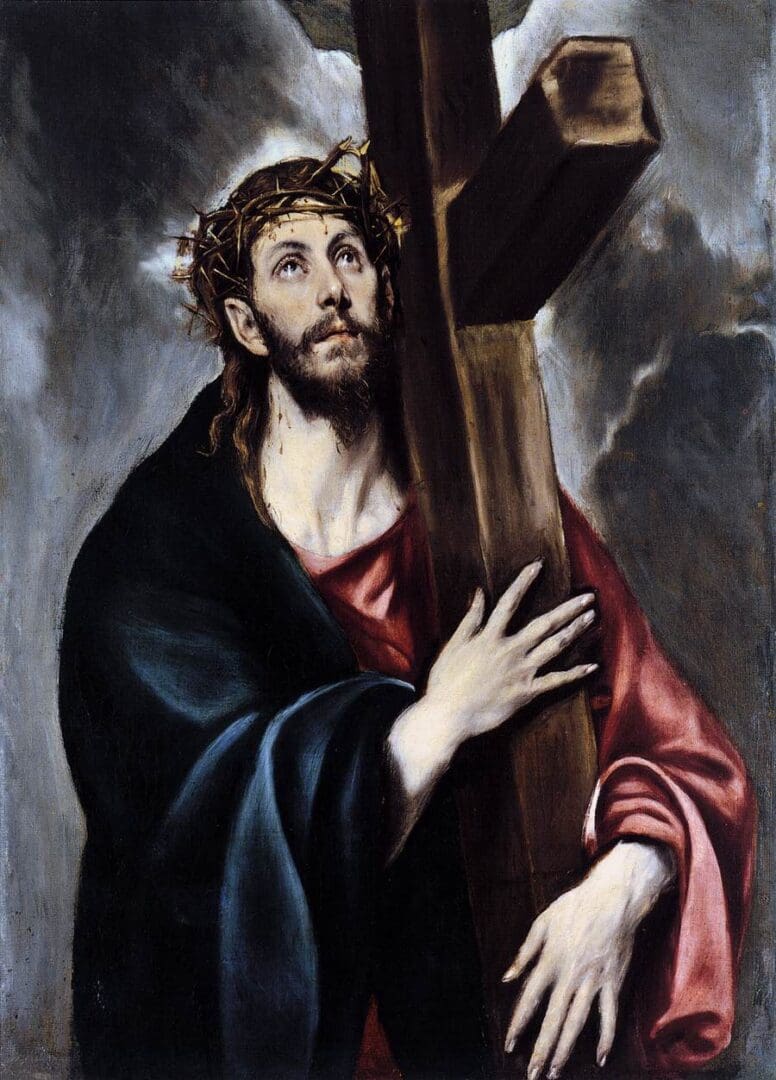
Christ Carrying the Cross, El Greco (Domenikos Theotokopoulos) ca. 1577–87 | Oil on canvas | The Metropolitan Museum of Art
Sacred Associations and Inner Significance
Within the Christian faith, the Greek cross occupies a pivotal role, especially in Orthodox practices. It points to themes of renewal and everlasting existence, with limbs reaching outward without limit. Clergy and scholars see it as an emblem of divine authority spanning the entirety of being, projecting uniformly across all paths. Variations in design, such as those found in Greek Crosses, highlight how artisans have adapted this symbol to reflect personal or communal devotion while preserving its core symmetry.
Outside Christianity, comparable outlines emerge in diverse spiritual systems. In Eastern philosophies like those of India and Tibet, circular diagrams and rotational figures parallel the cross’s harmonious build, denoting completeness and life’s ongoing flow. Native groups in the Western Hemisphere and on African continents likewise drew intersecting lines for ceremonies, commonly to summon safeguards or designate holy grounds.
The emblem’s flexibility arises from its basic geometry. Those versed in numbers observe that joining the arm ends forms a flawless square, reinforcing ideas of firmness and base. Sacred writings from multiple paths employ such figures in analogies for ethical direction, where evenness wards off disorder.
In medieval times, religious communities throughout Europe featured the Greek cross in scripted books and official marks. These objects demonstrate how the symbol linked the divine with the everyday, appearing on currency, standards, and worship platforms. Its inclusion in monumental structures like the one in Constantinople merges belief with craftsmanship, as sunlight through apertures cast shadows of the cross onto paved surfaces.
In biblical literature, the cross carries layered meaning that extends beyond its physical form. The New Testament frames it as the central act of sacrifice and redemption, with Paul writing in 1 Corinthians that the cross represents divine wisdom operating outside ordinary human logic. For early Christians, it was simultaneously a symbol of shame, a Roman instrument of execution, and a sign of ultimate victory over death. This tension is precisely what gave the symbol its power. Theologians across centuries have parsed the four equal arms of the Greek cross as representing the four directions into which the message of salvation was meant to spread, or the four Gospels themselves. The cross does not appear in isolation in scripture; it functions as a hinge between the Hebrew concept of covenant and the Christian understanding of grace, making it one of the most theologically dense geometric forms in recorded religious history.
Cross Types and Their Distinct Meanings
The Greek cross is one member of a large symbolic family, and understanding how it differs from related forms sharpens its meaning considerably. The Latin cross, with its elongated lower arm, is the form most associated with the Crucifixion in Western Christianity and dominates Catholic and Protestant iconography. The Celtic cross surrounds the intersection with a circle, a form that likely absorbed pre-Christian solar symbolism as Christianity moved through the British Isles. The Eastern Orthodox cross adds a slanted footrest bar below the main crossbeam, referencing the suppedaneum on which Christ’s feet rested. The Tau cross, shaped like the Greek letter T, is among the oldest variants and appears in both Egyptian and early Christian contexts. The ankh, while not a cross in the Christian sense, shares the equal-arm geometry and carries its own resonance around life and immortality in Egyptian tradition. Each variation tells a different story about the culture that refined it, making cross typology a window into comparative religion and art history simultaneously.
Creators have repeatedly turned to the Greek cross for its striking visual qualities. During the revival of arts in Italy, masters such as da Vinci integrated geometric elements, crosses among them, to craft balanced scenes. The symbol’s strokes direct attention, fostering a sense of movement and concentration.
In construction, the Greek cross served as a template for houses of worship and civic edifices. Edifices like the Venetian basilica dedicated to a saint showcase this arrangement, with vaulted roofs atop crossing sections. Builders prized its practicality, enabling vast inner spaces free from dense pillars. This method extended to Slavic lands and southeastern Europe, where bulbous tops surmounted cross-formed buildings.
Present-day planners carry forward this heritage, modifying the shape for current demands. An American innovator like Wright toyed with aligned designs drawn from old icons, fusing them with natural features. Carvers such as a Romanian modernist refined the cross into spare pieces, reducing it to core traits while keeping its spirit.
The emblem flourishes too in visual communication and personal ornaments. Body art with the Greek cross commonly holds individual narratives, ranging from ancestry to endurance. In non-figurative painting, artists like a Dutch pioneer distilled shapes into lattices akin to the cross, probing exchanges between hues and edges.
For those drawn to carrying this symbolism in everyday life, the tradition of wearing the cross in precious materials has never disappeared. Contemporary artisans continue to translate the Greek cross’s geometry into cross necklaces crafted in precious metals, maintaining the same balance of form and meaning that Byzantine goldsmiths pursued centuries ago.
The question of whether wearing a cross constitutes a meaningful act of faith, or a purely aesthetic one, surfaces repeatedly in theological and cultural conversations. For many believers, a cross worn close to the body functions as a tactile reminder of core convictions, a private ritual carried into public life. This practice has roots in the early Church, when Christians wore small cross-shaped objects during periods of persecution as quiet identifiers of community membership.
A separate but related debate concerns whether the cross predates Christianity as a pagan symbol and whether that history complicates its religious use. Historians note that crossed lines appear in virtually every ancient culture, often representing the four directions, the elements, or celestial bodies. Some scholars point specifically to the Tammuz cross of ancient Mesopotamia as a precursor that early Christian communities may have absorbed. The mainstream scholarly position is that the cross’s pre-Christian presence reflects universal geometry rather than deliberate borrowing, and that its meaning is ultimately defined by the tradition and intention behind its use, not by the shape alone.
Societal Differences and Worldwide Adjustments
Around the world, the Greek cross assumes varied connotations. In insular knotwork from the British Isles, twisted renditions signify linkage, mingling with loops and whirls. Peoples native to North America etched crossed symbols or shafts into rock faces to indicate accords or tranquility.
In family crests and banners, the cross features prominently, denoting courage or descent. Warriors from medieval Europe displayed it on defenses during campaigns, shifting a holy sign toward warfare. Fabrics from African traditions incorporate akin designs, threaded into cloths for rites, where they stand for group ties.
Asian viewpoints recast the symbol through lenses of wisdom. In island nations of the East, contemplative landscapes occasionally arrange stones in cross-like patterns, encouraging reflection on alignment. Principles of spatial harmony in China resonate with its orientational evenness, applying it to balance environments.
Journeys and commerce paths enabled these swaps. Traders along ancient routes transported patterns that transformed into blended signs, combining Hellenic touches with regional manners. Eras of expansion propelled the design farther, as envoys brought it to unfamiliar shores, where it merged with local emblems.
Modern Pertinence and Emblematic Progression
In today’s landscape, the Greek cross appears in brand marks, national banners, and online symbols. Groups focused on relief, such as one with a crimson emblem, modify it for aid missions, stressing impartiality and support. In attire trends, makers imprint it on garments, converting a venerable indicator into an assertion of self.
Those studying the mind examine its draw, observing how uniformity prompts serenity and reliability. In healing sessions, exercises with circular drawings often include cross aspects to promote focus. Advocates for nature adopt it to depict linked habitats, with segments for separate living zones.
Advances in machinery broaden its scope. Simulated environments reconstruct past locations with the cross, permitting visitors to traverse vintage shrines. Online forums facilitate talks on its implications, where participants offer views from their own angles.
Difficulties surface in its adoption, with certain observers regarding it as overly marketed and weakened by bulk creation, yet this widespread use affirms its adaptability—showing how a plain contour can shift while holding fundamental qualities, much like discussions in cultural history magazines from Smithsonian Magazine
Thoughts on Persistent Influence
The Greek cross remains because of its elemental layout, which welcomes continual reimagining. From chiseled rocks to digital dots, it binds earlier days to now, providing a surface for expression. As communities advance, this emblem follows suit, mirroring altered principles yet sustaining its centered balance.
Investigators keep revealing items that widen knowledge, tying it to yet more ancient customs. Teachers present its background in learning settings, motivating fresh cohorts to value shaped meanings. Amid division, its matched limbs propose solidarity, a subtle prompt for steadiness during shifts.
