


Areas We Cover
Categories hhhh

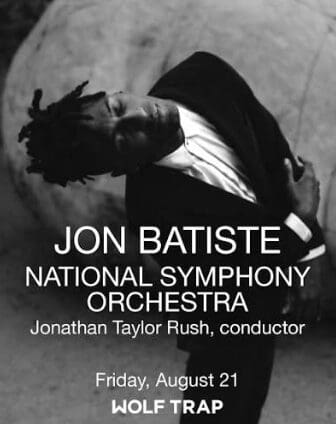
Concert Review: JON BATISTE WITH THE NATIONAL SYMPHONY ORCHESTRA (Wolf Trap)
by Barbara Papendorp | August 22, 2026
in Concerts / Events, D.C.
(Maryland / Virginia)
BATISTE INFECTION
Jon Batiste and the NSO make
musical boundaries disappear
From the very start of Jon Batiste’s performance with the National Symphony Orchestra at Wolf Trap last night, I couldn’t stop smiling, and I couldn’t stop shimmying in my seat.
That was the first clue that this was going to be more than a concert. It was an evening of infectious joy.
Under the direction of Jonathan Taylor Rush, the National Symphony Orchestra and Batiste created a musical conversation that seemed to erase the boundaries between jazz, classical music, gospel, blues, soul and pop. Songs were braided together in medleys, styles folded into one another, and the marriage between Batiste’s jazz trio and the orchestra was particularly satisfying. Together, they became greater than the sum of their parts.
Perhaps that is exactly what we needed. We needed this. We deserved this.
Batiste has a remarkable ability to leave an audience feeling both energized and at peace. From the opening numbers through the medleys, Wolf Trap became a place where strangers were connected by rhythm, melody and the simple pleasure of making music together.
“Georgia (On My Mind)” offered one of the evening’s early vocal highlights. Batiste’s voice was warm and mellifluous, beautifully complemented by Desiree “Desz” Rodriguez’s harmonies. But he couldn’t resist making the song his own or, more precisely, making it Wolf Trap’s own. Borrowing the familiar melody, he playfully sang:
“Wolf Trap, Wolf Trap, the whole day through…
Just an old sweet song keeps Wolf Trap on my mind.”
It was an irresistible bit of improvisation and exactly the kind of spontaneous connection that made the evening feel less like a performance being delivered to an audience and more like a celebration being created with one.
Then came “Big Money,” when the entire audience joined in the clapping. Batiste barely had to ask. The response was immediate.
With “When the Saints Go Marching In,” he moved from piano to melodica and encouraged the audience to sing along. “What a Wonderful World” began with a beautiful orchestral introduction, including harp, before settling into the song’s deceptively simple vocal line. The strings gave it an almost weightless tenderness. Batiste took a moment to acknowledge the NSO, recognizing the musicians who had helped make the evening’s sound so expansive.
Then he and his trio reminded us just how powerful a small ensemble can be.
“Blue Monk,” Thelonious Monk’s classic, brought Batiste to the grand piano with his trio of drums, bass and piano, and then, in one of the evening’s many musical surprises, the music folded into Beethoven’s Fifth. The transition was not simply clever; it demonstrated Batiste’s extraordinary instinct for finding connections between musical languages that might initially seem worlds apart.
“In Walked Bud” stripped away the orchestra altogether, allowing the trio to revel in ragtime and jazz, complete with a drum solo and bass feature.
Then came “Cry,” with Desz on vocals. The blues gave way to scat singing, which slipped into “Für Elise.” Batiste continued the classical-jazz conversation with a snippet of “Alla Turca Blues” before arriving at “I Need You.”
By then, the audience was completely his.
He encouraged us to clap and sing along, transforming the amphitheater into one enormous choir. It was a perfect way to close the first set.
“In this world with a lot of problems, all we need is a little loving,” Batiste told us. “Thank you, thank you, thank you for your love.”
It would be easy to mistake Batiste’s relentless joy for avoidance, a refusal to acknowledge the difficult world beyond the amphitheater. But the opposite is true. His joy creates the space in which the difficult things can actually be heard.
You can’t bring up the downers if there isn’t joy.
You have to earn those ballads. You have to fill the room with enough light that an audience is ready for the shadows. Batiste understands that. He knows when his audience is ready for the message, and he knows how to make them embrace it rather than resist it.
The second set deepened that conversation.
“Freedom,” with Batiste on electric guitar, brought another surge of energy, while “American Symphony” turned inward. With the orchestra set aside, Batiste drew upon “America the Beautiful” and African American musical traditions, allowing the idea of America to become something complicated, beautiful and unfinished.
The soul medley continued the journey, and midway through it Batiste picked up a saxophone at the piano. The evening seemed to contain multitudes: jazz club, concert hall, church, dance floor and summer gathering, all at once.
The music from Soul, Pixar’s animated film, fit naturally into this world. Batiste’s compositions and arrangements for the film understand that music is not merely something we hear; it is something that reminds us that we are alive.
“Green Hill Zone,” a Masato Nakamura cover, “‘Round Midnight,” another Thelonious Monk selection, and “Moonlight Sonata Blues” continued Batiste’s playful dialogue between classical and popular traditions.
“Don’t Stop” brought back the full orchestral force, while “Ode to Joyful” became another opportunity for Batiste to turn Beethoven into something communal.
Amen. Amen. Amen.
“Hallelujah,” Leonard Cohen’s song, brought yet another shift in atmosphere. There was something almost dreamlike about the moment, a butterfly flying home, a phrase of music lingering in the night.
Then, fittingly, Batiste closed with “It’s All Right.”
By that point, the title was no longer simply the title of a song. It felt like a benediction.
The extraordinary thing about this evening was that Batiste never asked us to choose between joy and seriousness, between jazz and classical music, between the intimate sound of a trio and the grandeur of a symphony orchestra. He showed us how all of those things can coexist.
Under Rush’s direction, the NSO was not simply an accompaniment. It was an essential partner, adding breadth, color and emotional depth while allowing Batiste’s improvisational spirit to remain at the center.
The audience became part of the music, too.
We clapped. We sang. We listened. We laughed. We moved in our seats. We connected with the people sitting around us.
This was the most joy-filled night I’ve had in quite a while.
Jon Batiste clearly loves what he is doing, and he exudes that love with every breath he takes and every note he makes. There is nothing guarded about his musicianship, nothing calculated about his generosity. His joy spills off the stage and into the audience.
The NSO? No words. They are a blessing to us all.
For a few hours beneath the summer sky at Wolf Trap, joy was not an abstract idea. It was palpable.
We needed this.
On this night, Jon Batiste reminded us that joy is not frivolous. Sometimes joy is precisely what allows us to face everything else.
✦ ✦ ✦ ✦ ✦ ✦ ✦ ✦ ✦ ✦
Jon Batiste
National Symphony Orchestra
Jonathan Taylor Rush, conductor
Filene Center, 1551 Trap Road in Vienna, Virginia
August 21, 2026
for more info, visit Wolf Trap
✦ ✦ ✦ ✦ ✦ ✦ ✦ ✦ ✦ ✦
